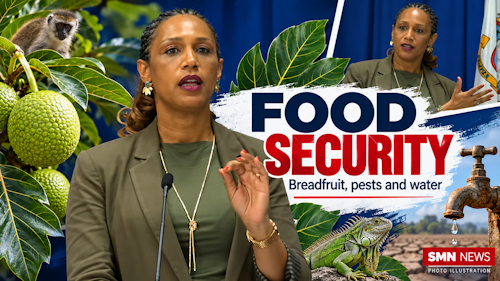
Breadfruit initiative raises harder food-security questions over monkeys, iguanas and water.

grishaiguana28102026PHILIPSBURG:---  Efforts to strengthen local food production must confront crop damage from monkeys, iguanas and snails, Minister of TEATT Grisha Heyliger-Marten said Wednesday, as questions about a breadfruit-tree initiative highlighted the practical obstacles facing agriculture in St. Maarten.

At the Council of Ministers press briefing, Heyliger-Marten said support for farmers must be matched by action against animals that damage production. She called for cooperation between the French and Dutch sides and said they were exploring possible European funding.

“I cannot establish support for my farmers without some kind of relief from these invasive species,” she said.

Heyliger-Marten was the only minister present at the briefing. A journalist raised the breadfruit initiative, a proposal discussed at an earlier briefing; it was not a new announcement by another minister on Wednesday.

The question asked whether planting breadfruit trees could deliver meaningful food-security benefits if animals might eat the crop before residents could harvest it. The question also raised how long it would take trees to produce fruit.

Heyliger-Marten’s answer focused on the animals and the need for coordinated action. She described agriculture as a personal priority and acknowledged that these obstacles could hamper the wider initiative.

The minister said a response limited to the Dutch side would be inadequate. She wants an approach involving both sides of the island and indicated that securing funding is part of the work ahead.

However, she did not announce an approved budget, an agreed cross-border programme, a start date or the methods that would be used. Her remarks described an initiative in development, not a funded operation ready to begin.

Water remains an unanswered part of the equation

The lack of water in local food production is another practical issue for the breadfruit initiative and agriculture more broadly. Planting targets alone do not explain how growers will maintain trees and crops where water is unavailable or unreliable.

Wednesday’s briefing did not outline an agricultural water-supply plan, irrigation arrangements, water-storage assistance, or funding to help growers meet those needs. Heyliger-Marten did not make a specific announcement addressing the water concern in her answer on breadfruit and crop-damaging animals.

That leaves important questions about how a planting initiative would be supported: who would receive trees, where they would be planted, who would maintain them, and how access to water would be secured. The discussion did not provide those operational details.

No quantified projections of breadfruit production, household savings, or reductions in food imports were presented either. The briefing therefore did not establish how much the initiative could contribute to the food supply or when residents might benefit.

The agriculture discussion took place alongside the minister’s announcement of a separate supermarket price-and-cost study, for which she wants results in approximately six months. That work will examine the imported-goods market and possible government interventions, while agriculture concerns the development of local production.

Both matter to household food security, but the briefing offered no calculation linking the breadfruit initiative to a reduction in grocery bills.

Heyliger-Marten’s acknowledgment of the damage caused by monkeys, iguanas and snails identifies a problem that government says it intends to tackle. Turning that intention into dependable food production will also require answers about funding, implementation, crop protection and water.
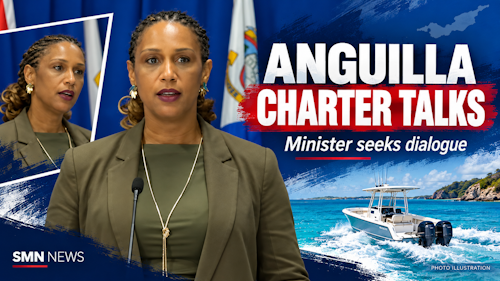

Heyliger-Marten seeks talks with Anguilla over charter-boat concerns.

grishaanguilla28102026PHILIPSBURG:---  Minister of TEATT Grisha Heyliger-Marten plans to meet local maritime stakeholders before approaching her Anguilla counterparts over concerns affecting charter boats operating in Anguilla’s waters.

Speaking at Wednesday’s Council of Ministers press briefing, the minister said the issue should be addressed through constructive dialogue, with both jurisdictions’ concerns heard and their legal responsibilities respected.

Heyliger-Marten, the only minister present at the briefing, said she expected to meet with the maritime sector shortly, provisionally referring to the following day. She would then seek discussions with Anguilla.

She did not announce that an agreement had already been reached, that restrictions had been lifted or that any operating requirements had changed.

St. Maarten and Anguilla share family connections, historical ties and tourism interests, she said. Maritime operators have long helped visitors move between the islands, so it's important to resolve disagreements without letting them escalate.

The minister said St. Maarten must be willing to listen to Anguilla’s authorities while ensuring that local operators’ interests receive equal attention.

She explained that the objective is to identify practical solutions that respect both jurisdictions' responsibilities and allow legitimate maritime activity to continue.

“Let’s sit together and discuss the concern and work towards a solution that benefits both our islands,” she said in her appeal to Anguilla.

The briefing did not specify the disputed requirements, identify individual operators or provide a detailed account of the incidents behind the concerns. It also did not give a confirmed date for talks with Anguilla or quantify the economic impact on charter businesses.

The sequence announced was consultation at home followed by engagement with the neighboring government. That would allow the minister to take the sector’s concerns into the proposed discussions.

For charter operators, the next step is therefore a consultation process. Wednesday’s announcement did not establish a settlement or authorize any change in how they operate in Anguilla’s waters.

King Charles begins Caribbean Tour as Region Mobilizes for Reparations Talks.

Ali calls for an apology, Mottley demands justice, and Caribbean reparations bodies prepare to press their case at Commonwealth summit

charlesroyaltour28102026PHILIPSBURG:--- King Charles III’s Caribbean tour is unfolding against organized demands for Britain to confront its colonial past, with regional leaders and reparations advocates pressing for an apology, accountability and practical measures to repair the damage caused by enslavement.
The nine-day tour began in The Bahamas on Tuesday, October 27, includes a state visit to Guyana, and will conclude in Antigua and Barbuda, host of the Commonwealth Heads of Government Meeting (CHOGM). Buckingham Palace confirms that the tour runs through November 4. Barbados is not on the schedule.

The Bahamas visit runs from October 27–29. Guyana’s government has confirmed a two-day state visit beginning Thursday, October 29, at the invitation of President Dr. Mohamed Irfaan Ali. Queen Camilla will join the King in Antigua and Barbuda for the final leg, including the Commonwealth gathering scheduled for November 1–4.

Behind the ceremonial welcomes, preparations for the reparations debate are already taking shape through national advocacy, correspondence with the Palace and coordinated regional action.

In The Bahamas, National Reparations Committee Chair Dr. Niambi Hall Campbell-Dean has called for the King to acknowledge responsibility through an apology and engagement with the reparations movement.

Speaking to Our News ahead of the visit, Campbell-Dean connected reparations to present-day development challenges. The committee was preparing a presentation to Cabinet explaining how reparatory justice could support national development, while campaigning to secure the issue’s place on the CHOGM agenda.

Those preparations reflect a push to turn public attention surrounding the royal visit into political action. They do not establish that the Bahamian government has secured a reparations agreement or a dedicated negotiating session.

In Guyana, President Ali has made clear that acknowledging slavery’s horrors must be followed by further action.

“Now, moving to the apology is the next step,” Ali told ITV News, according to AFP’s reporting of the interview.

ITV reported that Ali identified two steps beyond the King’s previous expressions of regret: a formal apology and reparatory justice. He also recognized Charles’s environmental advocacy, including his commitment to rainforest protection and Indigenous peoples.

The position allows Guyana to welcome the monarch while maintaining its demand for historical accountability. ITV also documented a pro-reparations rally ahead of the visit, illustrating the public pressure accompanying the diplomatic program.

Barbados Prime Minister Mia Amor Mottley, although her country is not on the itinerary, has delivered an unequivocal statement on the regional case.

“We are not asking for charity. We are asking for justice,” Mottley wrote in an earlier public statement published on her LinkedIn account.

She rejected suggestions that Caribbean people owed Britain for the institutions that oppressed their ancestors and warned against using the region to serve British political arguments.

“The Caribbean will not be used as a prop for anyone’s politics,” she stated. These remarks predate the current tour and reflect her broader position on reparatory justice.

Barbados has also served as a regional hub for preparations. CARICOM’s Reparations Commission announced an October 22 media briefing after relaunching its revised Ten-Point Plan at the Third CARICOM Regional Conference on Reparations in Barbados.

The briefing aimed to outline planned CHOGM engagements and strategies to advance reparatory justice through the Commonwealth and the United Nations. This provides documented evidence of coordinated preparations ahead of the King’s arrival at the summit.

In Antigua and Barbuda, the Reparations Support Commission has appealed directly to the royal household.

According to Antigua News, Chairman Ambassador Dorbrene E. O’Marde wrote to the King’s Private Secretary, Sir Clive Alderton, on October 21, urging Charles to help move Commonwealth discussions toward meaningful action.

The commission welcomed the visit but criticized resistance to a formal apology. It argued that institutions could accept moral responsibility for historical wrongdoing without assigning personal guilt to their present members. The correspondence was addressed to Antigua and Barbuda’s Governor-General and Prime Minister.

Charles acknowledged past suffering during his opening appearance in The Bahamas and indicated that Commonwealth leaders would discuss slavery’s legacy. However, ITV reports that the British government has not advised him to offer an apology or reparations.

That leaves a central issue unresolved as the tour continues: whether renewed recognition of historical injustice will produce formal dialogue and concrete commitments Caribbean leaders and reparations bodies are seeking.

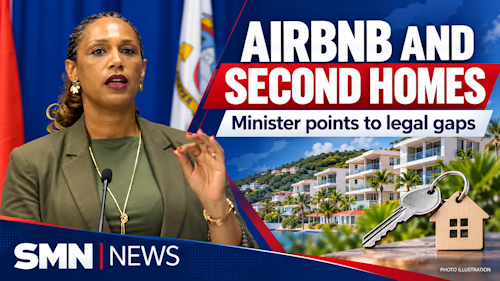
Minister points to legal gaps as government seeks changes for Airbnb and second-home rentals.

grishaabandb281022026Draft tax amendment awaits Finance input; no implementation date announced
PHILIPSBURG:---  Minister of Tourism, Economic Affairs, Transport and Telecommunication Grisha Heyliger-Marten says shortcomings in the legal framework are complicating efforts to regulate and collect revenue from homes used as short-term tourist accommodation, with a draft amendment awaiting input from the Finance Department.

Responding to questions at Wednesday’s Council of Ministers press briefing, Heyliger-Marten said her ministry had prepared a legislative amendment and sent it to Legal Affairs. Because the proposal concerns taxation, Finance must also weigh in before it proceeds through the remaining stages.

“The main complication is our law,” the minister said.

Heyliger-Marten was the only minister present at the briefing. She did not announce a new tax rate, a date for parliamentary consideration or an implementation deadline.

The issue arose during questions about foreign-owned second homes and properties advertised on Airbnb. When asked why the government could not simply identify operators through their listings and pursue compliance, the minister said the legislation needed to clarify how homes are taxed.

“It’s not even clear in our laws,” she said.

According to Heyliger-Marten, the proposal would still have to follow the legislative process, including consideration by the Council of Advice and eventual parliamentary treatment. She said she might take it to Parliament with the Minister of Finance.

The minister also referred to owners who, she said, approached the tax office wanting to pay but were uncertain how their rental activity should be treated. She contrasted those accounts with rentals whose proceeds pass through a company, referring to turnover-tax payments in that context.

Her remarks did not provide a comprehensive explanation of the tax obligations applicable to each category of owner or rental arrangement. They also did not establish a blanket exemption for Airbnb operators or foreign homeowners.

Heyliger-Marten said the government was examining related issues involving condominiums, foreign homeownership and real-estate legislation. She argued that the different areas of regulation needed to complement one another, including where investment and residence intersect.

She accused the government of having turned a blind eye to the sector and losing revenue as a result. However, she did not provide an estimate of the uncollected amount, the number of affected properties, or the share of operators outside the applicable requirements.

Wednesday’s exchange highlighted uncertainty over the framework for a growing segment of tourist accommodation, but it produced no announced enforcement programme or immediate change for property owners.

The minister identified the next step as Finance’s contribution to the draft proposal, followed by the required legal and parliamentary process. Until those details are presented, the scope of the intended changes—and their effect on individual rental operators—remains unclear.

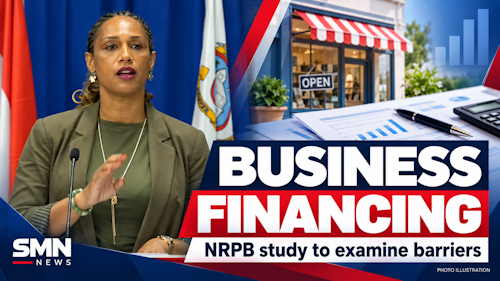
NRPB to examine business financing barriers with World Bank technical support.

Heyliger-Marten urges entrepreneurs to describe the obstacles preventing them from growing

businessfinancing28102026PHILIPSBURG:--- The National Recovery Program Bureau will undertake an access-to-finance study with technical support from the World Bank to examine whether the funding available to St. Maarten businesses meets their needs and what government could do to address the gaps.

Minister of TEATT Grisha Heyliger-Marten announced the initiative at Wednesday’s Council of Ministers press briefing, saying she and the Minister of Finance had endorsed the work.

For micro, small and medium-sized enterprises, she said, the inability to obtain affordable financing can prevent a viable idea, product or expansion opportunity from becoming a functioning business investment.

“How can we expect our small businesses to grow if they cannot access the financing they need?” the minister asked.

Heyliger-Marten, the only minister present at the briefing, said the study would examine existing financing options, assess how well they serve businesses, and identify measures the government could consider to close the gaps.

She urged entrepreneurs to participate if NRPB representatives or project team members contact them. Financial institutions and other relevant stakeholders may also be approached.

Business owners should explain their experiences seeking finance, the type of funding they need, the obstacles they have encountered and the changes they believe would help, she said.

“Good policy should not be developed solely behind a desk,” Heyliger-Marten said.

The consultation aims to bring businesses' experiences into the policy process. The minister argued that government cannot credibly promote entrepreneurship without examining the practical barriers that prevent firms from growing.

She highlighted the role of smaller businesses in creating employment, providing services, supporting tourism, and strengthening economic independence.

Wednesday’s announcement concerned a study, rather than the launch of a new lending facility or grant programme. Heyliger-Marten did not announce a funding allocation for businesses, a subsidized interest rate, an application window or eligibility requirements for financial assistance under this initiative.

She also did not give a specific commencement or completion date, saying the study would begin soon.

The World Bank’s involvement was described as technical support. No commitment to direct World Bank lending to individual businesses was announced.

The immediate opportunity for entrepreneurs is to help establish what is—and is not—working in the financing market. The study’s eventual findings would inform possible government responses, but the minister did not commit to a particular policy measure before that work is undertaken.


Subcategories