September 24 decisions include €2.84 million in European education assistance, a projected €1.49 million court-ordered payment schedule, and measures covering tourism, disability services, sports, and development.
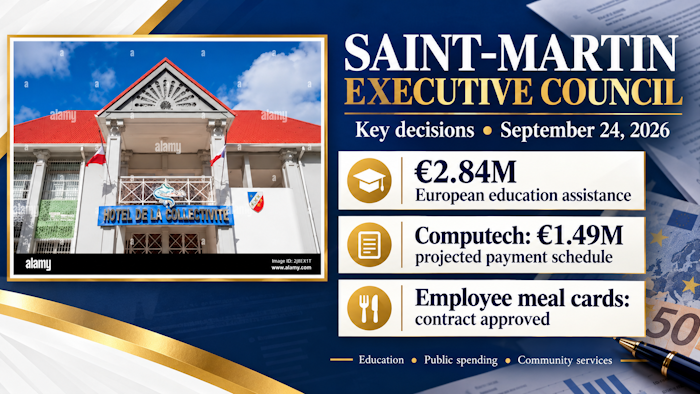 MARIGOT:--- Saint-Martin’s Executive Council approved a series of financial and administrative measures during its September 24, 2026 meeting, including European education funding, an employee meal-card contract and arrangements to pay Computer Technologies while continuing litigation over the final amount owed.
According to a Collectivité press release dated September 28, the Council examined 32 deliberations. The published summary details decisions affecting education, tourism, public employees, youth participation, disability services, sports, planning and employment.
The Computech dispute carries particularly significant financial implications. The Council approved a payment schedule with a projected total of about €1.49 million, while authorizing legal proceedings to challenge aspects of the debt and seek reimbursement.
€2.84 Million Approved for Education Through European Social Fund
The Council approved €2,838,278.37 in European Social Fund Plus assistance for an education application submitted by the Collectivité’s Education Directorate.
The award falls under a call for projects promoting equal access to education and academic success, launched during the first half of 2026 with an envelope of approximately €6.61 million.
Saint-Martin’s overall European Social Fund Plus allocation for the 2021–2027 programming period is €20.85 million, compared with €16.60 million for 2014–2020.
The release states that management of the full 2021–2027 allocation was delegated to the Collectivité through a global grant arrangement. The Collectivité acts as an intermediary body administering assistance under the national program’s employment, inclusion, youth and skills priorities.
The September decision concerns a specific education award within that broader allocation. The published summary does not provide a detailed breakdown of the activities financed by the €2.84 million grant.
Gastronomy Festival Funding Revised Following Audit-Related Review
The Council also approved a revised financing plan and an amendment to the European funding agreement for the 2024 Gastronomy Festival.
The assistance allocated to the Saint-Martin Tourism Office remains €832,455. The Council had previously allocated that amount on May 9, 2025.
The September decision authorizes an amendment reflecting the renewed examination of the funding file following an audit of the European Regional Development Fund program’s management and control system.
The release therefore describes a revision to an existing award and its financing arrangements, rather than an additional €832,455 grant on top of the earlier allocation.
Saint-Martin’s overall 2021–2027 mainstream regional development fund allocation is €58.8 million. Within that program, the Collectivité manages a €17.21 million global grant supporting economic development, entrepreneurship, innovation and related priorities.
Computech Payments Scheduled Through April 2027
The Council approved an agreement organizing payments required under a June 15, 2026 interim court order benefiting Computer Technologies, commonly known as Computech.
The schedule provides for eight payments, due on the last day of each month from September 30, 2026, through April 30, 2027.
After accounting for €128,050 already processed for payment, the remaining principal is €1,146,005.15. The schedule also includes €3,720 in associated amounts and late-payment interest calculated invoice by invoice at the date of each installment.
The projected total is €1,491,750.28.
The Council also approved a jointly acknowledged accounting statement confirming that previously processed invoices totaling €128,050 must be credited against the amount owed and cannot be paid twice.
The release emphasizes that the agreement establishes payment arrangements for a court order. It does not constitute a negotiated settlement involving mutual concessions or abandonment of the parties’ rights.
Collectivité Challenges Final Debt and Seeks €538,476 Reimbursement
In a separate decision, the Council authorized the Territorial Council President to pursue proceedings before the Saint-Martin Administrative Court to establish the final debt owed to Computech.
The June order required an interim payment of €1,274,055.15 relating to 43 invoices issued between 2023 and 2025, together with interest and associated charges.
The release states that the Collectivité did not submit a defense memorandum in either of the two interim proceedings identified in the document.
The Collectivité now argues that €1,146,005.15 relates to services provided outside the contractual procurement framework and that compensation should be limited to useful expenditure, excluding profit margins.
It also seeks corrections to interest calculations and restitution of €538,476, with offsetting against amounts owed.
These are the Collectivité’s claims in the proceedings. The release does not establish that the court has accepted them.
The Council ratified a protective filing made on September 18, 2026, and authorized legal representation.
Crucially, the litigation does not suspend compliance with the interim payment order. Payments will be credited against the debt ultimately determined by the court, and any excess will be subject to repayment.
Employee Meal-Card Contract Has €8 Million Maximum
The Council awarded a framework agreement to issue, load, and manage electronic meal cards for Collectivité employees.
The specifications use an average of 900 beneficiaries, an indicative value of €8.20 per meal voucher and 20 vouchers monthly, representing €164 in monthly face value per beneficiary.
The estimated quantitative amount stated in the award is €1,771,200 excluding tax.
The agreement has no minimum amount and a maximum of €8 million excluding tax over its full duration. It begins with a 12-month term and may be renewed three times, for a maximum of four years.
The €8 million figure is a contractual ceiling, rather than confirmation that the entire amount will be spent.
The procurement evaluation assigned 30 points to price, 60 to management and service quality, and 10 to sustainable-development performance. The published summary does not name the selected operator.
€360 Refund Intended to Resolve Waste-Funding Dispute
The Council authorized reimbursement of € 360 in bailiff fees improperly borne by OCAD3E, the coordinating organization for electrical and electronic equipment waste.
The dispute arose after two revenue claims were issued for the same purpose and amount for the third quarter of 2020.
Although the Collectivité canceled its claim in December 2022, the refund remained outstanding. OCAD3E subsequently suspended financial support payments linked to electrical and electronic waste collected and treated in Saint-Martin.
The release says this suspension deprived the Collectivité of recurring revenue and blocked the funding relationship.
The reimbursement decision is intended to close the longstanding complaint and restore regular relations with the organization. The summary does not quantify the payments withheld.
Youth Council Delegation Approved for French Guiana Congress
The Council approved travel-related expenses for a seven-person delegation attending the 2026 Childhood and Youth Congress in French Guiana.
The congress takes place October 21–25, with the delegation’s travel scheduled for October 21–27.
The delegation comprises four Territorial Youth Council members, one elected representative, and two Collectivité employees.
Approved expenses include air travel, required health measures, a contribution toward accommodation for the seventh participant, and necessary overnight transit and transfers in Martinique.
The published decision does not specify a total cost.
The congress is organized by the Territorial Collectivity of French Guiana with the National Association of Children’s and Youth Councils and focuses on youth participation in public decision-making.
Disability and Elderly Services Receive Formal Framework
The Council approved an agreement with the French State governing the Collectivité’s exercise of Territorial Autonomy House functions through its existing autonomy directorate.
The arrangement preserves the current organization while formalizing responsibilities involving disability-related services.
These include reception, information, advice, referral, application processing, needs assessments and assistance planning.
The release notes that the directorate has administered services for elderly people and people with disabilities jointly since 2007.
The decision establishes a legal and administrative framework; it does not announce a newly constructed facility.
Sports Grant Figures Corrected
The Council corrected data-entry errors in an earlier decision allocating 2026 subsidies to sports leagues and committees.
The confirmed total is €183,727.93, distributed as follows:
|
Organization
|
Approved subsidy
|
|
Saint-Martin Football League
|
€152,621.93
|
|
Saint-Martin Territorial Cycling Committee
|
€13,171
|
|
Northern Islands Pétanque Committee
|
€9,875
|
|
Northern Islands Territorial Basketball Committee
|
€8,060
|
|
Total
|
€183,727.93
|
The Council also approved the objectives-and-resources agreement with the Football League and authorized its signature.
Planning Decisions Include Approvals and Refusals
The release states that 10 planning files were examined, but provides individual summaries for six.
Favorable decisions covered changes to the exterior appearance of a roof in Marigot, dividing land into eight parts for development in La Savane, constructing two villas with associated facilities in Cul-de-Sac, and approving a two-level residential building with three units and five parking spaces in French Quarter.
An Oyster Pond application received an unfavorable decision. The Council cited the applicable planning rule and the absence of a mandatory preliminary study required for the relevant high-hazard area under the natural-risk prevention framework.
An application for an additional level on an existing Grand Case building was recorded as a tacit rejection because the applicant did not supply all missing documents within the prescribed three-month period.
Separately, the Council declined to exercise urban or statutory preemption rights on properties covered by 15 declarations of intended sale.
Work Authorization Renewal Linked to Local Training
The Council approved an eight-month renewal of a foreign worker’s authorization for a versatile event-technician position at Tuned Productions.
The renewal is linked to an arrangement in which a qualified young person from the local labor market participates in workplace immersion through France Travail.
The release states that a local young person had already been identified and was undertaking immersion, with possible recruitment if the placement proved successful. Recruitment efforts were also continuing for a second technician position.
The decision includes a requirement for specific insurance covering medical care, hospitalization, repatriation and civil liability.
The Council’s published decisions combine major funding commitments with administrative corrections and implementation conditions. The next stage will be execution: disbursing approved assistance, meeting court-ordered payments, implementing contracts and reporting the outcomes of the measures adopted.
 MARIGOT:--- Luciana Raspail has been appointed Director General of the Chambre Consulaire Interprofessionnelle de Saint-Martin (CCISM), taking the institution’s top administrative position after 15 years of service.
 PHILIPSBURG:--- Sint Maarten will enter 2027 without a structured school meal program, Minister of Education, Culture, Youth and Sport Melissa Gumbs confirmed during Parliament’s Central Committee budget discussions.
 PHILIPSBURG:--- MP Egbert Doran challenged the government’s response to damaged school walls during the ECYS budget debate, telling Parliament that he had personally witnessed a piece of concrete fall and feared that children remained exposed to danger.
 Simpson Bay:--- Princess Juliana International Airport (PJIA), in collaboration with the Elektralyets Foundation and the Positive Foundation, is once again bringing the community together for the Princess Walk, in recognition of Breast Cancer Awareness Month.