Work began before agreement was signed, Gumbs tells parliament as MPs question canal project.

The VROMI minister said safety concerns prompted work to begin. He confirmed that the private partner also had a building permit application before government and said the two matters were handled separately.

patricerollanduscanal09112026PHILIPSBURG:---  VROMI Minister Patrice Gumbs Jr. told Parliament on Monday that work on the privately backed canal project began before the public-private partnership agreement was signed. He said the work was started to reduce risks and improve residents’ safety. He also confirmed that the private entity supporting the project had submitted a building permit application to the government and denied that its participation influenced the permit decision.

Gumbs returned to Parliament on November 9 to answer 13 follow-up questions during debate on the draft 2027 budget. MPs Darryl York and Ardwell Irion pressed him on how the project was authorized, who bears the risk, how the contractor was selected, and what documentation Parliament could review.

Work underway while agreement remains unsigned

Irion asked Parliament for the signed agreement, even if it had to be shared confidentially. Gumbs said the document had not yet been signed. He said it would go to the Council of Ministers if signed.

Gumbs also confirmed that the government has no government-wide policy or framework for public-private partnerships. He described the document as a VROMI working framework that underwent initial legal vetting. Once finalized, he said, it would go to Legal Affairs before being presented to the Council of Ministers.

The minister said the ministry developed the framework in response to urgent infrastructure needs and a limited budget. He described the canal arrangement as a public-private partnership with some unusual features. The private entity provides most of the funding, while the government has contributed milled asphalt for a temporary road during construction, he said.

Gumbs said government retains oversight and must approve the work at each stage. He said construction risk rests outside government during the works, with risk and control passing to government upon completion. When Irion asked for the project’s insurance policy, Gumbs said it could not be shared. The minister did not identify a specific party responsible for defects discovered after handover.

Procurement, contractor selection and project costs

Irion asked whether Article 47 applied and who selected the contractor. Gumbs said the ministry had received legal advice and that, in his view, Article 47 did not apply because the country had not purchased goods or services under the arrangement.

He said private entities choose how to carry out construction, including whether to use a subcontractor. He denied directing the partner to hire a particular contractor.

Asked who had independently verified the cost, Gumbs said an estimate existed and that an independent third party would review spending and produce reports. He did not present a completed independent cost review to Parliament.

York, meanwhile, questioned whether Article 7.2 of the draft would require negotiation and mediation before government could terminate the agreement, even if a private partner breached it or abandoned the work. Gumbs said the document had been revised to include recourse to the Court of First Instance and arbitration if mediation failed. He also said a design-and-build project could fall within a public-private partnership, responding to York’s question about how the canal arrangement should be classified.

Blue Mall permit and demolition stop order

Gumbs said the application to renovate and redevelop the Blue Mall was submitted on March 7, 2025, and approved on July 17, 2026. He said the application met the requirements for approval and that a concern over setbacks was set aside because the building had already been permitted and had stood for years.

To support his account that the developer received no preferential treatment, Gumbs outlined how the ministry handled demolition work at the site in 2025. He said landfill security flagged an unusually large amount of demolition waste on August 6, and the landfill was instructed the following day to stop accepting that contractor’s demolition waste.

According to Gumbs, inspectors visited the site on August 20, confirmed that demolition was underway, and issued a warning followed by a stop order. A follow-up inspection took place on September 4. The contractor was instructed to separate steel from concrete and aluminum from sheetrock, send steel for recycling, and document the contents of each bin before disposal. Gumbs said the developer was also subject to labor inspections.

The minister said the permit application and the request for private support were handled separately. His account put the permit and enforcement dates on the parliamentary record. The signed partnership agreement and independent cost review remained outstanding at the close of his remarks.

Symbolic price considered for emergency homes

In a separate response to MP Veronica Jansen-Webster, Gumbs said government was considering charging a symbolic amount if it proceeds with selling the St. Peters and South Reward emergency homes to their occupants. He said any proceeds could be reinvested in housing. The proposal, including the price, had not yet been confirmed.
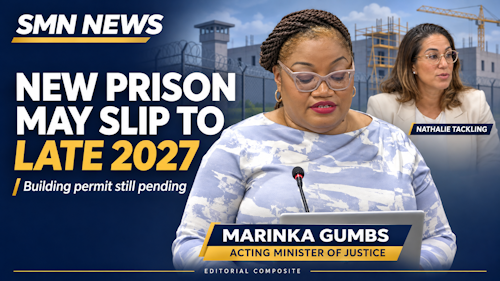

New Prison may slip to Late 2027 as building permit awaits fire department clarifications.

Acting Justice Minister Marinka Gumbs told Parliament that the first phase could be completed two to three months later than previously anticipated. She also said staffing shortages will persist and set November 30 as the target for processing justice workers’ salary files.

marinkajustice09112026PHILIPSBURG:--- The first phase of St. Maarten’s new prison could be completed in November or December 2027 instead of September, Acting Minister of Justice Marinka Gumbs told Parliament on Monday. The revised schedule still requires formal approval, and the project’s building permit has not yet been issued.
Answering questions on the draft 2027 budget, Gumbs said the civil works permits were submitted to Parliament on November 5. She said the building permit application had otherwise been found satisfactory, with clarifications arising from the Fire Department’s review still being addressed.

Technical assessments, site conditions and a review of construction options prompted the proposed schedule changes, she said. The second phase could also shift from July 2028 to the final quarter of that year.

Construction completion and prison opening have separate timelines

Gumbs said roughly one month is expected for handover, commissioning and testing after construction. The ministry will confirm the opening and detainee transfer dates once the revised schedule is approved and the facility passes its readiness assessments.

Before detainees can be moved, critical safety and security systems must be tested, enough staff must be in place, operating procedures must be approved, and essential prisoner services must be available. A transition team is coordinating those preparations.

The draft staffing plan proposes 72 full-time correctional officer positions, subject to approval. Gumbs said 22 officers had been recruited by October 15 and had begun training. Another recruitment round for 15 officers is planned for early 2027. The ministry is also exploring an extension of the agreement under which correctional officers from Suriname provide interim support. The initial one-year agreement runs through the end of February.

Police shortfall persists as unarmed tourist unit takes shape

Gumbs told MPs that seven police trainees nearing deployment and five more expected to be ready in about two years would be insufficient to close the staffing gap. She described the proposed tourist police pilot as a shorter-term measure to ease pressure on the force.

The tourist unit would be unarmed and operate under the Police Force of St. Maarten. Its duties would focus on prevention, visibility, supervision and public assistance. Gumbs said the plan was in its final stages and that Justice would then engage the Ministry of TEATT on implementation.

Responding to MP Sjamira Roseburg about police holding cells, Gumbs said urgent repairs were carried out in 2025, and roof work completed in 2026 was undergoing final verification. Procurement for the final phase was completed in October, with contract signing and implementation preparations awaiting final approvals. That phase includes mold remediation, waterproofing, and new sanitary fixtures designed to resist vandalism. The specialized fixtures require about 12 weeks to prepare and ship. Gumbs said the dedicated funding covers the holding cells and associated work.

November 30 is the target for processing salary files

Gumbs confirmed November 30, 2026, as the ministry’s target for validating salary-scale calculations and preparing the formal advice for the second phase of the justice personnel placement process. Payments will depend on subsequent Finance Ministry review, execution of the relevant national decrees, and Treasury disbursement. She gave no date for workers to receive the money.

The ministry identified 5.8 million guilders for the placement process and retroactive payments. The ministry is checking calculations covering October 10, 2010, through December 31, 2022, department by department. Of 15 active employees still awaiting their decrees and corresponding retroactive pay, three cases were in the finalization phase. Gumbs said the ministry intends to submit its updated staffing plan to Parliament’s Justice Committee in the first quarter of 2027.

Prosecutor’s Office lacks verified totals for unpaid fines and victim compensation

Gumbs said the Prosecutor’s Office could not provide a verified count or total value for unpaid fines. Outdated or incorrect civil registry addresses complicate collection, she said. The ministry is considering recording telephone and WhatsApp contact details to improve follow-up.

The Prosecutor’s Office also could not give a total for compensation awarded by the courts in 2024 and 2025 without reviewing individual judgments. It reported seven requests in 2025 and five in 2026 for statutory advances of 5,000 Caribbean guilders each. The figures count requests. Gumbs did not provide a verified total of payments made.

She said Victim Support Services helps people communicate with police and prosecutors but lacks the capacity to support every victim continuously through trial, appeal and an offender’s release. The draft Criminal Procedure Code would give victims and eligible bereaved relatives a right, subject to conditions, to explain the impact of an offense in court. The ministry’s response to proposed amendments and external opinions could reach Parliament in the first quarter of 2027. Gumbs said there were no immediate plans to raise the ceiling for court-awarded victim compensation or the statutory advance limit.

Youth rehabilitation, Customs and immigration

Gumbs said the ministry intends to dedicate the Miss Lalie Center to rehabilitation for children under 18, with a separate ward and regime at the new prison for young adults aged 18 to 21. Refurbishment and possible expansion of the center remain under consideration. Work planned for 2027 will define how the facility should operate and what upgrades it requires.

The proposed 1.196 million Caribbean guilders in Crime Fund spending covers 11 projects for 2027. Gumbs said the 2026 policy plan would continue to guide the fund while the ministry prepares a handbook on applications and eligibility. She identified Second Chance Builders as an existing project intended to offer entrepreneurial training, mentoring and reintegration support to about 15 to 25 participants in the coming year.

On Customs, Gumbs said preparations for the ASYCUDA automated customs management system were complete. The project estimate rose from 740,000 to 748,000, prompting renewed approval from the Council of Ministers. The agreement with UNCTAD was scheduled for signature in November, after which implementation could begin in phases.

The ministry is still reviewing MP Omar Ottley’s proposed amendment addressing the residence status of children born and raised in St. Maarten whose immigration status remains uncertain. Gumbs said the final eligibility criteria would determine how many additional applications the department might receive.

In the follow-up exchange, MP Francisco Lacroes clarified that his yacht-clearance question concerned seasonal operators who come to St. Maarten to offer services without local registration. He proposed checking the business license or permit of third-party agents while allowing people aboard a vessel to clear it using its manifest. Parliament recessed after his clarification, before Gumbs responded to that specific proposal.

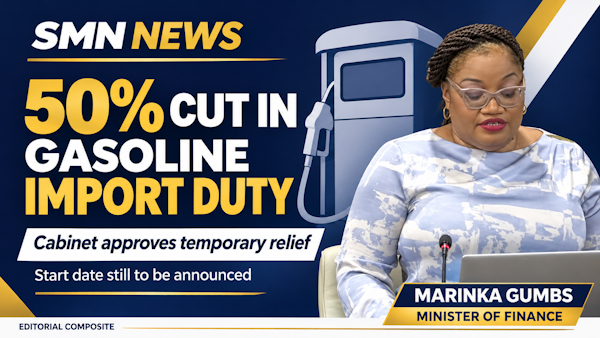
Cabinet approves 50% cut in gasoline import duty, but Gumbs gives no start date.

The temporary measure is expected to run for two to three months. Finance Minister Marinka Gumbs also told Parliament that only 3.5 million guilders of the proposed 9 million-guilder road construction program would be available on January 1, with the balance dependent on a loan.

gasolineimport09112026PHILIPSBURG:---  The Council of Ministers has approved a temporary 50 percent reduction in the special import duty on gasoline, Finance Minister Marinka Gumbs told Parliament on Monday, November 9. The measure is expected to run for an initial two to three months, after which the government could reassess it.
Responding to MP Darryl York during the 2027 budget debate, Gumbs said she first brought the proposal to Cabinet in March to ease fuel costs for households and businesses. She said the ministries of Finance, Justice and TEATT worked on the measure. She gave no effective date or estimate of the savings per liter. The 50 percent reduction applies to the duty charged on gasoline.

Gumbs puts January road construction funding at 3.5 million guilders

Gumbs told York that the government has allocated 5 million guilders in motor vehicle tax revenue for roads. Of that amount, 1.5 million guilders is for operating expenses, and 3.5 million guilders is for capital projects. The remaining 5.5 million guilders of the proposed 9 million-guilder capital program depends on loan financing.

The breakdown clarifies the 5 million-guilder figure VROMI Minister Patrice Gumbs Jr. cited during the debate. The finance minister put the amount available for road construction on January 1 at 3.5 million guilders.

She also said the Road Fund has had a legal basis since its national ordinance took effect on October 10, 2010. The proposal to operate it through a foundation funded by a subsidy requires a separate framework, which was still pending when the draft budget was prepared.

Capital projects depend on financing, and CFT concerns remain

Responding to MPs Egbert Jurendy Doran and Ardwell Irion, Gumbs said listing capital projects in the budget gives government the authority it needs to seek financing after parliamentary approval. If government fails to secure a loan, she said, affected projects could be postponed, carried out in phases or financed another way.

Gumbs said discussions with the Board of Financial Supervision, or CFT, have focused on how to submit the 2027 loan request and what information it must contain. She reported no financing decision. She identified five outstanding concerns raised by the CFT: healthcare fund deficits, financial risks from government-owned entities, limited liquidity, the need for a realistic multiyear investment plan, and insufficient information to assess compliance with the interest burden limit.

The minister said the government is preparing separate proposals on healthcare fund sustainability and financial risks associated with state-owned entities, including TelEm and the post office. She intends to report progress to Parliament and the CFT before the end of November, subject to Cabinet approval.

Visitor tax and pensioner relief could reach Parliament in early 2027

Gumbs said the visitor tax draft is undergoing final internal legal review and is expected to go to Parliament in the first quarter of 2027. She disputed Doran’s estimate that the previous administration had completed about 80 percent of the work. She said the draft required substantial revisions, including more stakeholder consultation and clearer arrangements for collection and enforcement. Finance is working with Justice and other stakeholders on how it would collect the tax.

Gumbs also expects to submit the proposed age pension tax relief legislation in the first quarter. She said her ministry received the calculations on October 23 and still has to select a scenario before the draft proceeds through legal review and the Council of Advice. She gave no date for pensioners to begin receiving relief.

On the financial transaction tax, Gumbs said Finance is awaiting further research with TEATT. The measure is outside Finance’s current phased tax reform program, and the ministry is preparing no legislation for it. The draft budget contains no revenue from the proposed tax.

Gumbs says she paused a proposed 90 million-guilder payment to verify the amount

During questioning about payments to SZV, Gumbs said she had been asked to sign off on 90 million guilders without documentation showing how the amount had been calculated. She said she paused the process to establish what the government owes. She acknowledged that the liability could be substantial.

The minister also said casinos and lotteries were current on their 2026 payments, while historical balances were still being checked. On long-lease revenue, she said Finance depends on VROMI to supply the leaseholder information needed to issue invoices and establish what is outstanding.

On Mullet Bay, Gumbs said the government’s priority is to establish the boundary between the public beach and Sun Resort’s property and determine when the property will return to market so St. Maarten can exercise its matching right. She said she was still awaiting an answer on who would pay for the proposed master plan and cautioned that government participation could affect the property’s value or its position in a sale.

Minister of Finance Marinka Gumbs Encourages Public to Participate in 4th Annual Financial Literacy Month.

financialliteracy09112026PHILIPSBURG:--- The Minister of Finance, Honorable Marinka Gumbs, is encouraging Sint Maarten residents to take advantage of activities organized by the Ministry of Finance in recognition of Financial Literacy Month 2026, under the theme “Make It Make Cents.”

This November marks the fourth annual observance of Financial Literacy Month on Sint Maarten, reflecting the Ministry’s continued efforts to promote financial awareness and equip residents with the knowledge and tools needed to manage their finances, plan for the future, and make informed financial decisions.

Minister Gumbs emphasized that financial literacy is not only about earning money, but also about knowing how to manage what you earn. “Too often, we work hard for our money, but we are not always equipped with the knowledge to make that money work for us. Financial literacy is about understanding how to budget, save, invest, plan for retirement, and protect what we have worked so hard to build,” the Minister stated.

The Minister also noted that financial education should not be seen as something reserved for people with high incomes. “Whether you earn minimum wage, operate a small business, are raising a family, or preparing for retirement, financial knowledge is important. You do not have to be wealthy to start planning for your financial future. What matters is taking that first step,” Minister Gumbs added.

As part of Financial Literacy Month, the Ministry has organized a series of free educational sessions featuring professionals from various financial sectors. These sessions will address

practical matters that affect individuals and families in their everyday lives, with topics relevant to students, young adults, working professionals, parents, business owners, and senior citizens.

“Financial literacy has no age limit. It is never too early to start learning how to manage your money, and it is never too late to make better financial decisions,” Minister Gumbs stated.

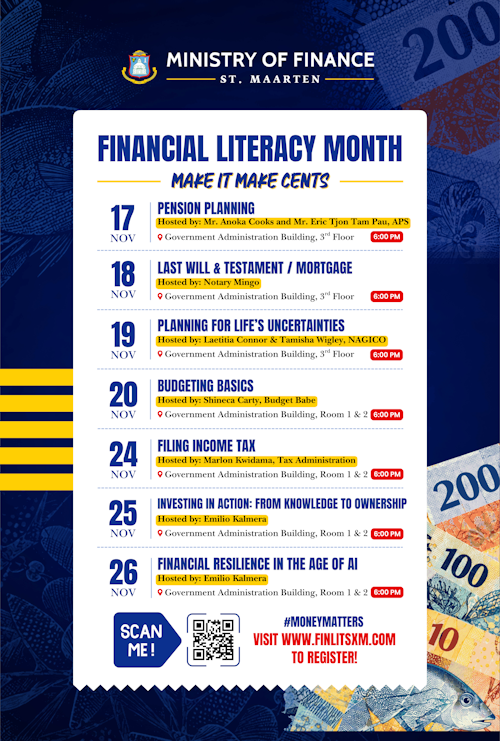
The scheduled sessions include:

  • November 17 – Pension Planning: Hosted by Algemeen Pensioenfonds St. Maarten (APS)
  • November 18 – Last Will & Testament / Mortgage: Hosted by Notary Mingo
  • November 19 – Preparing for Life’s Uncertainties: Hosted by Laetitia Connor and Tamisha Wigley of NAGICO
  • November 20 – Budgeting Basics: Hosted by Shineca Carty, Budget Babe
  • November 24 – Filing Income Tax: Hosted by Marlon Kwidama of the Tax Administration
  • November 25 – Investing in Action: From Knowledge to Ownership: Hosted by Emilio Kalmera
  • November 26 – Financial Resilience in the Age of AI: Hosted by Emilio Kalmera

All sessions will begin at 6:00 PM at the Government Administration Building. Participation is free, and members of the public are encouraged to register in advance at www.finlitsxm.com.

Minister Gumbs stressed that one of the initiative's main objectives is to make financial information more accessible and easier to understand. “We sometimes use financial terms that sound complicated, but managing your money should not be complicated. We want people to feel comfortable asking questions, whether it is about filing their income taxes, preparing a will, understanding their pension, or simply learning how to stretch their salary until the end of the month.”

The Minister also highlighted the importance of encouraging young people to develop good financial habits early in life. “If we want to build a financially stronger Sint Maarten, we must start by educating our people.

We must teach our young people the value of saving, the importance of budgeting, and the difference between what we need and what we want.” Minister Gumbs thanked the participating organizations and professionals who have committed their time and expertise to making the initiative possible.

She concluded with a call to the public:
“Knowledge is power, and financial knowledge can change lives. I encourage everyone to attend at least one of these sessions. Bring a family member, encourage a young person, or invite a friend. The information you receive today may help you avoid financial difficulties tomorrow. Let us work together toward a more financially informed and financially secure Sint Maarten.”

Make It Make Cents – Because Your Financial Future Matters.

Unpaid Government bills stall fleet repairs as Gumbs gives no count of operational police vehicles

Acting Justice Minister Marinka Gumbs told Parliament that some garages are declining warranty work, maintenance, and repairs until the government pays outstanding invoices.

policevehiclesrepairs09112026PHILIPSBURG:---  The government owes money to several garages, including authorized dealerships, and some service providers are declining to work on government vehicles until their invoices are paid, Acting Minister of Justice Marinka Gumbs told Parliament on Monday, November 9.

Gumbs disclosed the arrears during the 2027 budget debate in response to MP Darryl York, who asked how many recently purchased police vehicles were still operational. York also asked about reports that some newly acquired Justice Ministry vehicles had become inoperable after only a year and were being serviced outside the authorized dealer network.

Gumbs cited operational and national security reasons for withholding the status of individual police vehicles. She gave no overall count of how many vehicles in the recently purchased fleet were in service.

Garages decline warranty work and routine repairs

Gumbs said the Department of Facility Affairs, under the Ministry of General Affairs, confirmed that the government had outstanding payments to several garages. Some providers were unwilling to carry out warranty work, routine maintenance or repairs until the invoices were settled. She did not disclose the total owed, identify the garages, or provide a payment timeline.

When authorized providers are unavailable, government may turn to other garages to keep vehicles in service, Gumbs said. She said those arrangements are intended to maintain essential services, including law enforcement, emergency response, inspections and water management.

The ministry had received no confirmation of specific cases in which newly acquired Justice Ministry vehicles became inoperable after a year, Gumbs said. Establishing what happened would require identifying the vehicles and garages involved. Her response did not establish how many police vehicles, if any, were awaiting repairs because of the unpaid bills.

Repairs outside dealer network could affect warranties

Gumbs said the main risk of using garages outside the authorized service network is the potential loss of warranty protection or manufacturer support. Whether coverage is affected depends on the manufacturer’s terms and the type of work performed. In some cases, government could have to pay for repairs that would otherwise have been covered, she said.

York also questioned why government continues buying different brands, including Nissan, Dodge and Toyota, for its fleet. Gumbs said ministries still buy vehicles based on their operational needs, while Facility Affairs is encouraging more coordinated procurement. Using fewer vehicle types for similar duties could simplify maintenance and improve access to replacement parts, she said.

Government considers a central garage

Asked why the government does not operate its own garage, Gumbs said it is studying whether a centralized facility with in-house mechanics could improve cost control, oversight and vehicle reliability. The assessment includes staffing, infrastructure and operating costs. No decision has been made.

Facility Affairs has designated fleet coordinators within ministries, tightened controls over maintenance requests and repairs, and begun reviewing insurance coverage. Gumbs said government is also working toward a common fleet policy and digital records, though implementation has taken longer than anticipated.


Subcategories