Budget procedure sparks political firestorm as opposition accuses chair of weakening parliamentary oversight.

~Opposition says new process silences debate, reduces transparency and helps Government fast-track late 2026 Budget~

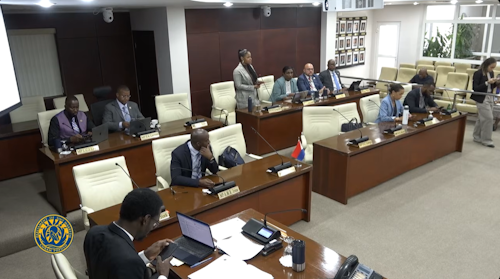
mpsonrulesforccmeeting26062026PHILIPSBURG:---  Before Minister of Finance Marinka Gumbs had the opportunity to present a single figure from the 2026 national budget, Parliament erupted into one of its most heated procedural battles in recent months, with Opposition Members accusing Chairlady Sarah Wescot-Williams of attempting to fundamentally change the way Parliament scrutinizes the country's finances.

The dispute was not over taxes, spending, or government priorities. Instead, it centered on how Parliament itself should examine the most important piece of legislation presented each year—the national budget.

What began as a procedural proposal quickly evolved into a fierce constitutional and political debate over parliamentary oversight, transparency, accountability, and the rights of elected Members of Parliament.

At the center of the controversy was Chairlady Wescot-Williams' proposal to require Members of Parliament to submit all budget questions in writing by July 2, have Parliament ratify those questions on July 6, and then forward them to Government for written responses before the public budget debate begins.

Under the proposed timetable, Government would have approximately two weeks to answer the questions, allowing Parliament to reconvene during the July recess if the responses are delivered on time.

For the Opposition, however, the proposal represented far more than a scheduling adjustment.

They argued it fundamentally alters decades of parliamentary practice while reducing opportunities for ministers to publicly defend their budgets before the people of St. Maarten.

Doran: Parliament should not experiment with the country's Most important law

The first major objection came from MP Egbert Jurendy Doran, who reminded Parliament that faction leaders had already discussed the handling of the budget during an earlier meeting and had left with the understanding that another approach would be followed.

Instead, Members were now presented with an entirely different proposal.

Doran questioned whether Parliament was attempting to solve the government's administrative shortcomings by weakening parliamentary scrutiny.

He revealed that he still has seven to eight unanswered parliamentary letters, some dating back more than a year, and questioned why Members should believe the Government would suddenly respond promptly to hundreds of detailed budget questions.

"We're talking about a Budget that is already super late," Doran argued.

According to him, removing the traditional opportunity for Members to seek immediate clarification from ministers amounts to "a gross infringement" of parliamentary rights.

He warned that Parliament was effectively using the country's most important legislation as a "pilot project."

Later in the debate, Doran again challenged the Chair, questioning how Members could raise issues omitted from the Minister's presentation if they were only permitted to ask clarification questions before submitting written questions.

He also argued that the proposal appeared designed to fast-track debate while limiting public discussion.

Lewis: Don't Change the Rules for the National Budget

Opposition MP Lyndon Lewis echoed many of those concerns.

While supporting efficiency in principle, Lewis said the annual budget is not the legislation on which Parliament should begin experimenting with new procedures.

He pointed to recent parliamentary meetings where even the Prime Minister failed to answer questions posed by Opposition MPs and argued that reducing opportunities for direct exchanges would only weaken Parliament's oversight role.

Lewis later admitted he was confused by the proposed sequence, asking how Members could submit meaningful questions before hearing detailed presentations from each ministry.

He also criticized the government's poor record in responding to parliamentary correspondence, revealing that he still has approximately 50 unanswered questions submitted to the Minister of Justice.

"The people's business should be taken seriously," Lewis declared.

Irion: Parliament Exists to Speak

Perhaps the most philosophical criticism came from MP Ardwell Irion, who reminded colleagues that the very word Parliament means "to speak."

Irion suggested Government appeared increasingly reluctant to publicly debate legislation, warning that Parliament was now considering limiting discussion on the country's "heaviest" piece of legislation.

He revealed that he had already written to the Chair warning that the proposal contradicted previous parliamentary reasoning regarding legislative procedures.

Irion also argued that Members currently benefit from an informal second opportunity during Central Committee meetings to obtain clarification from ministers—an opportunity he believes would effectively disappear under the proposed system.

Far from making Parliament more efficient, Irion predicted the proposal would delay approval of the Budget even further, increase pressure on already overworked civil servants, and ultimately reduce accountability.

He formally placed his objection on the parliamentary record.

Later, he questioned whether every future bill—including tax legislation and other major laws—would now be handled under the same process.

"What are we going to do?" Irion asked. "Change the rules every month?"

York: Government cannot ignore basic administration

MP Darryl York delivered one of the debate's most detailed criticisms.

York said Parliament should first ensure Government is capable of performing basic administrative functions before attempting to modernize legislative procedures.

He noted that ministers routinely fail to answer parliamentary letters and that questions submitted in writing are frequently skipped altogether.

"Before we elevate the process of handling the Budget," York argued, "we must first demonstrate that we can execute the fundamentals."

York also warned that replacing live exchanges with written questions would significantly reduce transparency because most citizens follow Parliament through live broadcasts—not by reading official documents placed online.

He further criticized what he described as Parliament's inability to properly plan its own work, saying Members continually receive schedules at the last minute while ministers know well in advance what they are expected to do.

According to York, the proposal leaves Members uncertain about when they will question ministers individually and how they will obtain technical explanations for each ministry's budget.

"We continue operating on a wait-and-see basis," York complained. "That is not how Parliament should function."

Lacroes Questions whether the proposal is even permissible

Adding a legal dimension to the debate, MP Francisco Lacroes cited Article 95 of Parliament's Rules of Order, arguing that Parliament may only deviate from established procedures when there is no objection from Members.

Since several MPs had already voiced opposition, Lacroes questioned why the proposal was still being discussed at all.

His intervention shifted part of the debate from politics to parliamentary law.

Coalition MPs Back Chair's Proposal

Coalition Members Dimar Labega, Viren Kotai, Franklin Meyers, Veronica Jansen-Webster, and Sjamira Roseburg generally supported the Chair's proposal, although several stressed that Government must respond to questions promptly.

Roseburg emphasized that her support depended entirely on receiving complete answers to parliamentary questions before the public debate.

Jansen-Webster questioned whether Parliament sometimes overlooked answers already provided by ministers and suggested better use of parliamentary transcripts.

Myers argued that Parliament cannot continue operating exactly as it has in the past if it expects greater efficiency, while acknowledging that Government must improve the timely submission of future budgets.

sarahwescotwilliams26062026Chair Rejects Claims of Rights Violations

Chairlady Sarah Wescot-Williams spent considerable time responding to nearly every criticism.

She rejected claims that Members' rights were being infringed, insisting the proposal does not violate Parliament's Rules of Order.

She reminded Members that faction leaders' meetings are informal discussions and do not make binding parliamentary decisions.

Wescot-Williams also rejected suggestions that Parliament was attempting to fast-track the budget, stating that the problems surrounding the 2025 budget arose for entirely different reasons.

The Chair further argued that Members would not lose any rights because Government cannot proceed to a public budget debate until it formally answers Parliament's written questions.

If Government fails to respond, she explained, Parliament simply cannot continue consideration of the budget.

She also noted that the budget document already exceeds 300 pages and contains detailed ministry explanations available both to Members and to the public through Parliament's website.

Rather than requiring ministers to repeat information already contained in the document, she argued that Members should use the written process to identify the issues requiring further clarification before the public debate.

Wescot-Williams concluded by proposing that Parliament submit all questions by July 2, ratify them on July 6, give Government roughly two weeks to respond and then begin the public budget debate during Parliament's summer recess if all responses are received.

Political Battle Begins Before Budget Debate

Ironically, the first major battle over the 2026 Budget had nothing to do with government spending, tax policy, education, healthcare or infrastructure.

Instead, Parliament spent nearly an hour debating how the Budget should be debated.

The exchange exposed deep divisions between coalition and opposition MPs over transparency, accountability and parliamentary procedure.

With the 2026 Budget already months behind schedule, Friday's confrontation demonstrated that the political battle over the country's finances had begun well before Minister Marinka Gumbs presented the first page of Government's financial plan.


MPs sound alarm over growing motorcycle and scooter crisis on St. Maarten roads.

scooteraccidentsparliament26062026PHILIPSBURG:---  Growing concern over the increasing number of motorcycle and scooter accidents once again dominated discussions in Parliament on Friday, as Members warned that reckless riding is placing both riders and motorists in constant danger.

The renewed warnings came just days after several serious scooter accidents across the island and only weeks after multiple fatal crashes involving motorcycle riders.

MP Lyndon Lewis recounted a frightening experience from the previous evening, describing how he narrowly avoided striking a young motorcyclist who suddenly entered his path.

"Last night I too would have had to give up myself for hit and run," Lewis said, explaining that the rider was traveling from Madam Estate while he was driving toward Dutch Quarter.

"He would have ended up under my vehicle."

Lewis used the incident to issue a direct appeal to young riders.

"I'm asking these young motorists to please take your life seriously," he said, noting that the near collision occurred around 10:00 p.m.

The concerns were echoed by MP Egbert Jurendy Doran, who described the situation as nothing short of a national crisis.

"My colleague mentioned about the bike rider crisis—I would call it that—we have on Saint Martin," Doran told Parliament.

Doran reminded Parliament that he has repeatedly appealed to government to take stronger action and even suggested organizing a National Day of Prayer as a way to encourage reflection and unity during what he described as increasingly difficult times for the country.

"We should have some kind of dialogue and be able to pause and reset as a country," Doran said while calling on government to initiate broader discussions on public safety.

The parliamentary warnings come amid an alarming rise in scooter-related accidents on St. Maarten. In recent weeks, multiple riders have been hospitalized, while several families continue to mourn loved ones killed in motorcycle crashes.

The repeated appeals from Members of Parliament underscore growing public concern that stronger enforcement, improved rider education, and greater personal responsibility are urgently needed before more lives are lost on the island's roads.

Friday's discussion demonstrated that road safety is no longer viewed simply as a traffic issue but as a national concern requiring coordinated action from government, law enforcement, schools, parents, and the wider community.

Parliament extends sympathy to Venezuela following deadly earthquake.

parliamentofsxm26062026PHILIPSBURG: --- Members of Parliament on Friday paused the start of the 2026 Budget debate to express heartfelt condolences and solidarity with the people of Venezuela following the devastating earthquake that has left scores of people dead and many others affected.

Several Members of Parliament used their notification time to acknowledge the tragedy and to offer prayers for the Venezuelan people, recognizing the close ties between Sint Maarten and the Venezuelan community living on the island.

MP Sjamira Roseburg was among the first to address the disaster, expressing sincere solidarity with the people of Venezuela and wishing all those affected strength and a swift recovery.

"Our thoughts are with all those affected and we wish them strength and a swift recovery," Roseburg told Parliament before continuing with her other congratulatory messages.

Later in the session, MP Franklin Meyers echoed those sentiments, noting that Venezuela has already endured years of hardship and that another natural disaster would only deepen the suffering of its people.

"In the past couple of years that country has been through a lot, and to be hit with this natural disaster, I can only imagine what it is like and what they are feeling at this particular time," Meyers said while extending his prayers and thoughts to the Venezuelan people.

Other Members of Parliament including Francisco Lacroes also joined his parliamentary colleagues by expressing concern over reports indicating that nearly 200 people had reportedly lost their lives. He said his prayers were not only with those in Venezuela but also with members of the Venezuelan diaspora residing in Sint Maarten.

"I hope that they've gotten in contact with their families and that they could help them in any way possible," Lacroes said.

The expressions of sympathy reflected the strong cultural and family connections that exist between Venezuela and the Caribbean islands, including Sint Maarten, where many Venezuelan nationals have established homes and businesses over the years.

As Parliament proceeded with the national budget discussions, lawmakers first set aside politics to acknowledge the human tragedy unfolding in the neighboring South American nation, sending a united message of compassion and support to those mourning their loved ones.

Youth Dialogues Initiative.

melissagumbs26062026PHILIPSBURG:--- On Friday, June 5, the Department of Youth conducted a training session for representatives of several youth-serving organizations across St. Maarten. The training focused on equipping youth leaders with the skills and tools needed to facilitate meaningful youth dialogues within their organizations.

The session was facilitated by Ms. Dwynette Eversley, a consultant specializing in youth development and youth work. Participants received guidance on how to engage young people in structured discussions and creative activities designed to encourage them to share their thoughts and perspectives.

Youth between the ages of 4 and 12 who participate in various youth organizations will take part in these interactive dialogues under the guidance of their respective youth leaders or other facilitators. The sessions will be conducted between June and September 2026.

The Youth Dialogues Initiative aims to gather the perspectives, experiences, opinions, and ideas of young people on St. Maarten. The information collected will help inform the direction of youth policy and the development of programs that reflect the needs and aspirations of the island’s youth.

By providing young people with a platform to express their views, the Department of Youth is taking an important step toward ensuring that the voices of children are included in shaping a brighter future for St. Maarten.

Top of Form

CRCDC launches modern campaign to boost cervical cancer screening across Guadeloupe, St. Martin and St. Barthélemy.

cancerscreening26062026MARIGOT:--- The Regional Cancer Screening Coordination Center (CRCDC) for Guadeloupe, St. Martin, and St. Barthélemy has launched its 2026 "Juin Vert" (Green June) campaign, an ambitious initiative aimed at encouraging more women to undergo cervical cancer screening and to break long-standing taboos surrounding women's health.

Held annually throughout June, the national awareness campaign places a strong emphasis this year on prevention, self-care, and female well-being through a more modern, positive, and digital approach designed to reach younger women, particularly those between the ages of 25 and 35.

The campaign carries a simple but powerful message:

"Taking care of yourself also means getting screened."

A preventable cancer that still claims lives

According to the CRCDC, cervical cancer is one of the few cancers that can largely be prevented through two complementary measures: vaccination against the Human Papillomavirus (HPV) and regular screening.

When precancerous lesions are detected early, treatment can prevent the disease from developing into cervical cancer. Despite these advances, health officials say the disease continues to have a significant impact in the region.

Statistics presented by the CRCDC show that Guadeloupe records approximately 30 new cases of cervical cancer annually, with 32 cases reported in 2022. The disease claimed 16 lives in 2022, while the five-year survival rate stands at 57 percent, compared to 63 percent in mainland France.

Health officials say these figures underscore the urgent need to improve access to prevention, early detection, and public education.

Screening participation remains too low

CRCDC is particularly concerned about participation rates in organized screening programs.

Women between 25 and 29 years old are encouraged to undergo cervical smear testing, while women aged 30 to 65 should receive HPV screening.

Between 2023 and 2025:

  • 8,958 women aged 25-29 were eligible for screening, but only 2,771 were screened.
  • Among women aged 30-65, 112,201 were eligible, yet only 21,686 participated, representing a participation rate of just 19.3 percent.

Overall participation reached 56 percent in Guadeloupe, compared to the national average of 60.9 percent.

The CRCDC hopes the new campaign will encourage women to make cervical cancer screening a regular part of their healthcare routine.

Jalylane Maës Named Campaign Ambassador

Leading this year's awareness campaign is Jalylane Maës, Miss Guadeloupe 2023 and second runner-up in Miss France 2024.

The CRCDC selected Maës to serve as the face of the campaign because of her ability to connect with younger generations and promote a positive message about women's health.

Officials believe her influence will help normalize conversations about cervical cancer screening, encourage women to seek preventive care, and reinforce the message that looking after one's health is an act of confidence, strength, and self-love.

Community Outreach and Public Events

Throughout June, the CRCDC organized several activities to raise public awareness.

These included community outreach events offering cancer screening information and prevention services, a professional dinner conference bringing together physicians, gynecologists, oncologists, pharmacists, nurses, and other healthcare specialists to discuss improving cervical cancer care, and a large Self-Care Village featuring educational presentations, wellness workshops, HPV awareness sessions, yoga, nutrition advice, artistic activities, and public discussions centered on women's health.

Healthcare professionals also examined challenges affecting cervical cancer prevention, including expanding HPV vaccination coverage, improving access to screening in underserved communities, increasing the number of specialists available to patients, and strengthening coordination throughout the healthcare system.

Breaking the Taboo

Unlike traditional public health campaigns that often rely on fear-based messaging, the CRCDC says this year's initiative embraces a more positive, inclusive and empowering approach.

Officials hope to remove the stigma surrounding intimate health by presenting screening as an important form of self-care rather than a medical obligation.

The campaign also seeks to expand its digital presence through social media, educational videos, testimonials, and partnerships with community ambassadors to reach younger audiences and encourage both women and men to become active participants in cancer prevention.

"The goal is to make prevention more accessible, encourage open conversations about women's health, and remind everyone that early detection saves lives," the CRCDC stated.


Subcategories