One parcel becomes two: Gumbs defends garbage tender changes as equipment checks remain outstanding.

Minister says new companies can qualify and access to equipment can satisfy submission requirements—but operational capacity must be verified before contracts are finalized.
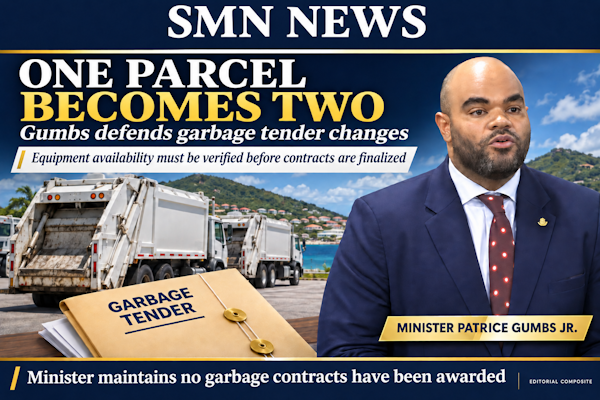
patricegarbagetender06112026PHILIPSBURG: Minister of VROMI Patrice Gumbs Jr. confirmed that the government changed the garbage tender rules to allow a company to receive two parcels instead of one, defending the adjustment as a way to improve service quality and continuity while acknowledging that prospective contractors must still demonstrate they have the equipment and capacity to perform.

His additional responses during the 2027 budget deliberations provided a fuller account of the disputed procurement process, including the treatment of newly established companies, equipment requirements, missing government documents and the use of funds left over after roadside-cleaning contracts ended.

The minister maintained in his earlier answers that no garbage contracts had been awarded. He described the names circulating publicly as the outcome of individual parcel assessments rather than a final contracted list.

Taken together, his responses place the next stage of scrutiny on the verification process: which companies can substantiate their capacity, what records support that determination, and whether any parcel must be reallocated.

Minister Confirms One-to-Two Change

Gumbs said the original tender limited each company to one parcel. The revised tender permits a maximum of two.

He defended the change as an attempt to balance competition with service quality and operational efficiency.

According to the minister, a one-parcel limit could prevent a qualified contractor from serving another area even where it has sufficient equipment, personnel, experience and capacity.

Allowing two parcels, he argued, gives the evaluation committee greater flexibility to place work with contractors demonstrating the strongest ability to deliver the required service.

He also said bidders from the previous tender had expressed concerns about the earlier restriction.

The minister did not identify those bidders during this response or present a comparative assessment showing how the change would affect competition, costs or service reliability.

His explanation establishes the government’s stated justification. It does not, by itself, resolve concerns about how the revised rule was applied to individual companies.

Equipment Access Can Qualify at Submission

Gumbs confirmed that tender submissions can include documentation showing either ownership of equipment or access to it.

He said that provision had not changed from the previous process.

What had changed, according to the minister, was an additional verification stage at which bidders must demonstrate that the equipment is actually available.

Gumbs linked the measure to problems during the 2021–2026 contracting period, saying contracts were awarded to companies without all the equipment needed to service their parcels.

The distinction matters: permission to submit evidence of equipment access differs from verification that trucks and other resources will be available to execute the work.

The minister said the ministry must be satisfied that prospective contractors have access to the necessary trucks, machinery, personnel and other resources before contracts are finalized.

His response did not provide a bidder-by-bidder verification outcome.

New Companies Are Not Automatically Excluded

Asked how a newly established company without a history in garbage collection could receive multiple parcels, Gumbs said a company’s age or incorporation date does not automatically disqualify it.

Instead, bidders are assessed against the eligibility, technical, financial and operational requirements in the tender documents.

A new company could potentially receive two parcels, he said, provided it satisfies the relevant qualification requirements and demonstrates sufficient operational capacity.

However, he emphasized that participation in a tender and the ability to successfully perform a contract are separate matters.

That answer neither confirms that a particular new company met the requirements nor establishes that any specific bidder should be excluded. It sets out the ministry’s position that it must determine qualification through the published criteria and subsequent verification.

Failure to Verify Can Lead to Reallocation

The minister said the revised process includes meetings with prospective contractors to establish which parcels they can realistically manage.

Bidders must complete the required documentation and substantiate equipment availability before contracts are awarded. Failure to satisfy those requirements can trigger reallocation.

He also explained that parcels are evaluated individually. A company may therefore rank highest for several parcels even though it cannot ultimately receive more than two.

In his earlier responses, Gumbs said two companies had been assessed as eligible for two parcels each.

Their ability to execute remained subject to confirmation through the meetings and verification process, he said.

The additional explanation reinforces his distinction between assessment results and final awards. It also makes the verification records essential to understanding how the final allocation will be reached.

Seven-to-Ten-Year Recommendation Still Hangs Over Shorter Term

The equipment discussion unfolded alongside questions about whether contractors can make sustainable investments within the proposed contract period.

Gumbs previously told Parliament that a Grant Thornton assessment commissioned by the ministry recommended solid-waste contracts lasting at least seven to ten years.

Government nevertheless chose a shorter period because of anticipated changes to landfill management and pricing associated with the Trust Fund project to rehabilitate and close the landfill, he said.

He also argued that government contracts are meant to purchase services rather than finance private companies' full investment needs.

Asked in additional responses how contractors could do more work for less money, Gumbs said bidders are expected to submit realistic and sustainable proposals that account for personnel, equipment, fuel, maintenance, transportation and other operational costs.

He stressed that the ministry’s responsibility continues after award through performance monitoring and contractual standards.

However, he did not provide a cost comparison showing how the required services could be delivered sustainably at the questioned amounts.

No Mid-Tender Relaxation for Delayed Documents

Gumbs also addressed companies struggling to obtain required documents, including tax documentation, from other government entities.

He acknowledged the difficulty but said all bidders receive the same period to prepare their submissions.

“We cannot change terms for a few during an ongoing tender,” he said.

He urged companies experiencing delays to raise them as early as possible so the ministry could determine whether assistance might be available.

The response did not announce an exemption, an extension or a remedy for a particular bidder.

Roadside-Cleaning Surplus Used Elsewhere

The additional data also disclosed that money remaining after roadside-cleaning contracts ended was used beyond cleaning activities.

Gumbs said the surplus helped finance temporary road and beach cleaning. Although household bins had been among the intended uses, remaining funds also helped address shortages under other budget posts and urgent projects, including cemetery vaults and car-wreck collection.

He did not provide the total surplus, a breakdown of transfers or the amount ultimately available for bins.

Those figures remain necessary to establish precisely how the allocation was used.

Separately, the minister said district-cleaning bids submitted on October 9 were still being evaluated. He announced plans for another island-wide cleanup before the new district-cleaning contracts begin.

District cleaning and garbage collection are separate processes and should not be treated as the same tender.

Documentation Will Determine Whether Assurances Hold

Gumbs’s responses provide a clearer defense of the revised garbage tender: two parcels are permitted, new companies can qualify, equipment access can support an application, and final capacity checks can result in reallocation.

He has also acknowledged receiving bidder documentation and questions, which he said were under review.

What Parliament has not yet received through these answers is a complete account of the individual verification results, the disposition of bidder complaints and the basis for each final allocation.

The minister’s assurances now depend on those records. They will show whether the flexibility introduced into the tender is matched by consistent enforcement of its requirements—and whether the contractors ultimately selected can deliver the service residents are paying for.
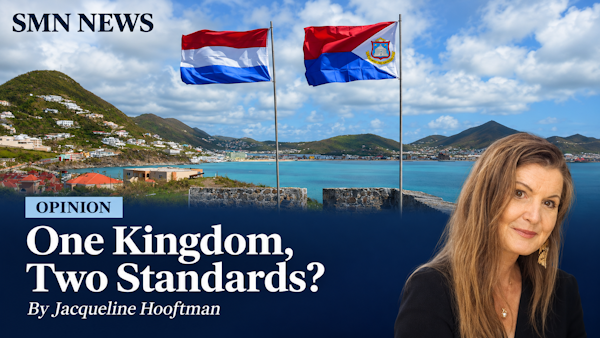

The Netherlands protects its own, while St. Maarten gets the prosecutions - One Kingdom, two standards of accountability?

jacquelinehooftman11072026Why does the Netherlands, despite its thousands of politicians and history of major political scandals, have relatively few criminal investigations involving its political establishment, while tiny St. Maarten has seen eleven politicians and former politicians face criminal proceedings, several ending in prison sentences?

Is this simply a difference in corruption levels? Or should we also question how the two countries investigate, prosecute, and punish political misconduct?

The question is particularly relevant because much of St. Maarten's enforcement machinery is supported by substantial Dutch financial and institutional resources.

- Dutch scandals, limited criminal accountability -

The Dutch childcare benefits scandal, the Toeslagenaffaire, devastated thousands of families wrongly accused of fraud. Parents were financially ruined, and some children were separated from their families. The scandal brought down the third Rutte government in January 2021.

Yet criminal consequences for the political leadership were remarkably limited.

Following criminal complaints against several ministers and former ministers, the Prosecutor General at the Supreme Court advised against ordering a criminal investigation.

Under Article 119 of the Dutch Constitution, prosecuting ministers and MPs for official misconduct requires a special order from the Government or a resolution of the House of Representatives.

Parliament also rejected a proposal to establish an investigative committee into allegations that the government had withheld information during the scandal. The proposal was defeated by 97 votes to 34.

Then came the Mondkapjesaffaire. Sywert van Lienden and his business partners made approximately €29.3 million in profit from a face-mask transaction involving around €100 million worth of masks. The businessmen faced criminal prosecution, but the political leadership did not face comparable criminal consequences.

The Netherlands does prosecute corrupt politicians. Former North Holland provincial executive member Ton Hooijmaijers, for example, received two years and five months in prison for bribery, forgery and money laundering. But how often do investigations involving political officeholders, particularly at national level, actually result in prison sentences?

- Twelve Dutch mayors, thirteen misadventures -

My own journalistic experience offers another perspective.

In the 1990s, together with the late investigative reporter Henk Hanssen, I investigated twelve Dutch mayors. Our investigation exposed allegations involving substantial bribes, misuse of public funds, fraud, and abuse of office.

Panorama magazine published the investigation on its cover under the headline "Twaalf Burgemeesters, Dertien Ongelukken" – "Twelve Mayors, Thirteen Misadventures".

I do not recall any of the twelve being prosecuted when our investigation appeared.

An official figure is also worth considering. In a letter to Parliament dated April 25, 2023, the Dutch Minister of the Interior reported approximately twenty criminal investigations involving political officeholders since 1990.

Twenty investigations in more than three decades, in a country with thousands of political officeholders.

- And then there is St. Maarten -

Since obtaining autonomous country status in 2010, St. Maarten has seen eleven politicians and former politicians face criminal proceedings. Several have received prison sentences or been disqualified from public office.

Consider former MP Rolando Brison. In the Lisbon case, the court found him guilty of bribery in one of three cases and acquitted him in the other two. He received six months of unconditional imprisonment, was ordered to repay approximately US$8,000 in benefits associated with the proven offense and was disqualified for five years from holding public office or standing for election.

How does that sentence compare with punishments for comparable offenses elsewhere in the Kingdom? The Public Prosecutor's Office also appealed aspects of the judgment.

Other cases include former Minister Christopher Emmanuel, sentenced to 29 months in the Jasmine investigation, former Minister Maria Buncamper-Molanus and her husband Claudius, and former Minister of Justice Lyndon Lewis, who faces prosecution in the Alicante investigation.

Nobody should be above the law. But accountability must also be proportionate.

- Millions invested in Caribbean enforcement -

Dutch funding for the coordinated approach to undermining crime in the Caribbean part of the Kingdom increased from €12 million to €24 million annually by 2025.

The program involves organizations including the RST, the Caribbean Public Prosecutor's Office and the Joint Court of Justice, and targets corruption, financial crime and money laundering, including offenses involving politically exposed persons.

I am not arguing against Dutch assistance. But where is the transparency?

How much is spent investigating politicians? How many cases result in convictions, acquittals or discontinued proceedings? Who evaluates whether the enforcement priorities and methods are proportionate?

Dutch financial support should come with accountability.

- One Kingdom, two standards? -

Every arrest, search of a government office, and prison sentence generates another headline about corruption in St. Maarten. The island risks being portrayed as a place where political corruption defines public life.

Yet the Netherlands itself has experienced scandals involving abuse of government power, devastated families and questionable public procurement.

Why do the standards of scrutiny appear so different?

Why does the Dutch Constitution impose a special procedure for prosecuting ministers and MPs? Why did the childcare benefits scandal not result in criminal investigations of the political leadership?

And why should St. Maarten accept a different standard of justice simply because it is smaller and has less political influence?

The fight against corruption is necessary. But so is the fight against double standards.


Tintamarre responds to SMN News on French Quarter Fiber Delays.

gillesgumbs07112026MARIGOT: --- Tintamarre President Gilles Gumbs has issued a written response to SMN News’s November 5, 2026 article, “Nine Years After Irma, French Quarter Still Waiting as Funding Gaps and Infrastructure Delays Demand Answers.”

In his response, Gumbs says the first phase of Tintamarre’s underground duct network is complete and in service, while construction of the second phase awaits financing. He says the grant funding anticipated in 2024 was not secured and that the partners are preparing an alternative financing arrangement. According to Gumbs, the legal and financial work on that arrangement was still underway when the November 13 Territorial Council agenda was prepared.

Gumbs also addresses the shareholders’ roles and explains who is responsible for installing fiber, activating service, and correcting coverage declarations.

In response to “Nine Years after Irma, French Quarter still waiting...” (SMN News, 5 November 2026)

Tintamarre welcomes the attention given to French Quarter residents. Their expectations regarding digital infrastructure are legitimate; we share them, and completing the network is our priority. The article raises several fair questions. Several concern Tintamarre directly, and we would rather answer them than leave them open.

Our role. Tintamarre’s sole purpose is to build and operate the passive civil-engineering infrastructure, that is, the underground ducts that house the fiber-optic cables. Deploying the fiber itself, activating the lines, and selling services are the responsibility of the electronic-communications operators. Whether fibre can actually be ordered at a given address therefore depends both on the presence of our ducts and on the deployment the operators carry out within them. This distinction matters for understanding where each responsibility lies.

Where the project stands. The first phase of the network is complete and in service. The second phase remains to be built, and securing its financing is our current priority. Following the procurement consultation, construction costs came back materially higher than the initial business-plan assumption, in a context shaped by the aftermath of Hurricane Irma and by the general rise in construction costs. This is the main reason the project has not yet moved into its second phase.

The 2024 financing package. The complementary financing considered at the end of 2024 did not come together as planned: the components anticipated at that time, in particular the expected grant funding, were not secured. That is precisely why the partners are now finalizing an alternative financing structure. Funds received to date have been applied to the completed first phase and to preparatory work; second-phase construction is pending the new financing.

The financing is being prepared. The Collectivité and the other project partners are working on a financing solution. Putting it in place has required additional legal and financial work, which is why it was not ready in time to appear on the 13 November council agenda. We will submit it to the competent bodies once the structuring is complete, and we will make its terms public then. We will not disclose figures or mechanisms that are still under discussion: these decisions involve a public authority and must follow its deliberative process, and premature disclosure would serve neither the project nor the residents.

The shareholders. Tintamarre has a share capital of 600,000 euros, and its shareholding, a matter of public record, brings together public and private partners: the Collectivité de Saint-Martin and Banque des Territoires, both public, each hold 40 percent, and Dauphin Telecom Infrastructures, a private company, holds 20 percent. In addition, the operators that use the network, including Dauphin Telecom Infrastructures and Orange, co-invest in it through long-term access contracts.

Fibre coverage declarations. The “déployé / raccordable” status shown on ARCEP’s map is declared by the operators, based on their own deployment, not by Tintamarre. In the streets where the second-phase civil engineering has not yet been built, fibre cannot be deployed and is genuinely not yet available. Where a declaration does not match the situation on the ground, the operator that made it must correct it. For our part, we will readily confirm, for any location, whether the civil engineering is in place.

Procurement and schedule. The construction framework advertised in early 2026 reflects planned procurement capacity, as the article rightly notes, not funds already committed or spent. We will order works under it once financing is secured, and we will publish a realistic completion schedule then. Committing to dates before the funding is in place would not be credible.

Matters outside our scope. Several topics in the article fall outside Tintamarre’s purpose. Public lighting, video-protection and the presence of public services are the responsibility of the Collectivité and the State; mobile-telephony installations and the wireless project are the responsibility of the operators concerned.

Tintamarre remains committed to serving the French Quarter and the rest of the territory, and to being transparent about the progress of its works as decisions are formalized.


MP Lewis seeks answers from Justice Minister on passenger’s release after firearms seizure (citing class justice).

lyndon01042026PHILIPSBURG:--- Member of Parliament (MP) and Chairman of the Justice Committee Lyndon Lewis is requesting that Minister of Justice Nathalie Tackling provide a written and public update on the seizure of three firearms at Princess Juliana International Airport and explain why the passenger was released after questioning.

According to the Public Prosecutor’s Office, as reported in Friday’s paper, “A woman arriving in St. Maarten on a flight from Saba was arrested after three firearms were found in her luggage. All weapons were confiscated, and the woman was released from police custody after questioning. The investigation into the importation of firearms into St. Maarten remains ongoing.”

“I'm asking the Minister to clarify who made the decision to release the suspect after questioning, what factors informed that decision, and whether any conditions were imposed. Why pictures of the confiscated firearms, including the make and caliber, were not published as customary.” MP Lewis said.

“Many persons in the community are shocked to hear that the suspect was released after questioning and that if it were a local public figure, they would have been remanded in police custody pending further investigation. This presumes to be another situation of Class Justice. The public deserves answers and a clear explanation of what can be disclosed at this stage, with full respect for the presumption of innocence and the integrity of the investigation,” MP Lewis stated.

MP Lewis is seeking clarification as to whether investigators have established who owned the firearms and whether the required authorizations were obtained. He seeks clarification on the screening procedures in place for passengers and luggage on the Saba–Sint Maarten route and whether the relevant authorities are reviewing those procedures following the incident.

MP Lewis requests a prompt response and asks when Parliament can expect a further update on any matters that cannot be addressed while the investigation is ongoing.

Interact Clubs Led Rotary Club of St. Martin Sunset Meeting in Celebration of World Interact Week 2026.

rotary08112026PHILIPSBURG:--- More than 150 Interactors came together in a powerful celebration of youth leadership, service, and fellowship as the Rotary Club of St. Martin Sunset dedicated its November 2nd, 2026, general meeting to World Interact Week 2026. In a special show of partnership between Rotary and its youth leaders, the meeting was jointly chaired by Rotary Club President Jade Maccow and five Interact Club Presidents: Reese Prince of the Interact
Club of St. Maarten Academy; Aditi Vaswani and Nikita Setpal, Co-Presidents of the Interact Club of Learning Unlimited Preparatory School; Dandranee McNamee of the Interact Club of MAC Comprehensive Secondary Education; and Audrey Wever of the Interact Club of St. Dominic High School.
The evening celebrated the voices, vision, and commitment of young people who are already making a difference in their schools and communities. Each Interact President presented their club’s plans and activities for the 2026–2027 Rotary year, highlighting upcoming projects and their commitment to service and leadership.

Interact, established by Rotary International in 1962, is a program for young people ages 12 to 18. The name combines “International” and “Action,” reflecting its mission to develop young leaders through community service, fellowship, and international understanding. Through Interact, young people gain valuable leadership experience while turning their ideas into meaningful action.
The meeting welcomed Past District Governor Louis Wever and his wife, Amanda Wever, Assistant Governor Jeffrey Sochrin, Rotarians, parents, sponsors, teachers, club advisors, and other supporters of youth development.

The meeting blended leadership and presentations with exciting activities and fellowship. Attendees enjoyed a 360-degree photo experience, capturing memorable moments with friends and fellow Interactors. A lively bingo game brought added excitement, with a round-trip airline ticket courtesy of Island 92 and Winair as the prize.
The grab box activity offered another opportunity to win, with Amazon gift cards up for grabs. The evening concluded with pizza and fellowship, giving everyone time to connect and celebrate together.
Rotary Club President Jade Maccow expressed her appreciation for the tremendous turnout and the enthusiasm displayed by the young leaders.
“Interact is where young people discover their potential, find their voice, and turn their passion into purpose.

We look forward to continuing our collaboration with our Interact Clubs, supporting their initiatives, and empowering young leaders to create lasting change in St. Maarten.”

To recognize their leadership and participation, each of the five Interact Club Presidents received a certificate and a token of appreciation from the Rotary Club of St. Martin Sunset.
The Rotary Club of St. Martin Sunset remains committed to supporting all four Interact Clubs, providing opportunities for young people to lead, serve, and grow. The evening reinforced the importance of investing in
youth and giving them the encouragement and platform to make their voices heard.
The Rotary Club of St. Martin Sunset meets on the second and fourth Mondays of each month at 7:30 p.m. at Carl & Son’s in Cole Bay. For more information about the club and its community initiatives, follow @rotarysxmsunset on Facebook and Instagram or contact This email address is being protected from spambots. You need JavaScript enabled to view it..


Subcategories