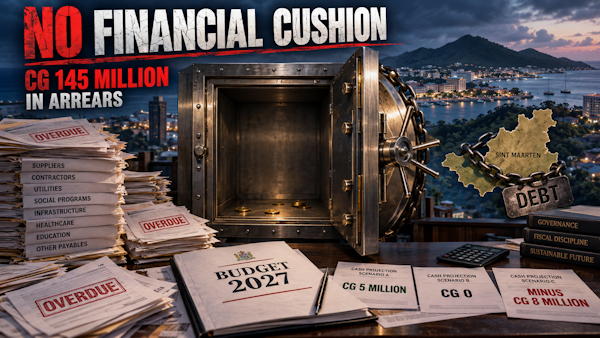
St Maarten has no financial cushion—Cg 145 million in unpaid bills while government plans more borrowing.

financialcushion10092026PHILIPSBURG:---  Sint Maarten is heading into 2027 without the financial cushion needed to absorb an emergency, introduce new policies, or confront the growing risks at SZV, TelEm, GEBE, and Postal Services Sint Maarten.

Behind the government’s projected budget surplus lies a far more troubling reality: approximately Cg 145 million in payment arrears, conflicting cash projections and hundreds of millions of guilders in unresolved liabilities.

The Committee for Financial Supervision (Cft) delivers the warning bluntly in its assessment of the draft 2027 budget: Sint Maarten has no liquidity to absorb unexpected setbacks or introduce new policies.

That warning strikes at the credibility of the government’s plans. A budget may appear balanced on paper, but paper cannot pay overdue bills, finance emergency measures, or rescue a government-owned company that suddenly cannot meet its obligations.

Three different cash projections in one Budget

The government’s financial planning is immediately called into question by three conflicting liquidity projections in the budget documents.

For the end of 2027, the documents reportedly present:

  • One projection showing Cg 5 million in available cash;
  • Another table showing zero available cash; and
  • Accompanying text referring to a negative cash balance of Cg 8 million.

These are not minor typographical differences. They represent three fundamentally different pictures of the government’s ability to meet its obligations.

One projection suggests that Sint Maarten will have a small buffer. Another says there will be no buffer at all. The third suggests the government will already be in the red.

The Cft demanded more consistent and reliable liquidity projections, warning that the figures vary too frequently between budget documents without adequate explanation.

Parliament cannot meaningfully approve a national budget if it cannot determine whether government expects to end 2027 with a Cg 5 million, nothing, or a Cg 8 million deficit.

Cg 145 million in Payment Arrears

Even the most favorable projection of Cg 5 million in available cash is overwhelmed by approximately Cg 145 million in payment arrears.

The Cft concluded that improving the cash position and eliminating those arrears will require the government to generate new revenue or control expenditure. It called for a clear and executable plan.

Government’s response is to pursue stronger tax compliance, introduce a tourist tax, optimize fees and licenses and maintain strict expenditure controls.

But this response raises another central question: how much of the financial burden will ultimately be shifted onto residents, businesses and visitors?

The government is promising possible reductions in certain direct and indirect taxes to improve purchasing power. At the same time, it is relying on improved tax collection, a new tourist tax and higher or optimized fees to strengthen its finances.

Without exact calculations, implementation dates and an assessment of who will pay more or less, the public is left with promises on one side and new revenue demands on the other.

Another loan while previous investments remain unfinished

The 2027 budget contains plans for another major capital loan while approximately Cg 200 million in investments approved in earlier years remain unexecuted.

According to the Cft, Sint Maarten is already paying approximately Cg 5.5 million in interest on the loans connected to those outstanding investments.

The proposed new borrowing would add roughly another Cg 2 million in interest costs.

Borrowing for productive national development can be justified. Borrowing money, paying interest and then failing to execute the projects cannot.

The Cft warned that the draft budget does not clearly show which investments correspond with the new loan request. It also noted that the investment totals do not reconcile properly and that the government again failed to provide the repeatedly requested multi-year investment agenda.

Parliament is therefore being asked to consider further borrowing without a clear and complete accounting of what happened to hundreds of millions already designated for investment.

Debt estimated at Cg 1.424 billion

The Cft estimates that Sint Maarten’s central government debt, including short-term liabilities, will reach approximately Cg 1.424 billion by the end of 2027—equal to roughly 41% of gross domestic product.

That figure does not stand alone.

The country also faces:

  • Approximately Cg 500 million in accumulated debt between SZV’s healthcare and social funds;
  • More than Cg 100 million owed directly by government to SZV;
  • A Cg 75.6 million loan contracted on behalf of GEBE;
  • A requested Cg 5 million government guarantee for TelEm;
  • Approximately Cg 145 million in payment arrears; and
  • Possible future financial assistance for PSS.

Not every amount can simply be added together, because some obligations may overlap or carry different legal and accounting classifications. Nevertheless, taken collectively, they reveal the enormous pressure surrounding the government’s finances.

SZV could exhaust its liquid reserves

The healthcare funds are projected to record annual deficits of about Cg 35 million between 2027 and 2030, while SZV is expected to run annual operational deficits of about Cg 20 million.

Even after using surpluses from other social funds, SZV could still lose between Cg 15 million and Cg 25 million annually.

The Cft warns that SZV’s liquid reserves could be exhausted within several years.

The government has responded with broad commitments to improve oversight, financial management and revenue collection. It is also advancing General Health Insurance, a tourist tax and a proposed fluctuation fund.

However, the budget does not present a complete, legally secure and fully financed solution to the problem.

Instead, the current system still depends partly on cross-financing between funds—an arrangement the Cft questions on legal grounds.

Government companies waiting at the treasury’s door

TelEm, GEBE and PSS are all identified as companies with serious financial problems.

GEBE lacks completed financial reporting for 2023, 2024 and 2025, while its liquidity and equity are believed to have deteriorated. TelEm has difficulty meeting obligations to lenders and has requested a government guarantee. PSS continues to survive through additional operational contributions.

These companies provide essential public services. Allowing them to fail is hardly an option, meaning their financial problems can rapidly become the government’s—and therefore the taxpayers’—problems.

Yet the government has not established budgetary provisions for the possible TelEm guarantee or future assistance to PSS. It says it can address any financial consequences later through budget amendments.

That approach does not eliminate the risks. It merely leaves them outside the current budget until the bills come due.

Parliament must demand one honest financial picture

The draft 2027 budget is presented as a roadmap for another fiscal year. However, the documents reveal a government with limited cash, massive arrears, unresolved healthcare obligations, financially distressed public companies, and plans for additional borrowing.

The figures demand more than ceremonial speeches and political assurances.

Before approving the budget, Parliament should insist on:

  • One verified liquidity projection;
  • A payment schedule for the Cg 145 million in arrears;
  • A legally supported plan for the SZV deficits and accumulated debts;
  • Current financial statements from GEBE;
  • Full disclosure of the TelEm guarantee and proposed building purchase;
  • A clear plan for PSS;
  • A reconciliation of all proposed capital investments; and
  • A complete explanation of what happened to approximately Cg 200 million in previously planned investments.

A country with no emergency cushion cannot afford financial ambiguity.

Sint Maarten’s 2027 budget does not merely expose a shortage of money. It exposes a shortage of reliable information, completed accounts and enforceable solutions—and Parliament must not pretend that projected revenue on paper makes those dangers disappear.
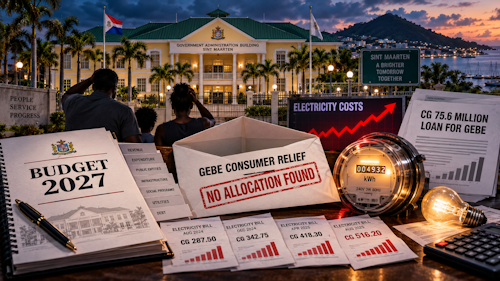

Promised GEBE consumer relief missing from 2027 budget—Government finds Cg 75.6 million for company, but nothing clearly earmarked for struggling households.

noreliefgebe10092026PHILIPSBURG:--- The Government of St Maarten’s draft 2027 budget contains no clearly identified allocation for the long-promised relief to GEBE consumers struggling under high electricity bills, disputed accounts and accumulated utility debt.
A review of the complete 337-page budget package found extensive discussion about protecting vulnerable consumers, improving price controls and strengthening GEBE’s financial position. However, no dedicated budget line is clearly labeled as GEBE consumer relief, electricity-bill reduction, fuel-clause relief, household utility assistance, or forgiveness of consumer debt.

The government has documented a Cg 75.6 million loan secured on behalf of GEBE in 2024, yet the 2027 budget does not clearly show how much—if anything—will be provided directly to the consumers waiting for relief.

The money went toward supporting the company. The promised relief for the people remains missing from the budget.

Plenty of language, no dedicated GEBE relief fund

The budget repeatedly speaks about “economic relief” and protecting vulnerable consumers. The Ministry of Tourism, Economic Affairs, Transport and Telecommunication states that it intends to protect consumers against inflation and market shocks.

But the relief described by TEATT consists primarily of:

  • Strengthening the Maximum Price System;
  • Creating a digital platform for monitoring maximum prices;
  • Developing dynamic price-adjustment models;
  • Increasing enforcement of price regulations;
  • Conducting market research;
  • Preparing competition and consumer-protection legislation; and
  • Supporting possible reductions in certain direct and indirect taxes.

These measures may affect food, fuel and other essential goods. They do not amount to a funded GEBE relief programme.

No amount is stated to lower residential electricity bills. No subsidy has been identified to reduce the fuel clause. No budgeted fund exists to assist households facing disconnection. There is no clearly defined debt-relief programme for consumers carrying disputed or accumulated GEBE balances.

A promise without a budget line is not yet relief.

Cg 75.6 Million Loan for GEBE

While consumers cannot locate their relief in the budget, the document confirms that the government secured a Cg 75.6 million loan for GEBE in 2024.

The capital-expenditure section also contains a bare entry reading “GEBE 75.000”, but it provides no explanation on that page showing that the amount is intended for consumers. The budget’s narrative separately identifies the Cg 75.6 million loan secured in 2024.

Nothing in the relevant GEBE section states that this financing will be converted into lower bills, customer credits, or debt forgiveness.

Government must therefore explain:

  • What the Cg 75.6 million financed;
  • How much has already been spent;
  • Whether any portion was intended for consumer relief;
  • Whether consumers received any measurable benefit;
  • Whether the capital entry is a carryover of the 2024 financing; and
  • Why the 2027 budget contains no separately identified consumer-relief allocation.

Without those answers, the public is left to conclude that millions were mobilized to support the utility company while households were given promises.

GEBE’s Financial Condition Described as “Worrying”

The absence of a consumer-relief programme is made more serious by the budget’s own description of GEBE’s finances.

Government says GEBE’s current situation is “worrying” and expects both its liquidity and equity to have deteriorated over the past two to three years.

Yet government does not have completed financial statements or current financial data for 2023, 2024 or 2025.

The newest available figures are from 2022. Those figures show GEBE’s cash position collapsing from Cg 54.6 million in 2021 to Cg 1.5 million in 2022.

At the same time:

  • Trade and other receivables increased from Cg 48.5 million to Cg 306.1 million;
  • Short-term liabilities increased from Cg 26.9 million to Cg 198.8 million;
  • Equity stood at Cg 226.6 million; and
  • The company recorded a 2022 profit of Cg 23.8 million.

The budget itself questions how much of the Cg 306.1 million in receivables can actually be collected.

That is particularly important for consumers. If a considerable portion of GEBE’s receivables consists of questionable, disputed, or unreliable customer balances following the billing crisis, the government must explain how those accounts are being treated.

The public should not be forced to finance accounting uncertainty through higher bills, aggressive collection or disconnections.

Consumers Are Mentioned Everywhere Except Under GEBE

The contradiction is impossible to ignore.

In the TEATT section, the government declares that affordable access to essential goods is a national priority. It speaks about increasing consumers’ disposable income and purchasing power through possible tax reforms.

But in the section dealing specifically with GEBE, the focus shifts entirely to:

  • Catching up on financial statements;
  • Repairing internal processes;
  • Determining whether receivables are collectible;
  • Restoring financial reporting;
  • Addressing weakened liquidity; and
  • Managing the company’s financial risk to government.

No accompanying section explains what happens to the people who must pay GEBE every month.

There is no consumer-relief amount, implementation date, eligibility criterion, or application procedure.

The government does not explain whether it intends to subsidize electricity, reduce the fuel clause, write off disputed balances, or protect vulnerable households from disconnection.

Price Controls Will Not Reduce a GEBE Bill

The government’s plan to modernize the Maximum Price System may assist shoppers by increasing oversight of prices charged for certain goods. It does not automatically lower a GEBE electricity bill.

A consumer-price database cannot replace an electricity subsidy.

A public-awareness campaign cannot cancel disputed utility debt.

Future consumer-protection legislation cannot provide immediate relief to a household facing disconnection.

Possible tax reductions may eventually improve purchasing power, but the budget does not establish the exact taxes to be reduced, the size of the reduction or when consumers will receive the benefit.

The language of relief is present. The actual relief is not.

Parliament must demand a dedicated relief plan

Parliament should not allow government to hide the absence of GEBE consumer relief behind broad references to consumer protection.

Before approving the 2027 budget, Members of Parliament should demand:

  • The exact amount promised for GEBE consumer relief;
  • The budget line under which that amount is recorded;
  • A breakdown of the Cg 75.6 million loan secured for GEBE;
  • An explanation of the unexplained “GEBE 75.000” capital entry;
  • The number and value of disputed consumer accounts;
  • The portion of GEBE’s Cg 306.1 million in receivables considered collectible;
  • The amount of consumer debt government proposes to forgive, reduce or restructure;
  • The proposed assistance for elderly, low-income and medically vulnerable customers;
  • The effect of any relief on the fuel clause and monthly electricity bills; and
  • A binding implementation date.

The government cannot continue announcing relief outside Parliament while presenting a budget that does not clearly fund it.

If GEBE consumers were promised assistance, that promise should appear in black and white—with an amount, a responsible ministry and a deadline.

Until then, the 2027 budget offers consumers protection in theory, reforms in the future, and another year of electricity bills in the present.

Coordinated Enforcement Action Strengthens Border Security and Supports Sint Maarten’s Efforts Against Human Trafficking.

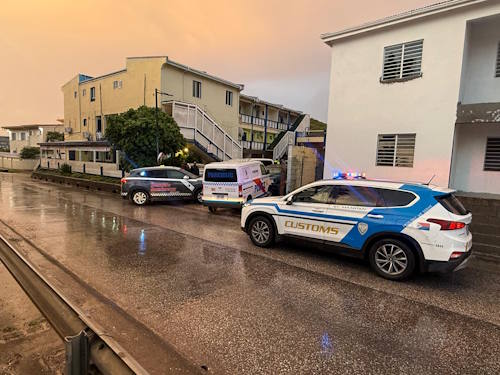
immigrationkpsmoperation10092026PHILIPSBURG:---  The Police Force of Sint Maarten (KPSM), in close cooperation with the Customs Department, Koninklijke Marechaussee (KMAR), and the Immigration Department of Sint Maarten, carried out a coordinated enforcement action at a hotel establishment in the Cay Hill area.

The joint operation forms part of the ongoing efforts of the authorities to strengthen Sint Maarten’s overall enforcement and border-security capacity, while addressing illegal stay, human smuggling and human trafficking, firearms, organized crime and other serious criminal activities.

During the operation, Immigration Department officers identified and arrested 18 persons found to be residing illegally on Sint Maarten. The Immigration Department took these individuals into custody for further processing and investigation.

In addition, the operation resulted in the arrest of a male suspect who was wanted in connection with several armed robberies involving jewelry stores. The suspect was apprehended during the operation and subsequently transported to the Police Station in Philipsburg, where he is being held for questioning.

During the same coordinated action, another male suspect and 2 female suspects were arrested in connection with the possession of a firearm and are suspects in several other criminal activities. Authorities also transported them to the Police Station in Philipsburg, where they remain in custody pending further investigation and questioning.

The authorities are fully aware of the importance of Sint Maarten’s current tier status in efforts to combat human trafficking and remain committed to taking concrete, sustained measures to strengthen compliance with international standards.

Sint Maarten recognizes that improving its response requires continuous, coordinated action across the agencies responsible for law enforcement, immigration, border control, prosecution, and victim protection.

Coordinated enforcement actions such as this operation are part of those ongoing efforts. They demonstrate the commitment of Sint Maarten’s law-enforcement, immigration and border-control agencies to identifying vulnerabilities, disrupting criminal networks, preventing and addressing human trafficking and human smuggling, protecting potential victims, and strengthening the island’s overall response to these serious crimes.

All persons arrested during this operation remain in custody while the respective investigations are ongoing.

The Police Force of Sint Maarten, together with the Customs and Immigration Departments and other partners, emphasizes that coordinated enforcement operations of this nature will continue in the coming days and weeks.

The authorities remain committed to working together and taking concrete action to ensure that Sint Maarten continues to strengthen its compliance with international standards and improve its overall response to human trafficking and related criminal activities.

CPS Encourages Men to Learn About Prostate Cancer and Discuss Screening with Their Doctor.

PHILIPSBURG (DCOMM):---  The Collective Prevention Service (CPS), an executive agency of the Ministry of Public Health, Social Development and Labor (VSA), is joining the Non-Governmental Organization community in adding its voice to encouraging men to become informed about prostate cancer, understand their personal risk and speak with their doctor about whether screening is appropriate for them.

The prostate is a small gland that forms part of the male reproductive system. It sits below the bladder and produces some of the fluid in semen. Prostate cancer develops when cells in the prostate begin to grow abnormally.

Prostate cancer is a significant men’s health concern. Although many prostate cancers grow slowly, some can be aggressive and may spread to other parts of the body. Detecting clinically significant cancer before it spreads can provide more treatment options and improve health outcomes.

Early-stage prostate cancer often causes no noticeable symptoms. This is why men should not wait until they feel unwell before discussing their prostate health with a medical professional.

When symptoms occur, they may include: Difficulty beginning urination; A weak or interrupted urine flow; Frequent urination, particularly at night; Difficulty emptying the bladder completely;

Pain or burning during urination; Blood in the urine or semen;

Persistent pain in the back, hips or pelvis; or Painful ejaculation.

These symptoms do not necessarily mean that a person has prostate cancer. An enlarged prostate, infection and other non-cancerous conditions can produce similar symptoms. Anyone experiencing persistent or concerning symptoms should consult a doctor for a proper medical assessment.

The risk of developing prostate cancer increases with age. Men of African or Caribbean ancestry, men with a father or brother who has had prostate cancer, and those with certain inherited genetic changes may face a higher risk. A family history involving several relatives or a relative diagnosed at a younger age may also be significant.

Screening can help identify certain cancers early, but it may also detect slow-growing cancers that would never have caused serious health problems.

CPS particularly encourages men at increased risk—including older men, men of African or Caribbean ancestry and those with a family history of prostate cancer—to initiate a conversation with their house doctor about prostate health and the most appropriate time to consider screening.

Men can also support their general health by remaining physically active, maintaining a healthy body weight, eating a balanced diet, avoiding tobacco and limiting alcohol consumption. These measures support overall health but do not replace medical consultation or recommended screening.

Fear, embarrassment and uncertainty sometimes prevent men from discussing changes in their health. CPS reminds the community that seeking medical advice is a responsible and potentially life-saving step.

Partners, relatives and friends can also help by encouraging the men in their lives to attend routine medical check-ups, learn about their family medical history and speak openly with their healthcare provider.

CPS urges men not to ignore persistent urinary symptoms, blood in the urine or semen, or unexplained pain in the back, hips or pelvis. Consult a healthcare professional for evaluation and guidance.

Persons seeking additional information should contact their family physician or CPS at telephone numbers: 542-1570 or 542-1222.

Caribbean Wellness Day – Healthy Caribbean Adults begin with Health Caribbean Children and Young People.

PHILIPSBURG  (DCOMM):---  Caribbean Wellness Day (CWD) will be observed across the region on Saturday, September 12, reminding Caribbean communities to take action and maintain healthy lifestyles under the theme “Our Mind. Our Body. Our Wellness. Empowering Caribbean Youth.”

CWD 2026 focus is on young people, their physical and mental well-being, and creating environments that allow Caribbean youth to make healthier choices.

The Caribbean Public Health Agency (CARPHA) 2026 message emphasizes that the future health of the Caribbean is strongly influenced by the choices, opportunities and environments being created for young people today.

The agency is therefore calling on Member States to put youth wellness at the centre of efforts to create healthier individuals, communities and societies.

CWD is also about promoting collectively good health and well-being of the whole of society, the Collective Prevention Service (CPS), a department within the Ministry of Public Health, Social Development and Labor (Ministry VSA) said.
The burden of Non-Communicable Diseases (NCDs) in the Caribbean has reached epidemic proportions, representing one of the most significant public health and economic challenges facing the region.
With NCDs like cardiovascular diseases, cancer, and diabetes accounting for over 75% of all deaths, the region has one of the highest rates of premature mortality from these conditions in the world.
This crisis is fueled by a number of behavioral risk factors, including unhealthy diets, physical inactivity, tobacco use, and excessive alcohol consumption.
Sint Maarten parents and guardians need to look at issues such as healthy eating, physical activity, maintaining a healthy weight, mental health and stress, adequate sleep, reducing excessive screen and sedentary time, avoiding tobacco/vaping and harmful alcohol use, developing positive relationships, and encouraging young people to obtain appropriate preventive healthcare.
NCDs are prevalent in Sint Maarten, and CPS uses its annual Health Observance Calendar (HOC) which highlights Caribbean Wellness Day, as well as raising awareness about NCDs that impacts the community such as hypertension, diabetes, prostate and breast cancer.
This CWD youth approach is particularly relevant because many NCD risk factors develop during childhood and adolescence and can continue into adulthood. Caribbean Wellness Day therefore provides an opportunity to move the conversation from treating chronic illness later in life toward establishing healthy behaviors earlier in life.
CPS for CWD 2026 is calling on young people, parents, schools, sports organizations, youth organizations and the wider community to collectively promote healthier lifestyles.
It would also fit well with the start of the 2026–2027 school year, where a healthier lifestyle allows for wellness with school performance, healthy meals, physical activity, emotional well-being and healthy decision-making.
CPS encourages members of the community to consult with their family physician or other health related organizations to learn more about healthy lifestyles and take action to improve their overall wellness.
CPS also encourages residents to participate and get involved in promoting health and wellness in their neighborhoods. Influencing positive lifestyle changes is by working together to better community and individual health.
The CARICOM Heads of Summit on Chronic Diseases in Port of Spain, Trinidad and Tobago, September 2007, established Caribbean Wellness Day.
Caribbean Wellness Day is observed every year on the second Saturday of September.


Subcategories