CPS: World Food Day – Friday. Healthy Eating and Greater Food Security.

GREAT BAY, Sint Maarten (DCOMM):---  Friday, October 16, 2026, marks World Food Day, and the Collective Prevention Service (CPS), an executive agency of the Ministry of Public Health, Social Development and Labor (Ministry of VSA), is calling on the Sint Maarten community to recognize the importance of healthy eating, food security and access to safe, affordable and nutritious food as essential components of public health and well-being.

World Food Day is part of CPS's annual calendar of health observances and offers an opportunity to raise awareness of the relationship between nutrition, disease prevention, sustainable food production, and the challenges of ensuring everyone has access to sufficient, nutritious food.

The 2026 World Food Day theme, established by the Food and Agriculture Organization of the United Nations (FAO), is “Innovate today. Nourish tomorrow.”

This year's theme highlights the importance of combining innovation, traditional knowledge, community participation, and sustainable approaches to food production and distribution to build healthier, more resilient food systems for present and future generations.

World Food Day is observed annually on October 16 to commemorate the FAO's founding in 1945. The international observance highlights global hunger, malnutrition, food insecurity, and the need for sustainable agriculture and food systems.

For Sint Maarten, World Food Day offers an opportunity to reflect on the importance of ensuring residents have access to healthy, affordable food and to recognize the connection between nutrition, public health, economic development, and environmental sustainability.

CPS emphasizes that maintaining a healthy and balanced diet is one of the most important steps individuals and families can take to protect their health and reduce their risk of developing noncommunicable diseases (NCDs).

Unhealthy dietary habits, including excessive consumption of salt, sugar, saturated fats and highly processed foods, can contribute to obesity, high blood pressure, type 2 diabetes, cardiovascular disease and other chronic health conditions. 

These diseases remain significant public health challenges throughout the Caribbean.

CPS encourages residents to make healthier food choices by including a variety of fruits, vegetables, whole grains, legumes, and appropriate protein sources in their daily meals.

Traditional Caribbean foods such as sweet potatoes, pumpkin, green leafy vegetables, beans, peas, and fresh fish can support a balanced, nutritious diet when prepared with healthy cooking methods.

Residents are also encouraged to reduce sugary drink consumption, choose water more often, limit high-sodium foods, and avoid excessive processed foods.

Healthy eating doesn't have to mean expensive or complicated meals. Planning meals, selecting nutritious ingredients, preparing food at home and reducing food waste can help families make better use of their food budgets.

As the global community observes World Food Day 2026, CPS calls on Sint Maarten residents to reflect on their everyday food choices and the role they can play in promoting healthier families and a more resilient community.

Small changes, including preparing balanced meals, choosing healthier beverages, reducing food waste, supporting local food initiatives, and teaching children good nutritional habits, can collectively contribute to improved public health.

CPS encourages every household to make healthy eating a priority and to recognize that investing in good nutrition today contributes to healthier individuals, stronger communities, and a more sustainable future.

World Food Day 2026 – “Innovate today. Nourish tomorrow.”

Healthy food, healthy people, healthy communities.


ODM: Forecasters Continue to Favor Below-normal Storm Activity for the Next Two Weeks.

PHILIPSBURG (DCOMM):--- Fire Chief and National Disaster Coordinator (NDC) Clive Richardson of the Office of Disaster Management (ODM) says forecasters at Colorado State University (CSU) Department of Atmospheric Science forecast 60 percent below-normal storm formation activity for the next two weeks.

Richardson added that while the Atlantic season for the Caribbean area has been rather quiet, this has not been the case for the Eastern Pacific hurricane season, which has been considerably more active and intense than normal, producing numerous powerful hurricanes, including three that reached Category 5 intensity when the broader Eastern and Central Pacific are considered.

According to the National Hurricane Center's October 15 seasonal summary, the Eastern Pacific has already recorded 19 named storms, nine hurricanes and six major hurricanes within its reporting area.

So far, the Atlantic has seen nine named storms: Arthur, Bertha, Cristobal, Dolly, Edouard, Fay, Gonzalo, Hanna, and Isaias; the latter became the first hurricane of the Atlantic hurricane season and the first major storm, Category 3.

Remember, one tropical storm or hurricane passing near or directly over the island can cause significant damage, disrupt essential services, and threaten lives.

The Office of Disaster Management (ODM) therefore reminds residents and the business community that preparedness should never be based solely on seasonal forecasts. Approach every hurricane season with the same level of readiness, whether it is forecast to be above normal, near normal, or below normal.

The remaining 2026 storm names are: Josephine, Kyle, Leah, Marco, Nana, Omar, Paulette, Rene, Sally, Teddy, Vicky, and Wilfred.

The community is urged to learn more about hurricane hazards and resources you need on how to prepare your family, home, or business for a storm/hurricane strike by visiting the Government website: www.sintmaartengov.org/hurricane where you will be able to download your “Hurricane Season Readiness Guide’ and “Hurricane Tracking Chart.” The information here is also valuable for new residents.

Listen to the Government Radio station – SXMGOV 107.9FM - for official information and news before, during, and after a hurricane. You can also follow weather-related news and information, as well as national addresses by the Prime Minister and the chairperson of the Emergency Operations Center (EOC), by going to the @SXMGOV Facebook Page.

For official weather-related information, rely on forecasts that can be found on the website of the Meteorological Department of St. Maarten (MDS): www.meteosxm.com or visit their social media page Facebook.com/sxmweather/

Remember, it only takes one hurricane to make it a bad season.  Remain vigilant and prepared!

The hurricane season runs through November 30.

Minister Connor Marks World Food Day by Calling for Sustainable Food Security and Community Self-Reliance.

connorclaret15102026PHILIPSBURG:--- On the occasion of World Food Day, observed annually on October 16, the Minister of Public Health, Social Development and Labor, Hon. Minister Claret Connor, is calling on the people of Sint Maarten to reflect on the importance of food security, healthy nutrition, and the need to build a more sustainable approach to feeding our communities.

This year’s World Food Day theme, “Innovate Today. Nourish Tomorrow,” highlights the importance of innovation, collaboration, and sustainable food systems in ensuring that present and future generations have access to sufficient, safe, and nutritious food.

“Food is a basic human necessity and an essential part of human dignity. As a community, we must continue to examine how we can make nutritious food more accessible and affordable, while also empowering our people to become more actively involved in producing the food they consume,” Minister Connor stated.

The Minister acknowledged and commended the many organizations, foundations, businesses, community groups, and individuals who continue to organize food distribution and feeding programs throughout Sint Maarten. These initiatives provide valuable assistance to individuals and families facing financial hardship and help ensure that vulnerable members of our community are not forgotten.

“We recognize and appreciate the dedication of everyone who takes the time and resources to prepare meals, distribute groceries, and support families in need. Your work makes a meaningful difference in the lives of our people, and we encourage these acts of compassion and community solidarity to continue,” the Minister emphasized.

While immediate food assistance remains essential, Minister Connor believes that Sint Maarten must also explore complementary, long-term solutions that strengthen household resilience and reduce dependency on external food supplies.

A Sustainable Approach: Growing What We Eat

In keeping with this vision, the Ministry of VSA is exploring an initiative to increase local food production by introducing and distributing breadfruit trees across Sint Maarten, followed by other fruit-bearing trees and plants.

The proposed initiative aims to encourage households and communities to cultivate breadfruit, a traditional Caribbean food source that can contribute to food security and promote greater self-reliance. By investing in trees that can provide food over many years, the initiative seeks to encourage a shift toward sustainable food production, community participation, and the preservation of regional agricultural knowledge.

Minister Connor noted that the initiative reflects the importance of combining traditional knowledge with forward-thinking solutions.

“We have a rich Caribbean heritage of growing, sharing, and making use of what the land provides. We want to build on that knowledge and encourage a renewed culture of growing food at home, sharing resources, and supporting one another.”

Everyone Has a Role to Play

World Food Day reminds us that food security is a shared responsibility. Governments, farmers, businesses, community organizations, and individuals all play a role in building food systems that are more resilient, inclusive, and sustainable.

Residents can contribute by reducing food waste, making healthier food choices where possible, supporting local farmers and producers, and exploring opportunities to grow fruits, vegetables, and other food crops at home or within their communities.

As Sint Maarten observes World Food Day 2026, Minister Connor encourages the community to embrace the theme, “Innovate Today. Nourish Tomorrow,” not merely as a slogan, but as a call to action.

The Ministry of Public Health, Social Development and Labor wishes everyone a meaningful World Food Day and encourages all residents to take one practical step toward a healthier, more sustainable, and food-secure Sint Maarten.

Robbery reported at business on Sucker Garden Road

armedrobberyfillin13082012PHILPSBURG:--- On Thursday, October 15, at approximately 9:00 p.m., the Police Force of Sint Maarten (KPSM) received a 911 call reporting a robbery at a business along Sucker Garden Road.

Preliminary investigations indicate that two unidentified suspects entered the establishment and robbed the occupants of an undisclosed amount of cash. The suspects then fled the scene on a parked scooter in front of the business, heading toward Sucker Garden Road.

Police patrols responded and searched the surrounding area, but they did not locate the suspects. Detectives and forensic personnel also visited the scene to gather evidence and speak with potential witnesses.

KPSM is appealing to anyone who witnessed the incident or has information that could assist the ongoing investigation to come forward.

Information can be shared through the following channels:

  • Police Station:542-2222
  • Anonymous Tip Line:9300

Roseburg’s dual role demands answers: Parliament must clarify constitutional limits on MPs practicing law.

Two Dutch judgments sharpen questions about prohibited representation, enforcement, and whether appearing in court establishes compliance with rules governing public office.
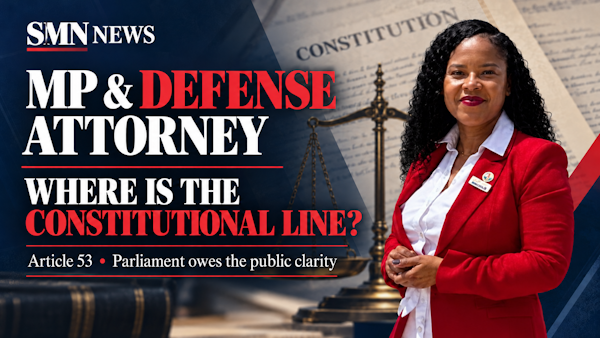
sjamiraroseburg16102026PHILIPSBURG:--- Parliament must provide a clear, legally supported explanation of whether a sitting Member of Parliament may defend someone prosecuted by Sint Maarten’s Public Prosecutor’s Office—and who is responsible for enforcing the constitutional restriction if it applies.

Reports that MP and attorney Sjamira Roseburg is representing a civil servant facing criminal proceedings have brought renewed attention to Article 53 of the Constitution. The provision expressly restricts parliamentarians from acting as lawyers in proceedings involving the Country. However, its application to criminal defense remains disputed.

Two Dutch judgments give this debate additional weight. They demonstrate that restrictions attached to elected or political office can affect legal representation, while also revealing a crucial distinction: an underlying prohibition and a court’s procedural power to exclude an attorney are separate questions.

Neither judgment conclusively determines Roseburg’s position under Sint Maarten law. Both strengthen the case for a public explanation grounded in law.

The constitutional question cannot be brushed aside.

Article 53(3)(a) prohibits MPs from acting as attorneys in court proceedings in which the Country is involved. Article 53(4) allows Parliament to grant exemptions in particular cases where the Country’s interest requires it. The wording does not expressly include or exclude criminal prosecutions. Whether they fall within its scope is the central dispute.

The question therefore goes beyond whether Roseburg is a qualified attorney. It concerns the limits attached to parliamentary office.

If the restriction covers criminal defense, a general entitlement to practice law would not settle the matter. If it does not, the public should be given legal reasoning supporting that conclusion.

Roseburg has already disputed broad interpretation.

The public aired this controversy in December 2024. A report published on December 30 presented legal advice attributed to attorney Roland Duncan alongside Roseburg’s response.

Duncan argued that criminal proceedings inherently involve the Country because prosecutors represent the state’s interests. Roseburg rejected that interpretation, maintaining that representing individuals in prosecutions brought by the independently operating Public Prosecutor’s Office falls outside the prohibition. She also disputed the characterization of publicly funded defense work as ordinary government contracting and stated that she would withdraw if a potential conflict arose. These were opposing legal positions, rather than a binding judicial resolution.

That disagreement deserves an institutional answer. The public should not have to choose between competing interpretations without knowing what position Parliament has adopted and why.

Prosecutorial independence is important, but invoking it does not automatically determine the meaning of Article 53.

The Kingdom legislation governing the Public Prosecutor’s Office assigns it responsibility for criminal enforcement, investigation and prosecution. It also permits the Justice Minister to issue written, reasoned general directions to the Prosecutor-General. Proposed directions concerning specific investigations or prosecutions require prior review by the Joint Court.

Those safeguards must be respected. They also illustrate why the relationship between prosecution, government and parliamentary oversight requires careful legal analysis.

There is no finding in the material reviewed that Roseburg used parliamentary authority to benefit a client. The concern is whether the law has authoritatively established the legal boundaries between her two roles.

The 2024 Dutch ruling shows that representation restrictions can have consequences.

On June 12, 2024, the Dutch Council of State upheld the refusal to allow a Waalwijk municipal councilor to represent a sports association in an administrative objection involving the municipality. The representation breached Article 15(1)(b) of the Dutch Municipalities Act.

Although the appeal succeeded separately on compensation for excessive procedural delay, the court upheld the refusal of representation. The judgment concerned a municipal dispute, rather than criminal defense or Sint Maarten’s Constitution.

Its relevance is therefore comparative: restrictions on the professional activities of public officeholders can be enforceable legal rules.

The 2026 judgment adds a critical distinction.

In a judgment dated August 17, 2026—ECLI:NL:RBNHO:2026:11287—the Noord-Holland District Court considered a lawyer who had become a municipal council committee member while representing a client against the municipality.

The court identified the applicable prohibition on such representation. However, it explained that the procedural power to refuse representatives under Article 8:25(1) of the Dutch General Administrative Law Act did not apply to attorneys because paragraph three expressly excluded them. It therefore attached no procedural consequence to the dual role and recorded that the lawyer had subsequently withdrawn.

The distinction matters. A court’s decision not to exclude an attorney under a particular procedural provision does not necessarily establish that the attorney’s conduct complies with every restriction attached to public office.

For Sint Maarten, that raises another question: if Article 53 applies to particular legal work, which institution must enforce it, how, and with what consequences?

The Dutch procedural exception cannot simply be assumed to govern proceedings here. Equally, the Dutch prohibition cannot be transplanted into Sint Maarten’s criminal courts without examining the applicable local law.

The Advocates Ordinance provides another relevant starting point. Article 5 grants attorneys broad representation powers subject to prohibitions imposed by national ordinance, while Article 3 requires obedience to the Constitution in the attorney’s oath. Neither provision independently resolves whether Article 53 covers criminal defense.

Roseburg, Wescot-Williams and the Bar should address the legal basis.

Roseburg should identify the authority supporting her interpretation and explain whether she relies on any relevant judicial ruling or parliamentary exemption.

Parliament Chair Sarah Wescot-Williams should explain whether Parliament has adopted a reasoned position, obtained independent advice or granted any applicable exemption. If an exemption exists, its scope and public-interest justification should be explained, subject to lawful confidentiality requirements.

The Bar Association should clarify its professional position and explain the respective roles of the association, disciplinary authorities and courts. An association’s opinion should also be distinguished from a binding determination.

These questions can be answered without disclosing confidential defense strategy or prejudging the accused. The defendant’s civil service employment does not resolve the issue: criminal representation and a separate employment dispute against government require distinct legal analysis.

The research reviewed for this article did not identify a published Sint Maarten judgment conclusively resolving Article 53’s application to ordinary criminal defense. It therefore does not justify declaring that Roseburg has definitively violated the Constitution.

It does justify demanding answers.

Parliament cannot expect public confidence in constitutional oversight while leaving the boundaries governing its own members unexplained.

Roseburg’s interpretation deserves a fair hearing. The constitutional restriction deserves an authoritative explanation. The public deserves to know how the rule applies, who enforces it, and whether the same standard governs every Member of Parliament.

Subcategories