Gumbs shifts Cg. 42.1 million in planned project borrowing to 2027.

Finance minister cites the timing of the 2026 budget after MP Viren Kotai presses for answers on delayed projects, financing and the missing multi-year investment plan.
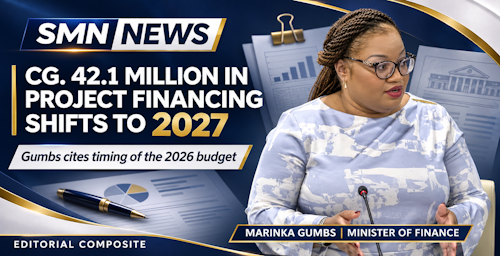
marinkashift09112026PHILIPSBURG:---  Finance Minister Marinka Gumbs told Parliament on Monday, November 9, that Cg. 42,111,184 in borrowing planned for 2026 capital projects had been shifted to 2027. She attributed the move to the timing of the approved 2026 budget and said that even after a loan is approved, it can take months for the money to become available.

MP Viren Kotai pressed Gumbs on why the 2026 loan did not receive favorable advice from the Board of Financial Supervision (Cft), whether the absence of a multi-year investment plan played a role, and how much the delay could add to project costs.

Gumbs disputed the premise that the missing investment plan explained the lack of favorable advice. She said previous loans had proceeded without such a plan and that budgets and loan requests are assessed by year. In her account, the Cft’s Article 11 advice called for adjustments to the loan request where needed. She said she had seen no indication at that stage that the loan would fail to go through and therefore had seen no need to issue a warning.

Projects await financing before tenders can go out

Gumbs said the 2027 budget includes about Cg. 98 million in planned investment. Execution depends on the budget and financing. For the new projects discussed in Parliament, she said no tenders had gone out, no contracts had been awarded, and no payments had been made. The government would move to tender once it had a favorable assessment and certainty about financing, she said.

The minister acknowledged that postponing projects can increase their costs. She gave Parliament no estimate of the additional expense. She also said she expected no impact on projected 2027 revenue from the delay because the projects were not expected to generate revenue and had not been included in the International Monetary Fund’s projections.

Some work has separate funding. Gumbs said Cg. 3.5 million from existing resources was earmarked for part of VROMI’s Cg. 9 million capital program. She also said funding had been secured and received for the tax administration system and the government’s enterprise resource planning system, both of which were already underway. The proposed Tax Administration building is a separate project that depends on borrowing in 2027. Preparatory work includes identifying suitable premises.

Government aims to answer five Cft concerns by month’s end

Gumbs said the government aimed to update the Cft and Parliament by the end of November on five issues. They include the financial position of the healthcare funds, risks at TelEm and Postal Services Sint Maarten, and the government’s liquidity and revised revenue estimates. The update is also expected to cover the multi-year investment agenda and the status of the collective sector, which bears on the assessment of the country’s interest burden.

On the proposed National Development Bank, Gumbs told Parliament it would receive the multi-year investment plan before any decision to establish the bank. She said the National Recovery Program Bureau was studying financing options for small businesses. A separate infrastructure fund spanning Justice, TEATT and VROMI remained at a preliminary stage, with no borrowing amount or cost presented.

The next documents will show how much of the delayed work can realistically go ahead in 2027. The investment plan is expected to give Parliament more detail on how projects will be financed and carried out. Monday’s answers set the amount of borrowing being moved into the next budget year, while the cost of the delay and the tender dates remained open.
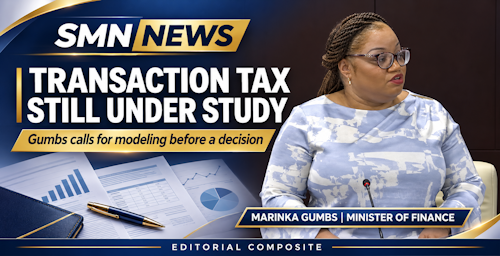

Visitor Tax Could Net Cg. 26 million a Year as Transaction Tax remains under study.

Gumbs targets early 2027 for the visitor levy to reach Parliament and says the government must first model who would pay under a financial transaction tax.

marinkatransactiontax09112026PHILIPSBURG:---  A proposed visitor tax could bring in about Cg. 26 million in a full year after implementation and operating costs, Finance Minister Marinka Gumbs told Parliament on Monday, November 9. The figure is preliminary, and the timing of the first collections depends on legislative approval and whether the government has its payment systems ready.

Gumbs said the estimate draws on passenger data that includes residents, connecting passengers and people who could qualify for exemptions. The eventual rules on who pays will affect how much the levy brings in. The government excluded the projected proceeds from its draft 2027 budget.

When could the first guilder come in?

Responding to MP Veronica Jansen-Webster, Gumbs said the proposal was in final internal legal review. The government was targeting November for the Cabinet and Council of Advice stages, with submission to Parliament targeted for the first quarter of 2027.

Gumbs said the goal was to begin collecting the levy one to two months after the law takes effect. That schedule depends on the legislative process and on getting the hardware, software and payment arrangements in place. The government would also need to inform travelers and others affected by the new levy.

MP Sjamira Roseburg raised the possibility of using a temporary room-tax measure or increasing the existing rate. Gumbs said Finance was prioritizing the visitor levy while TEATT’s draft room-tax amendment underwent legal review. The scope and rates of that amendment remain undecided. Gumbs made no commitment to set aside the proceeds for GEBE relief or social assistance and said spending would require approval through the budget process.

Why Cg. 11.8 billion in payments tells only part of the story

A separate proposal to tax financial transactions drew questions from MP Viren Kotai. Gumbs cited a TEATT figure of about Cg. 11.8 billion in payment transactions in 2022, but said the volume alone could not establish what a tax would yield. The same money can move more than once, and the total can include payroll and transfers between related accounts. How the law treats those payments would determine how much activity is taxable.

Gumbs said the government also has to examine whether a charge could accumulate as money moves through multiple transactions, whether businesses would pass the cost on to consumers, and whether some payments would move outside the formal banking system. Finance and TEATT are developing scenarios for the Central Bank of Curaçao and Sint Maarten to analyze. The government has not decided to introduce the tax and has budgeted no revenue from it.

MP Raeyhon Peterson also raised a proposal for a 4.5 percent capital gains tax involving notaries. Gumbs said that specific proposal had yet to be assessed. A concept involving nonresidents remains under consideration, though she said limited administrative capacity puts it lower on the government’s priority list.

For the visitor levy, the next milestone is a bill reaching Parliament. For the transaction tax, the next step is to establish which payments could be taxed, how much the measure could raise, and who would ultimately bear the cost.

Sint Maarten takes climate financing concerns to COP31 in Antalya.

Youth delegate Riddhi Samtani will discuss how islands can put climate data to work as a new study identifies five ways overseas territories could finance projects.

copi09112026PHILIPSBURG:--- Sint Maarten will bring its climate adaptation priorities to COP31 in Antalya, Türkiye, where youth delegate Riddhi Samtani is scheduled to speak about turning climate data into action. The island completed its first national climate adaptation report in 2026, setting out the risks it faces and priorities for protecting communities and the economy.

According to the EU-funded Green Overseas Programme, the report highlights Sint Maarten’s remaining 22.7 hectares of mangroves and the value of its coastal ecosystems, which provide services valued at more than US$76 million annually. The program estimates that about 80 percent of the economy depends on tourism, making coastal protection an economic priority as well as an environmental one.

Samtani is scheduled to speak at the Benelux Pavilion on November 13. She will also join Najannguaq Berthelsen of Greenland and Ilona Mayerau-Lonné of New Caledonia at the Climate Mobility Pavilion on November 16 to discuss climate vulnerability, biodiversity and gaps in funding for adaptation and disaster risk reduction. Mayerau-Lonné is also scheduled to speak at the France Pavilion on November 13 about how climate policy, jobs and investment can support one another.

Five ways territories could finance climate projects

The Green Overseas Programme, implemented by Expertise France, commissioned ODI Global to assess 18 financing mechanisms. The study identified five with potential for overseas territories. The program presented its findings at a four-day closing forum in Paris before taking them to COP31.

The program says many major international climate funds are structured around sovereign states. Overseas territories participate in the Paris Agreement through the countries to which they are constitutionally linked, and those countries’ income levels can affect access to financing even when a territory has substantial adaptation needs.

  • Green and blue bonds. Caribbean Utilities Company in the Cayman Islands raised US$50 million in 2024 for renewable energy, energy efficiency and climate adaptation projects.
  • Carbon markets. The study points to roughly 4,500 square kilometers of peatland in the Falkland Islands and extensive seagrass beds in New Caledonia and the Turks and Caicos Islands as opportunities to explore whether carbon finance could support conservation and coastal protection.
  • Conservation trust funds. Ascension Island established its AIMPACT fund with a £2 million endowment. In the British Virgin Islands, 40 percent of a US$10-per-passenger tourism levy goes to a trust fund supporting climate resilience and renewable energy. Niue’s program lets donors contribute NZ$250 to protect one square kilometer of ocean for 20 years.
  • Blended finance. Combining public, concessional and philanthropic funding can reduce risk for private investors. In the Caribbean, an EU-backed initiative is using this approach to support start-ups making commercial products from sargassum.
  • Environmental levies. Aruba collects a US$20 visitor contribution that provides a local revenue stream for climate infrastructure and conservation.

The study found that viable options depend on local laws, the capacity of institutions and financial markets, and the size of individual projects. Smaller investments can be especially difficult to finance when legal and technical work absorbs a large share of project costs.

“The funding exists. The challenge is to match OCTs with the right funding opportunities and build their capacity to turn priority projects into fundable proposals,” said Nicolas Andrade, the program’s project manager.

From adaptation plans to projects that can attract funding

Over six years, the Green Overseas Programme supported 31 projects in 23 territories. The work covered water security, coastal management, local food production, building efficiency, electric mobility and renewable energy, alongside training and policy studies.

In the Falkland Islands, where water demand in Stanley is projected to rise by 35 to 40 percent by 2050, the program helped assess the costs of developing groundwater supplies, building a river intake or installing desalination. On Ascension Island, a study identified about £87,000 in proposed investments that could raise local vegetable self-sufficiency to 65 percent. Those investments are awaiting funding.

In French Polynesia, researchers used public meetings and interviews to inform a study of future shoreline changes across six Tuamotu atolls and Pointe Vénus in Tahiti. In New Caledonia, the program helped develop a vehicle emissions label that lets buyers compare cars imported from markets with different rating systems. It also helped Greenland develop the evidence for its first climate strategy, including different approaches for towns connected to hydropower and settlements that depend on diesel.

At the Paris forum, the United Kingdom presented a separate £20.5 million pilot expected to begin in 2027. The three-year initiative is intended to help UK Overseas Territories develop climate projects that can attract investment. The EU has also proposed more than €999 million for its Overseas Countries and Territories under its 2028–2034 programming, with half earmarked for Greenland.

In Antalya, the program and its partners are scheduled to take part in sessions on climate finance, energy cooperation, youth-led climate action and the use of climate data in island planning. For Sint Maarten, the national adaptation report provides a local starting point for those discussions by identifying what needs protection and what the island stands to lose if its coastal ecosystems continue to decline.

Police investigate kidnapping of two men on Richmond Drive in Cole Bay.

kidnapping09112026COLE BAY:---  The Police Force of Sint Maarten (KPSM) is investigating the reported kidnapping of two men on Richmond Drive in Cole Bay on Monday, November 9, 2026.

Shortly after 2 p.m., Central Police Dispatch received several calls reporting that four men dressed in dark clothing and carrying what appeared to be long firearms had forcibly abducted two men. Callers said the suspects forced the men into vehicles and drove away in an unknown direction.

Several police patrols, detectives, and forensic personnel were immediately dispatched to Richmond Drive. At the scene, detectives took statements from several people who reportedly witnessed the abduction. Police also searched the surrounding area for the two victims and the suspects.

KPSM said the investigation remains ongoing and that officers are making every effort to establish the circumstances of the kidnapping and locate the two victims. Police said they will release further information as the investigation progresses.

Anyone who witnessed the incident or has information about the victims' whereabouts or the suspects is urged to contact police immediately.

  • Emergency — 911
  • Police station — +1 (721) 542-2222
  • Anonymous tip line — 9300

KPSM warned the public against approaching anyone believed to be involved because they may be armed and dangerous.

2027 budget under scrutiny as MPs press Gumbs for loan and tax reform timelines.

Sarah Wescot-Williams questions why capital projects keep rolling over, Darryl York seeks a date for gasoline relief, and Ardwell Irion asks who is leading the transaction tax review.

budgetreview09112026PHILIPSBURG:--- Members of Parliament pressed Finance Minister Marinka Gumbs on Monday, November 9, to say when the government could realistically secure its 2027 capital loan, which projects would be ready to start once financing was in place, and how its review of a financial transaction tax fits into the broader tax reform agenda.

The follow-up questions came after Gumbs outlined how Finance assesses capital projects and said the tax administration was still in the stabilization phase, with some work already underway to modernize the system. MPs Sarah Wescot-Williams, Darryl York and Ardwell Irion asked for details on how that work would translate into projects, legislation and relief that residents and businesses could count on.

Wescot-Williams questions why projects keep rolling over

Wescot-Williams said the government’s difficulty carrying out capital projects had persisted for years. She pointed to the timing of the 2026 budget, saying projects approved in October could hardly be expected to start and be completed before the end of the same year.

“Just moving the projects from year to year and just putting an amount in the budget and then looking for approval of the amount, I don’t think that we’re getting anything out of budgeting for capital projects the way we do it,” she told Parliament.

She asked whether the six financial considerations Gumbs had outlined were already being applied and how the government determines whether a project is ready to begin once money becomes available. Gumbs had explained that each ministry submits and justifies its own capital requests, while Finance evaluates whether the country can afford them. That assessment can include borrowing limits and liquidity, the reliability of cost estimates, how future maintenance will be paid for, procurement and implementation risks, and whether the project offers value for money.

Wescot-Williams also asked whether the government’s tax reform vision had been put in writing and sent to Parliament as a single document. She sought an update on how grants and loans provided to small businesses through the National Recovery Program Bureau’s enterprise support program were treated for tax purposes. She asked whether the issue had been resolved for businesses that had to register and file to qualify for support, and what options remained if it was still outstanding.

York presses for a 2027 loan timetable and a date for gasoline relief

York picked up the capital financing question, focusing on the 2027 borrowing request. He said the minister’s answers suggested work on several matters raised by the Board of Financial Supervision (Cft) was still incomplete. He asked when the government expected to finish that work and be in a position to submit its request.

York also asked what the Cft expects to see on new revenue and cost savings. He wanted to know whether the government must have specific measures worked out before submitting its request, whether a timetable would suffice, and whether those measures could require an amendment to the 2027 budget. Gumbs identified May, August and November as the periods when budget amendments could be made during the fiscal year.

York then challenged the timeline reported for gasoline price relief. He said he had heard Gumbs outline the steps taken so far but had heard no date on the floor of Parliament. After seeing a media report that referred to relief within three months, he asked whether the ministry had communicated that timeline separately and urged the minister to tell Parliament when motorists could expect relief. Irion followed up by asking whether the measure would be paid from a surplus, saying he had seen no allocation for it in the budget.

York also asked whether the government had assessed how changes to the room tax could affect boutique hotels and other small accommodations. He argued that smaller operators could be hit harder and asked what analysis the ministry had done.

Irion asks who is leading the transaction tax review

York and Irion both questioned whether Finance and the Ministry of Tourism, Economic Affairs, Transport and Telecommunication (TEATT) had enough staff to study a financial transaction tax while continuing work on the existing reform package. York asked whether the joint working group was already operating and whether the study could delay reforms already underway.

Irion raised a sequencing question. If TEATT sees a transaction tax as a way to reduce or replace other taxes, he asked whether Finance should first see the results of that research before proceeding with measures that could be affected. He also asked which ministry would lead the research and decide where it ranks among the government’s priorities.

Gumbs had told Parliament that the transaction tax remained under review and was behind existing legislative priorities. She said Finance was working to improve compliance and collect revenue already due under the law while preparing broader changes. For 2027, she listed improvements to the taxpayer register, a business taxpayer portal, better payment processing, filing relief for qualifying AOV pensioners, stronger reporting and a program to establish a baseline for tax compliance. She said an implementation date for broader changes to wage and profit taxes would follow the necessary assessments and policy decisions.

Irion also asked whether proposed procurement legislation discussed by MP Raeyhon Peterson had reached Parliament and what feedback it had received. Separately, he asked whether the government’s reporting obligations extend to donations, services and other in-kind contributions received through public-private partnerships.

The chair called a five-minute recess after the follow-up questions. At that point in the proceedings, Parliament was still waiting for answers on when the loan request could be submitted, which ministry would lead the transaction tax review, and when motorists could expect gasoline price relief.


Subcategories