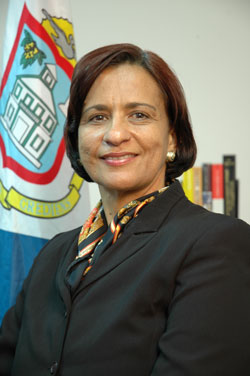
 PHILIPSBURG:--- Member of Parliament Sarah A. Wescot-Williams has formally submitted questions to the Minister of Public Housing, Spatial Planning, Environment and Infrastructure (VROMI), seeking clarity on how the recently launched St. Martin Climate Impact Atlas will be practically integrated into national planning, climate resilience, and funding strategies.
While welcoming the public availability of the Atlas, MP Wescot-Williams emphasized that its true value lies not in its launch, but in its active and systematic use across government decision-making.
“The Climate Impact Atlas is a powerful evidence-based tool. The critical question now is whether it will meaningfully guide spatial planning, infrastructure development, disaster risk reduction, and climate adaptation, or whether it risks remaining a purely technical exercise,” Wescot-Williams stated.
In her correspondence, the MP requested specific information from the Minister regarding:
- How the Atlas is being incorporated into VROMI’s planning, zoning, and permitting processes;
- Its role in shaping a national or sector-specific climate adaptation strategy for Sint Maarten.
- Capacity-building and outreach initiatives to ensure that government departments, public entities, and communities can effectively interpret and apply the data;
- Planned follow-up actions such as inter-ministerial coordination, workshops, regular updates, and alignment with ongoing or future projects.
The MP also raised the issue of climate financing, noting that the Atlas consolidates topic-specific risk data in a way that is well-suited to targeted and thematic funding mechanisms.
“Sint Maarten continues to face climate risks related to coastal erosion, flooding, heat stress, water security, and infrastructure resilience. The Atlas presents an opportunity to structure climate financing around real, documented vulnerabilities, but only if it is actively leveraged as a funding foundation,” she noted.
MP Wescot-Williams further asked whether the Ministry has already initiated discussions with potential funding partners, including Kingdom partners, the European Union, or international climate finance mechanisms, to use the Atlas as an evidence base for accessing climate adaptation and resilience funding.
She also underscored the importance of coordination across ministries and public entities to ensure that any funding pursued translates into measurable, on-the-ground resilience outcomes, rather than remaining at the level of reports and data platforms.
“Evidence must lead to action. The people of Sint Maarten deserve climate policy that moves beyond studies and launches into implementation,” Wescot-Williams concluded.
The questions were formally submitted via Parliament and forwarded to the Minister of VROMI for response .