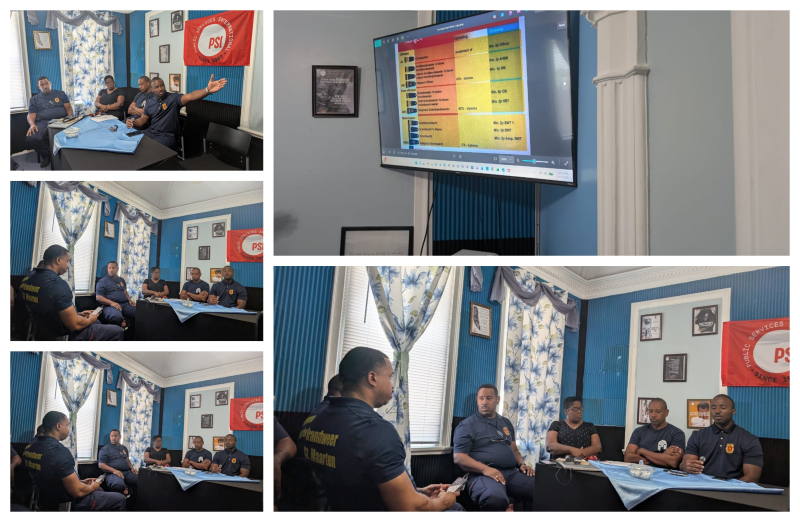
 PHILIPSBURG:--- In a raw, emotionally charged press conference, the men and women risking their lives for Sint Maarten issued a blistering indictment of government neglect, making it crystal clear: patience has burned out. The firefighters’ stance is unequivocal: without a signed agreement or commitment addressing their decades-long grievances, the slowdown will not end. Sint Maarten’s annual Carnival festivities, building permits, and other public services all hang in the balance.
For years, Sint Maarten’s firefighters have fought on two fronts: battling flames and rescuing lives, while quietly enduring administrative paralysis, stagnated promotions, and wages stuck at or near rock-bottom. Despite constant political lip service calling them “heroes,” they remain paid and positioned like expendable rookies.
“We Are Not Doormats”
Jamal Hodge, a veteran firefighter with 18 years of service, spoke not only for himself but also for scores of his colleagues frozen in time—trapped at lowly ranks, performing at the level of senior officers for years on end, their efforts unrecognized and uncompensated.
“We work in that position faithfully, but of course, we, the firefighters, believe what's due to us; that's what we want,” Hodge said. He explained that, by the official promotion schema, he should have risen at least two grades higher by now—but instead, he’s been left languishing as a “2 striper” since 2019.
The financial reality is equally stark: new recruits risk their lives daily for a starting monthly salary of just 1,800 guilders, shockingly close to Sint Maarten’s minimum wage. Firefighters spoke of investing years into mandatory education, training, and additional certifications, only to see no upward movement or fair compensation.
Tears of Frustration and Broken Promises
The brutal toll of government inertia was plain when Niesha Paul spoke up. A firefighter for six years, Paul’s voice broke as she outlined the indignity of wearing the “black epaulette”—the rookie signifier—year after year. “We've been here for six years, and still up to today... We're making the salary of a no-striper. It's not far from minimum wage.”
Her testimony served as a pointed reminder: career and dignity are on hold, as is the hope of passing on pride in public service to the next generation. “What message are you sending to my children?” she asked, referencing family members with deep ties to police and public service on Sint Maarten—traits now met with discouragement and disregard.
Permits, Mediation, and Ministers on the Line
Since the go-slow began on April 8, 2025—and escalated after Carnival-related disrespect from the Sint Maarten Carnival Development Foundation—firefighters have ceased providing mandatory safety advice for all building and operational permits, freezing business development and event planning across the island. As pressure mounts, union representatives report constant calls from ministers seeking to have permits processed quietly. The firefighters’ answer: address our concerns in the Council of Ministers, not via back channels or attempts to sidestep union processes.
At the heart of their protest are demands for overdue promotions, retroactive pay for years spent in higher positions without recognition, and a fair, updated function book that reflects their roles and sacrifices. All progress, they insist, hinges on a clear, written government commitment—and until such a signature is delivered, nothing moves.
A Symbol of Disrespect: Mark A. Polo
At the center of the firefighters' fury stands a figure they derisively refer to as "Mark A. Polo"—a government policy advisor who has become the personification of administrative obstruction in Sint Maarten. The firefighters allege that this advisor wields disproportionate influence over the Prime Minister, effectively holding their livelihoods hostage with a callous disregard for their service. They accuse him of orchestrating the disastrous 2010 changes to the function book that trapped dozens of officers in career limbo and of flatly declaring there would be "no retroactive pay" for years of undercompensated labor. For the men and women on the front lines, his stance is not just bureaucratic prudence but a direct insult to their sacrifice, treating veteran first responders as liabilities on a balance sheet rather than the life-saving assets they are.
Not About Carnival, About Rights and Respect
Union President Sharon Canigieter, representing WICSU/PSU, delivered a blistering rebuke to both government and the local media for trivializing the go-slow as a mere leverage tool for Carnival. She reminded everyone that the protest predates the festival, and that reducing it to party disruptions devalues the years of service, risk, and frustration at the core of the dispute. “They are more important than Carnival. They are more important than Regatta... but because Carnival is this big hoopla... everybody wants to know if Carnival is going to continue.”
She described the culture of waiting for crises to take firefighters seriously, insisting that their value must be recognized year-round, not just when public celebrations are threatened.
United Against Divide and Conquer Tactics
Despite rumors circulating about political ambitions or internal division, firefighters made it clear they remain united. Any suggestion of infighting serves as a distraction from a government content to stall, stall, and stall again—often hiding behind shifting terminology, unratified letters, and multi-year mediation processes that never reach a true conclusion. Sharon Canigieter urged an end to “divide and conquer” tactics, calling for an honest resolution rather than endless negotiation.
Mediation Process Criticism
WICSU/PSU President Sharon Canigieter conveyed a mixture of cautious optimism and profound frustration regarding the official mediation process. While confirming that the process is in its final stages, she condemned the government for its delaying tactics and the "media blitz" of noise and distractions that have undermined the negotiations. Canigieter clarified that a mediator, chosen from a government-suggested list, helped transform their initial "commitment letter" into a formal "agreement letter." However, the government's response has been sluggish, only materializing after significant public pressure. She stressed that if the government is truly committed to a resolution, it must end the political games, silence external noise, and sign an agreement that reflects the firefighters' core demands. For Canigieter, the path forward is simple: honor the mediation process, sign the paper, and bring the go-slow to a definitive end.
Sint Maarten at a Crossroads
The fact that critical public services—permits, safety checks, event approvals—are paralyzed by government inaction underscores the essential role of these first responders. The firefighters are no longer “in the back of the bus”; in their words, “the bus is not going to move unless we move.” A clear warning: unless the administration honors its obligations to promote and compensate those who keep the island safe, the economic, cultural, and reputational impacts will only grow.
The ball is now with the Council of Ministers and the community at large, who must choose between politicians content with platitudes, and the firefighters who show up—rain or shine, disaster after disaster, party or no party. As the go-slow continues, the people of Sint Maarten are urged to stand with their first responders and demand what is long overdue: fair pay, overdue recognition, and the respect every frontline worker deserves.
Click here for the Live Press Conference.