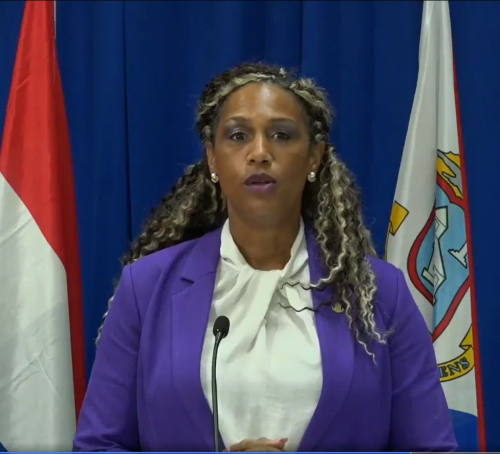
 PHILIPSBURG:--- Minister of Tourism, Economic Affairs, Transport and Telecommunication (TEATT) Grisha Heyliger-Marten announced Wednesday that the government has formally activated legal oversight mechanisms over NV GEBE amid mounting public concerns over electricity costs and fuel clause increases.
Speaking during the Council of Ministers press briefing, Heyliger-Marten detailed the government’s ongoing efforts involving GEBE, the Bureau Telecommunication and Post (BTP), and the electricity tariff regulation.
BTP Officially Designated as Supervisor
According to the minister, the government has now formally designated the Bureau of Telecommunication and Post as the legal supervisory authority under the Electricity Concession Ordinance.
The designation was approved through a ministerial decree signed jointly by the TEATT and VROMI ministries and is currently awaiting publication.
“For the first time, an independent authority will have the legal power to verify GEBE’s numbers, test its assumptions, and hold the company accountable under the law,” Heyliger-Marten stated.
Under Articles 20 and 21 of the ordinance, BTP will now have authority to demand information, conduct inspections, audit operational and financial data, review tariff calculations, assess fuel clause methodologies, and enforce compliance measures.
Government Says GEBE Failed to Provide Key Data
The minister explained that the government initially mandated BTP in January 2025 to conduct an independent review of GEBE’s tariffs with support from the Curaçao regulator RAC.
However, the April 2025 report reportedly identified significant gaps in GEBE’s data, tariff methodology, maintenance planning, and cost transparency.
Heyliger-Marten stated that the fuel clause formula could not be independently validated due to insufficient cooperation from GEBE.
“The requested tariff proposal was not submitted,” she said, adding that GEBE has yet to provide the complete pricing structure requested by the government.
Fuel Clause and Tariff Concerns
Responding to public frustration over rising electricity bills, the minister stressed that the government cannot simply impose new tariffs without legally verified financial data.
“Government cannot invent a tariff, and government cannot guess a tariff,” she stated.
The Electricity Concession Ordinance requires tariffs to remain cost-oriented and based on verified operational expenses and investments.
The minister also warned that improperly setting tariffs could either overcharge consumers or destabilize the country’s only electricity provider.
Enforcement and Legal Consequences
Heyliger-Marten noted that under Article 29 of the ordinance, obstructing the supervisory authority or violating concession terms may result in fines or imprisonment.
“These are real consequences, and they will be enforced if necessary,” she said.
Renewable Energy Compliance
The minister further pointed out that Article 14 of the concession requires GEBE to increase renewable energy production, something the government says has not been adequately addressed.
“With BTP formally designated as supervisor, renewable energy compliance will no longer be optional,” she said.
Government Examining Fuel Relief Measures
On fuel prices generally, the minister confirmed that the government is examining temporary fuel relief measures while also working on a long-term framework to manage future fuel price spikes.
According to Heyliger-Marten, the government is evaluating whether increased turnover tax revenues generated through higher fuel prices can be partially redirected toward temporary excise tax reductions.
“We are pursuing relief in a lawful and financially responsible manner,” she stated.
The minister stressed that, unlike previous governments, the current administration intends to ensure all relief measures comply fully with legal procedures and standards of good governance.