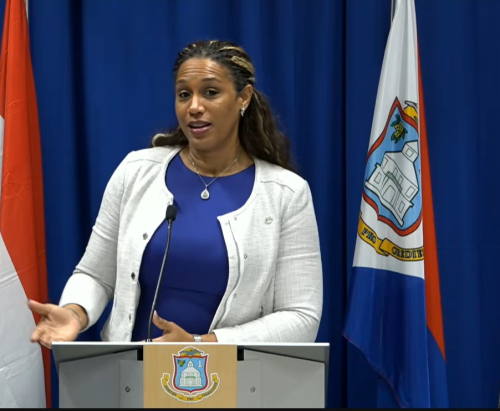
 PHILIPSBURG:--- “Today marks a turning point for St. Maarten’s electricity future.” Minister of Tourism, Economic Affairs, Transport and Telecommunication, Mrs. Grisha Heyliger-Marten, stated as she announced the official publication of the Ministerial Decree designating the Bureau of Telecommunications and Post (BTP) as Supervisor under the Electricity Concession Ordinance. This marks the first time since the Ordinance was established that the legal supervisory mechanism for the electricity sector has been activated.
Minister Heyliger-Marten stated that this step is “not only historic, but essential for restoring order, transparency, and long‑term stability in our electricity system.”
For years, the GEBE operated without the supervision afforded by law. The obligations between the Electricity Concession Ordinance and the Concession, including multi-annual planning, audited financials, quality reporting, maintenance standards, and tariff transparency, were not enforced. The result was predictable: unstable electricity supply, unverified tariffs, rising fuel clause charges, missing data, and a complete breakdown of public trust.
“The country is still recovering from the consequences of years of inaction, shortcuts, and political quick fixes that led to the near total collapse of GEBE,” the Minister said. “There was no proper oversight, and that left the people without protection.”
When this Government took office, the electricity sector was in crisis. Prime Minister Mercelina spent nearly two years stabilizing GEBE, rebuilding its Supervisory Board, and preventing further deterioration of the grid. The process to restore proper executive management is still ongoing.
“People forget how close we came to a total collapse,” the Minister said. “We inherited a GEBE that had no verified data, no audited financials, no approved multi-annual plan, and no functioning oversight. We had to rebuild the foundation before we could fix the roof.”
“When we assumed office in May 2024, the fuel clause was already above 40 cents per kilowatt hour. Yet at that time, those who now shout loudest were not calling it ‘too high.’ This shows the real issue: for years, governments reacted to symptoms instead of fixing the system. We are choosing a different path because leadership is not reflected by shouting; leadership fixes what’s broken. Anyone can demand instant action when they are sitting in opposition. Governing, however, requires understanding the consequences of every decision made.”
The Minister reiterated that under the Electricity Concession Ordinance, the Government cannot legally set electricity tariffs without verified, cost-oriented data from the concession holder. GEBE was given the opportunity to submit a complete tariff proposal as required by its concession itself. They did not. This triggered the need to activate the Supervisor, who now has the legal authority to:
• Request and verify all operational and financial data
• Inspect and audit GEBE
• Monitor compliance with the Concession
• Provide the Government with the verified information required to establish a lawful LBham tariff decree.
“This is the correct pathway,” the Minister said. “It is the only pathway that protects the people, protects the country, and ensures that any tariff decision we make will stand up legally and financially.”
The Minister addressed recent public commentary suggesting that the Government could bypass the Concession Ordinance and set tariffs immediately using the general Tariff Ordinance alone.
“This is simply not true,” the Minister said. “Electricity tariffs are governed by a specific law; the Electricity Concession Ordinance, and that law requires a National Decree containing general measures based on cost orientation regarding the concession holder’s investments and operational business activities concerning generation, distribution and supply of electricity. If Government were to take shortcuts now, the tariff would be unlawful, GEBE could collapse financially and the people would be worse off. I will not repeat the mistakes that caused the electricity crisis.”
She added “St. Maarten cannot afford another collapse. I will not gamble with the country’s economy, electricity system, or the people’s future just to satisfy political pressure or create catchy headlines.”
The Minister acknowledged the frustration many households and businesses feel.
“People want relief, and they deserve relief. But they also deserve a system that works, a system that is fair and a system that will not collapse again in two years. We are not here to repeat the mistakes of the past. We are here to fix them.”
The Minister reminds the public that during the previous administration, the relief that was given was possible only because the country received hundreds of millions in loans from the Netherlands during and after Covid-19. Loans that the people of St. Maarten, as taxpayers are still responsible for today.
“This is not about pointing fingers,” the Minister said. “It is a matter of understanding why we must fix the system structurally. Quick fixes feel good in the moment, but they leave the country weaker. We are choosing the responsible path, the path that protects the people long-term.”
The publication of the Ministerial Decree is the beginning of a new era of regulation in St. Maarten. For the first time, the Government will have structured oversight, enforceable compliance of the concession, transparent tariff methodology and a foundation for long-term energy transition.
“This is how we protect consumers,” the Minister concluded. “This is how we build a future where electricity is reliable, affordable and accountable. This is the beginning of a stronger, more reliable electricity future for every household and every business on our island.”