~At a regional meeting in Montevideo, the Social and Economic Council of Curaçao emphasized the need to connect education, labor policy, and social cohesion~
 Willemstad/Montevideo:--- In a region where artificial intelligence, migration, and inequality are rapidly reshaping the world of work, Curaçao faces a pressing policy question: how to ensure that young people, women, and workers are not left behind.
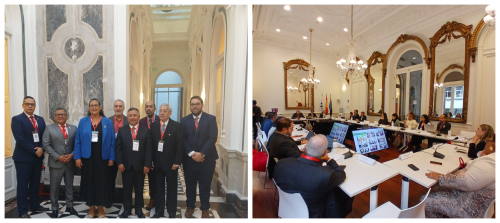
That question was at the center of the participation of the Social and Economic Council of Curaçao, the SER, in an international meeting of economic and social councils and institutions for social dialogue, held from May 19 to 21, 2026, at the Centro de Formación de la Cooperación Española in Montevideo, Uruguay. The SER was represented by Raul Henriquez, director and secretary-general, and Miloushka Sboui-Racamy, senior adviser for international affairs.
The meeting brought together social dialogue institutions from Spain, Guatemala, the Dominican Republic, Honduras, Portugal, Brazil, Peru, Chile, Uruguay, Argentina, Costa Rica, Panama, and Curaçao. Discussions focused on democratic governance, migration, discrimination, inequality, women’s access to opportunity, education, and the social consequences of artificial intelligence.
The meeting was officially opened by Juan Castillo, Uruguay’s minister of labor and social security. His presence underscored a central message of the gathering: social dialogue is not merely a formal consultative mechanism, but a tool for making societies more resilient in a period of rapid social, technological, and economic change.
During the meeting of CESISALC, the regional network of economic and social councils and similar institutions in Latin America and the Caribbean, the SER contributed to two themes directly relevant to Curaçao’s policy agenda: women’s access to development opportunities and the future of education in the age of artificial intelligence.
According to the SER, these issues converge in one central task: building a stronger connection between education, skills, the labor market, and social mobility. Formal equality is necessary, but not sufficient. Real opportunities for women require access to education, work, entrepreneurship, leadership, and decision-making. Education, vocational training, and lifelong learning are therefore not secondary policy concerns; they are conditions for economic independence and meaningful participation in society.
Artificial intelligence, the SER emphasized, should not be treated as a purely technological development. For a small, open, and multilingual economy like Curaçao, AI is above all a policy question. The way schools, employers, workers, and government respond to digital transformation will help determine whether new technologies expand opportunity or deepen existing labor-market divides.
“For Curaçao, the central question is not whether artificial intelligence will change the labor market, but whether our education and labor-market policies will adapt quickly enough to include young people, women, and workers
in that transition,” said Henriquez. “Institutionalized social dialogue is not an administrative formality. It is a necessary instrument for making policy workable, balanced, and broadly supported.”
The urgency for Curaçao is concrete. According to the most recent figures from Curaçao's Central Bureau of Statistics (CBS), the overall unemployment rate fell from 13.1 percent in 2022 to 7.8 percent in 2024. Youth unemployment declined over the same period from 29.8 percent to 16.3 percent. That improvement is significant, but the level of youth unemployment remains a clear warning: the connection between education, vocational training, and the labor market must be strengthened further.
For Curaçao, the debate in Montevideo therefore had direct significance. A country seeking inclusive growth can no longer treat education, digital skills, women’s participation, migration policy, and social protection as separate policy fields. Together, they form the basis for income security, productivity, and social cohesion.
Alongside education, gender equality, and technological transformation, migration and inequality featured prominently on the agenda. For Curaçao, those issues are not abstract. Labor migration, demographic change, and social cohesion directly affect the structure of the labor market, the pressure on public services, and the quality of policymaking. That is why the SER considers active participation in regional networks essential: they allow countries and institutions to exchange knowledge, experience, and policy practices.
On May 21, the SER also attended the opening of a meeting of RICESIS, the Ibero-American network of economic and social councils and similar institutions. Since Curaçao is not an Ibero-American country, the SER’s engagement with this network is framed around observer participation. That position offers an additional route to connect Curaçao with Ibero-American networks for social dialogue, policy knowledge, and institutional cooperation.
According to the SER, international participation is not an end. Its value lies in translating regional insights into better, evidence-based advice for Curaçao. The issues addressed in Montevideo — migration, inequality, women’s opportunities, education, and artificial intelligence — directly affect the future of work, income, and social cohesion on the island.
With its participation, the SER reaffirmed its commitment to connecting Curaçao with regional and global knowledge networks for social dialogue. At a time when social and economic challenges increasingly cross borders, that connection is essential to enrich Curaçao’s policymaking with comparative insights, practical experience and broadly supported solutions.