~Wescot-Williams explains why parliament had no choice but to support the motion against Minister Brug~
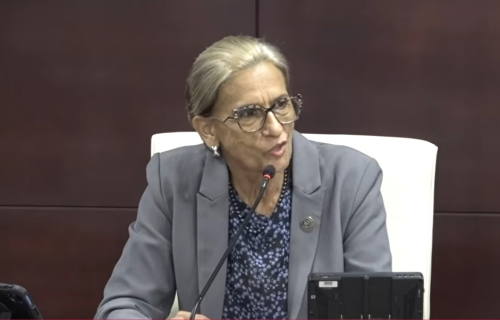 PHILIPSBURG:--- In one of the most emotional moments of Thursday's marathon parliamentary session, Chairlady of Parliament Sarah Wescot-Williams delivered a candid and deeply personal explanation of why she believed Parliament had no alternative but to support the motion of no confidence against Minister of Public Health, Social Development, and Labor Richinel Brug.
Her remarks came after hours of impassioned speeches by Members of Parliament, many of whom argued that Minister Brug's performance did not warrant his removal.
Wescot-Williams did not disagree.
In fact, she openly praised the minister.
But she argued that the issue before Parliament was never about performance.
It was about political reality.
"THIS HAS NOTHING TO DO WITH YOUR PERFORMANCE"
Addressing Brug directly, Wescot-Williams acknowledged his dedication and commitment to public service.
"I respect you for the work that you do," she told the minister.
She described him as one of the most responsive ministers in government and made it clear that the motion was not a reflection of his effectiveness in office.
"This motion has nothing to do with your performance. Absolutely not," she stated.
Instead, Wescot-Williams said the situation stemmed from a breakdown between the minister and the political movement that originally nominated him to government.
THE COALITION DILEMMA
At the heart of her argument was the structure of coalition government.
Wescot-Williams reminded Parliament that the governing coalition comprised four political parties, each of which nominated ministers to serve in the Council of Ministers.
The Unified Resilient St. Martin Movement (URSM) had nominated Minister Brug as one of its representatives.
According to Wescot-Williams, once the party indicated that it could no longer support one of its own ministers, coalition partners were left facing a difficult constitutional and political dilemma.
"What would we say? No, you have to keep him?" she asked.
She argued that coalition politics operates on the basis of confidence and support among partners.
If a coalition partner withdraws support from one of its ministers, maintaining the status quo becomes nearly impossible.
"The odds are against you politically," she told Brug.
GOVERNMENT CANNOT FUNCTION NORMALLY
One of the strongest points made by Wescot-Williams was her insistence that the government could not continue operating normally under the circumstances.
She said that recent events had exposed serious divisions within the Council of Ministers and that it was unrealistic to pretend everything was functioning as it should.
"We are expecting the impossible," she said.
The Chairlady questioned how any minister could effectively function within a Cabinet environment where trust and cooperation had deteriorated so publicly.
She also expressed concern for the civil servants working within the Ministry of VSA, asking how employees could be expected to feel secure amid the ongoing political turmoil.
"I HATE TO BE IN THIS POSITION"
Throughout her speech, Wescot-Williams repeatedly emphasized the personal discomfort she felt with the decision.
"I hate to be in this position," she said more than once.
She revealed that she had spoken privately with Minister Brug and had explained the difficult reality facing coalition leaders.
The veteran parliamentarian noted that she had experienced a motion of no confidence herself during her political career and understood the personal and professional impact such a vote can have.
Drawing from her own experience, she encouraged Brug to remember that political setbacks do not define a person's future.
"You will find your place, Minister," she said.
"You are going to prove your worth."
A POLITICAL, NOT PERSONAL, DECISION
Perhaps the most significant aspect of Wescot-Williams' remarks was her insistence that the motion should not be viewed as a judgment of Brug's abilities.
She characterized the vote as entirely political and constitutional in nature.
The reality, she argued, was that the coalition had reached a point where it could no longer ignore the conflict between the minister and the political faction that nominated him.
"This is the only thing we have to go by," she said, referring to the coalition agreement and the parliamentary system.
For Wescot-Williams, the issue boiled down to a simple but difficult question: when a coalition partner says it can no longer maintain confidence in one of its ministers, what is the alternative?
A VOTE THAT EXPOSED A DIVIDED PARLIAMENT
The Chairlady's remarks stood in sharp contrast to those of several MPs, who argued that Minister Brug had not been given a fair opportunity to answer outstanding questions and that no evidence had been presented to show any failures in governance.
Yet her speech also revealed an important point of agreement.
Even supporters of the motion largely avoided criticizing Brug's actual work as minister.
Instead, they focused on the collapse of political trust within the coalition.
Moments later, Parliament voted.
The motion passed by the narrowest of margins—eight votes in favor and seven against.
Minister Richinel Brug lost his post.
But as Wescot-Williams made clear, the vote was not about whether he could perform the job.
It was about whether the coalition could continue to function while one of its own parties publicly rejected the minister it had placed in office.
That question, she concluded, left Parliament with a decision many members did not want to make—but felt they could no longer avoid.