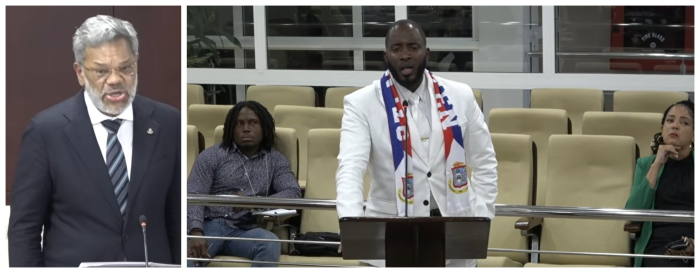
 PHILIPSBURG:--- With a public march scheduled for Monday and growing frustration over electricity bills and fuel clause charges, Parliament on Friday heard a recurring message from Prime Minister Dr. Luc Mercelina: relief for consumers remains under review, but government cannot simply order GEBE to lower rates or eliminate charges.
The explanation came during the continuation of a parliamentary meeting originally requested in 2025, where Members of Parliament repeatedly pressed the government for answers on relief measures promised to consumers struggling with rising utility costs.
The timing of the discussion is significant.
Public dissatisfaction with electricity costs has intensified in recent months, culminating in the formation of Consumer Protection St. Maarten (ACP-SXM), a movement calling for greater transparency, lower electricity costs, and action on the fuel clause, which many residents believe has become an unsustainable burden on households and businesses.
The organization has announced a public march for Monday.
The Question Consumers Keep Asking
Throughout the parliamentary debate, one question repeatedly surfaced: When will relief arrive?
MP Lyndon Lewis voiced what many residents have been saying publicly.
"The people want to know when they are going to get relief," Lewis stated during an interruption, arguing that consumers are tired of studies, reports, and explanations while their utility bills continue to rise.
Mercelina responded that relief remains a government objective but argued that the issue is far more complicated than simply removing the fuel clause or reducing tariffs.
According to the Prime Minister, relief can take different forms, including tariff restructuring, improved efficiency within GEBE, greater pricing transparency, and long-term measures designed to stabilize costs. However, he said any relief package must also protect the utility company's financial sustainability.
Why Government Says It Cannot Simply Order Relief
One of the strongest themes throughout the Prime Minister's presentation was the limitations imposed by corporate governance rules.
Mercelina repeatedly stated that government, as shareholder, cannot issue directives to GEBE management or the Supervisory Board. Instead, government can only provide recommendations and policy guidance.
He revealed that recommendations flowing from the BTP-RAC tariff review were shared with previous management, but according to government, those recommendations were never implemented.
The Prime Minister argued that many residents incorrectly assume government can simply instruct GEBE to lower costs.
"The shareholder cannot submit operational instructions," he told Parliament while explaining the separation between government, the Supervisory Board and management.
Fuel Clause Remains Flashpoint
One of the most controversial issues remains the fuel clause.
Many consumers have called for its removal, arguing that the surcharge has become one of the biggest drivers behind soaring electricity bills.
Mercelina, however, warned that eliminating the fuel clause entirely is not financially feasible.
According to government, the fuel clause exists to pass actual fuel costs directly to consumers. Removing it would not eliminate those costs but would instead create a multimillion-guilder funding gap that GEBE would be forced to absorb. Such a move, government argues, could threaten the company's ability to purchase fuel and maintain electricity production.
The Prime Minister further stated that addressing fuel costs in isolation would not solve the underlying problem because fuel charges are interconnected with the broader tariff structure, base rates and operational costs.
Questions About Fuel Pricing Persist
Government also acknowledged concerns surrounding fuel procurement.
Mercelina disclosed that negotiations between GEBE and Sol over a new fuel contract broke down because GEBE sought greater transparency regarding various charges included in fuel pricing. According to the Prime Minister, requests for additional documentation and justification of several pass-through costs were unsuccessful.
He further noted that Sol's position in the local market creates significant barriers for alternative suppliers, contributing to concerns about competition and pricing.
Relief Still Being Studied
While consumers are demanding immediate action, the government maintains that any relief package must be based on technical and financial analysis.
Mercelina confirmed that both the Minister of Finance and the Minister of TEATT are currently reviewing options to reduce the burden on consumers. However, no timeline was provided for when such measures could be implemented.
The Prime Minister also indicated that removing Turnover Tax (TOT) from fuel prices would require legislative amendments and cannot be achieved through a simple ministerial decision.
A New Phase at GEBE
Friday's debate also unfolded against the backdrop of major changes at the utility company.
Many of the questions posed to the Prime Minister originated nearly a year ago and reflected circumstances that existed under previous management and governance structures.
Since then, GEBE has seen significant changes, including the resignation of the two temporary managers whose final day was Friday and the appointment of a new temporary manager. A new Supervisory Board has also been installed, with additional appointments still expected.
Consumers Taking Their Concerns to the Streets
Despite the government's explanations, public frustration appears far from over.
The planned Monday march organized by Consumer Protection St. Maarten (ACP-SXM) reflects a growing sentiment among residents that discussions, reports and studies have not translated into meaningful reductions in their monthly electricity bills.
For many households, the debate is no longer about governance structures or corporate authority. It is about affordability.
And as Parliament continues its deliberations, consumers are preparing to take that message directly to the streets.