~Minister's decision reveals UN agency was asked to independently review prison sentence calculations, raising questions about the scope of its mandate. ~
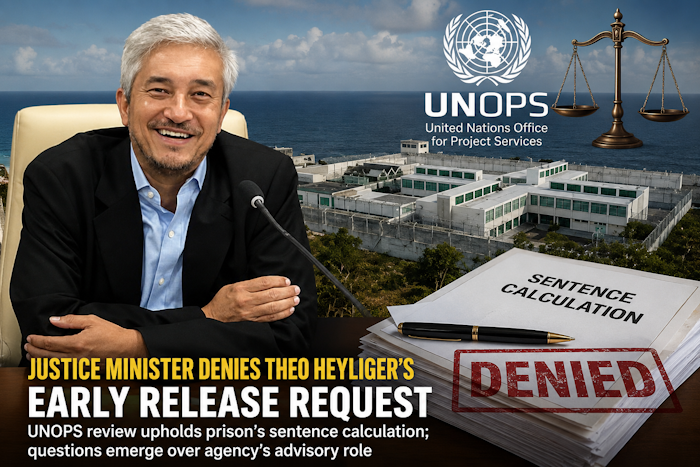 PHILIPSBURG — Justice Minister Nathalie Tackling's decision denying former Member of Parliament Theodore "Theo" Heyliger's request for early release has raised questions that extend well beyond one prisoner's application. At the center of the issue is the role played by the United Nations Office for Project Services (UNOPS) in advising the Ministry of Justice on the execution of a criminal sentence.
In her decision, Minister Tackling states that after Heyliger's attorney challenged the prison's calculation of the sentence, the Ministry requested UNOPS to conduct an independent technical assessment of the prison's calculations. According to the Minister, UNOPS was asked to review both the prison's calculation and the alternative calculation submitted by the defense before she reached her decision.
The Minister subsequently relied on that assessment in concluding that the prison had correctly calculated Heyliger's sentence and that there was no legal basis to grant either electronic monitoring or the requested early release.
The UNOPS review concluded that Heyliger's adjusted sentence expires on 18 September 2028 and that he becomes eligible for ordinary conditional release on 27 January 2027, while identifying only minor clerical errors that did not affect the legal outcome.
Beyond Construction
The Minister's decision now raises an important constitutional and governance question.
UNOPS was engaged by the Government of Sint Maarten to design, procure and manage the construction of the new Pointe Blanche Prison while ensuring compliance with international correctional and human-rights standards.
Its publicly stated mandate concerns infrastructure, procurement, construction management and project implementation.
Yet, according to the Minister's own decision, UNOPS was asked to determine whether the prison had correctly applied Sint Maarten's Criminal Code when calculating a prison sentence.
The review did not simply verify arithmetic.
UNOPS examined competing sentence calculations, determined which methodology complied with Sint Maarten law, rejected the defense’s calculation, confirmed the prison's interpretation of the statutory provisions governing conditional release, and made recommendations concerning how future sentence calculations should be presented.
Where does the mandate end?
That raises a legitimate public question.
If UNOPS was contracted to build and deliver a modern correctional facility, on what legal basis was it asked to advise the Minister on the execution of a criminal sentence?
Neither the publicly available Host Country Agreement nor the project descriptions publicly assign UNOPS responsibility for interpreting criminal legislation, reviewing inmate sentence calculations, advising on conditional release or making recommendations concerning the execution of sentences.
Those responsibilities traditionally belong to prison authorities, government legal advisers, prosecutors and, where necessary, the courts.
Questions That Deserve Answers
The Minister's decision now gives rise to several important questions:
- What legal authority empowered UNOPS to conduct an independent review of an inmate's sentence calculation?
- Was UNOPS retained solely to verify arithmetic, or was it also asked to interpret Sint Maarten's Criminal Code?
- Has UNOPS provided similar advice in other inmate cases?
- Will UNOPS now become the Ministry's independent adviser whenever sentence calculations are challenged?
- If UNOPS is advising on sentence execution, has its role expanded beyond project implementation into justice policy?
An issue larger than one prisoner
Whether Theodore Heyliger should have been granted early release is ultimately a matter decided by the Minister under Sint Maarten law.
The broader issue is institutional accountability.
The Minister's own decision confirms that UNOPS was invited into a process involving the legal execution of a criminal sentence and that its findings formed part of the basis for rejecting the application.
The public is therefore entitled to know whether this falls within UNOPS' contractual mandate—or whether an international agency engaged to build a prison has now assumed an advisory role in the administration of Sint Maarten's criminal justice system.