~Years of reports from the Ombudsman, Law Enforcement Council, CPT and the Kingdom all acknowledge systemic human-rights failures—yet the Minister says those failures do not justify individual relief.~
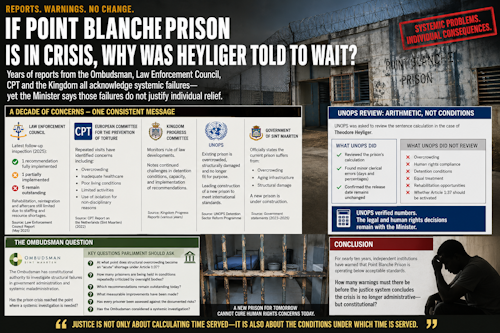 PHILIPSBURG: --- The decision by Justice Minister Nathalie Tackling denying Theodore Heyliger's request for early release may have settled one legal application, but it has opened a much larger constitutional question:
How many official reports must conclude that Pointe Blanche Prison fails to meet acceptable standards before those findings begin to influence individual decisions affecting prisoners?
The Minister's 10-page decision repeatedly acknowledges that Sint Maarten faces structural pressure on detention capacity yet concludes that these circumstances do not create an individual right to early release. The attached UNOPS review limits itself almost entirely to verifying sentence calculations rather than examining whether the prison's documented human-rights deficiencies should have any bearing on continued detention.
However, this case does not exist in isolation.
For nearly a decade, one oversight body after another has warned successive governments that Pointe Blanche Prison suffers from structural deficiencies affecting safety, rehabilitation, human rights and prison management.
The question is no longer whether there is a prison crisis.
The question is whether Government can continue relying on that same prison to oppose requests for relief while simultaneously admitting that the institution itself fails to meet acceptable standards.
One report after another has reached the same conclusion
The Minister's decision treats Heyliger's application as an individual legal matter.
But the prison itself has become the subject of repeated institutional criticism.
The Law Enforcement Council has inspected Pointe Blanche repeatedly since 2016.
Its latest follow-up inspection was conducted eight years after its original recommendations:
- only one recommendation had been fully implemented;
- one was only partially implemented;
- five remained outstanding.
The Council concluded that rehabilitation, reintegration and aftercare continue to suffer because of inadequate staffing and resources, while long-standing structural problems remain unresolved.
That finding did not come from political opponents.
It came from one of Sint Maarten's High Councils of State charged specifically with supervising the justice chain.
Prison has become a recurring human-rights concern
The Law Enforcement Council has gone beyond individual inspections.
In its 2026 State of Law Enforcement, the Council elevated prison conditions to a broader rule-of-law issue, emphasizing that respect for human rights must remain central within the detention system.
The Council has even exercised its extraordinary authority to sound the alarm regarding detention conditions and staff safety inside Pointe Blanche.
That language is significant.
Oversight bodies rarely use their statutory authority to publicly warn Parliament and the Kingdom Government unless they believe systemic intervention has become necessary.
Government itself admits the prison is no longer fit for purpose.
Ironically, the strongest criticism of Pointe Blanche may now come from Government itself.
When construction of the new prison began earlier this year, Government openly stated that the existing facility suffers from:
- overcrowding;
- aging infrastructure;
- structural damage;
- conditions that are no longer fit for purpose.
Those are not allegations made by prisoners.
They are official Government statements.
UNOPS, the international agency now building the replacement prison, similarly describes the existing facility as overcrowded, structurally damaged and no longer suitable for modern correctional standards.
If Government publicly acknowledges that the existing prison is no longer adequate, can it simultaneously argue in court that those same conditions are legally irrelevant when prisoners seek relief?
That contradiction deserves closer examination.
UNOPS reviewed arithmetic—not prison conditions
Perhaps the most overlooked aspect of the Minister's decision is the role played by UNOPS.
The attached briefing note did not examine:
- overcrowding;
- human-rights compliance;
- rehabilitation opportunities;
- detention conditions;
- equal treatment;
- or whether Article 1:37 should be activated.
Instead, UNOPS answered a much narrower question.
It reviewed whether Pointe Blanche Prison correctly calculated Heyliger's sentence.
Its conclusion was straightforward:
the prison's calculation was substantively correct.
It found only minor clerical errors involving day counts and percentages that did not affect the release date.
That means the ultimate legal decision remained entirely with the Minister.
UNOPS verified numbers.
It did not determine whether continued detention inside an institution repeatedly criticized by oversight bodies remains proportionate.
The reports now outnumber the reforms
Looking across the past decade reveals a remarkable pattern.
Nearly every institution responsible for oversight has identified significant shortcomings.
Among them:
- the Law Enforcement Council;
- the European Committee for the Prevention of Torture (CPT);
- the Kingdom Progress Committee;
- UNOPS itself through its justification for constructing a replacement prison;
- Government's own Detention Sector Reform Program.
Each report approaches the problem differently.
Some focus on infrastructure.
Others examine staffing.
Others examine rehabilitation.
Others emphasize human rights.
But they all point toward the same conclusion:
the existing prison system requires fundamental reform.
Where is the Ombudsman?
One institution has remained comparatively quiet in recent public debate.
The Ombudsman.
The Ombudsman has constitutional authority to investigate structural failures in government administration and systemic maladministration. The office also serves as the constitutional guardian against abuses of public administration.
Given the accumulation of findings by the Law Enforcement Council, the CPT, Kingdom institutions and Government itself, an obvious question arises:
Has the prison reached the point where a systemic investigation by the Ombudsman is warranted?
Such an investigation would not focus on one prisoner's application.
Instead, it could examine whether the Government has fulfilled its constitutional obligations toward everyone housed inside Point Blanche.
The constitutional issue is becoming larger than Heyliger
The Minister correctly notes that poor prison conditions do not automatically entitle every prisoner to immediate release.
That principle is well established.
However, another principle is equally important.
Governments cannot indefinitely acknowledge systemic deficiencies without demonstrating that meaningful corrective measures are protecting those still confined.
The Minister points to the future.
The new prison.
The reform program.
The construction now underway.
Those developments are encouraging.
But they do not erase today's conditions.
A new prison scheduled for tomorrow cannot cure human-rights concerns experienced today.
The question Parliament should now ask
This case has moved beyond Theodore Heyliger.
Parliament should now require Government to answer several broader questions:
- At what point does structural overcrowding become an "acute" shortage under Article 1:37 of the Penal Code?
- How many prisoners are currently being held in conditions repeatedly criticized by oversight bodies?
- Which recommendations from the Law Enforcement Council remain outstanding today?
- What measurable improvements have actually occurred since the latest inspection?
- Has every prisoner been assessed against the documented risks identified in those reports?
- Has the Ombudsman considered launching a systemic investigation into detention conditions?
The Minister's decision may have denied one application.
But it has unintentionally highlighted something much larger.
For nearly ten years, independent institutions have consistently warned that Point Blanche Prison is operating below acceptable standards.
If all of those warnings are insufficient to influence how individual cases are assessed, then the public deserves to know:
Exactly what level of institutional failure must exist before the justice system itself concludes that the prison crisis is no longer merely administrative—but constitutional.