~Central Bank says foreign direct investment has weakened while the economy remains heavily dependent on tourism and outside capital.~
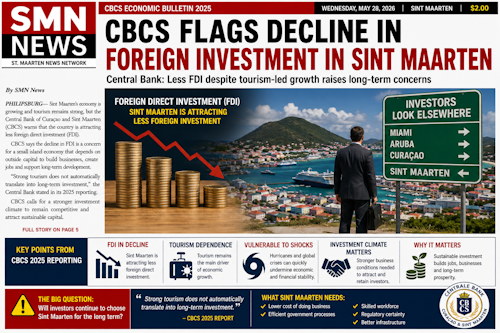 PHILIPSBURG:--- Sint Maarten may be recording economic growth and strong tourism activity, but the Centrale Bank van Curaçao and Sint Maarten (CBCS) has identified a significant weakness beneath those positive numbers: the country has been attracting less foreign direct investment.
The Central Bank highlighted the issue during 2025, noting that foreign direct investment (FDI) into Sint Maarten has declined significantly compared with earlier periods.
The finding is important for a small island economy that depends heavily on external capital to finance hotels, real estate, businesses and other productive investments that cannot always be funded from domestic savings alone.
CBCS examined foreign direct investment developments in Sint Maarten over an extended period and found that the country's performance has weakened.
Foreign direct investment is different from money spent by tourists while visiting Sint Maarten. It generally involves an investor from outside the country acquiring a lasting interest in a local business, establishing an enterprise, reinvesting earnings or providing financing connected to a foreign-owned enterprise.
The distinction is critical because record or increasing visitor arrivals do not automatically translate into increasing long-term foreign investment.
CBCS: Sint Maarten Attracting Less FDI
The Central Bank reported that Sint Maarten has been attracting less foreign investment and examined several factors that could explain the decline.
CBCS pointed to the country's investment climate and the need to strengthen the conditions necessary to attract and retain investment.
The Bank's analysis makes clear that strong tourism activity by itself does not guarantee that Sint Maarten will continue receiving the level of foreign capital necessary to support longer-term economic development.
That creates an important contrast in the country's economic picture.
Sint Maarten's economy is growing; tourism remains its principal economic engine and major reconstruction projects have been completed or are underway. Yet the Central Bank has simultaneously identified declining direct foreign investment as an area requiring attention.
Tourism Still Dominates Economy
CBCS's wider economic reporting continues to show how heavily Sint Maarten depends on tourism.
Stay-over and cruise tourism have remained major contributors to economic growth, while the completion of the reconstruction of Princess Juliana International Airport strengthened the infrastructure supporting the country's principal industry.
Private consumption and investment have also contributed to economic activity.
However, dependence on one dominant sector leaves Sint Maarten particularly exposed to developments outside its control.
The COVID-19 pandemic demonstrated that vulnerability when international travel collapsed. Hurricane Irma had previously demonstrated how a natural disaster could simultaneously damage housing, businesses, tourism infrastructure and Government finances.
CBCS's debt stress analysis has similarly shown that another major hurricane or severe economic downturn could substantially weaken Sint Maarten's financial position.
Where Is Investment Going?
CBCS's foreign-investment findings also make it important to distinguish between different forms of capital entering Sint Maarten.
A foreign buyer purchasing property, a multinational company investing in a Sint Maarten business, a hotel developer financing a new resort and an existing foreign-owned company reinvesting profits are not necessarily reflected in exactly the same manner in economic statistics.
The Central Bank's FDI data are based on balance-of-payments methodology and therefore measure specific financial relationships between foreign investors and enterprises within Sint Maarten.
Consequently, visible construction or real-estate transactions should not automatically be interpreted as proof that overall foreign direct investment is increasing.
Investment Climate Matters
CBCS has repeatedly stressed the importance of structural reforms and improvements to the business environment in Curaçao and Sint Maarten.
For Sint Maarten, attracting sustainable investment involves more than maintaining high visitor numbers.
Investors also consider the cost of doing business, availability of skilled labor, administrative procedures, infrastructure, access to financing, regulatory certainty and the efficiency with which permits and other government processes are handled.
The Central Bank's findings therefore put attention on whether Sint Maarten's economic environment is sufficiently competitive to attract investment that remains in the country and expands productive capacity.
Growth Alone Does Not Tell Entire Story
The FDI findings are particularly important when placed alongside CBCS's other assessments of Sint Maarten.
The economy continued expanding during 2025.
Tourism remained strong.
Inflation moderated.
The current-budget position improved.
Yet CBCS's analysis simultaneously identifies structural vulnerabilities that remain beneath those headline economic indicators.
Public debt remains substantial. The economy remains heavily tourism dependent. Residents face difficulties entering the housing market as property prices rise. And foreign direct investment has weakened compared with previous periods.
Taken together, those findings demonstrate why economic growth alone cannot be used as the only measure of Sint Maarten's economic health.
Small Economy Needs Outside Capital
Sint Maarten's limited domestic market means foreign investment can play an important role in expanding productive capacity, introducing new businesses, creating employment and financing projects that might otherwise be difficult to fund locally.
However, the economic benefit depends on the type and quality of investment attracted.
Investment that creates sustainable businesses, employment and productive assets can have a different long-term effect from short-term capital flows or transactions concentrated primarily in existing assets.
CBCS's warning that Sint Maarten is attracting less foreign investment therefore raises a broader economic-development issue for Government and policymakers.
The question is no longer simply whether tourists continue coming to Sint Maarten.
The more important question is whether investors still view the country as a competitive place in which to commit substantial capital for the long term.
A Warning Beneath Positive Numbers
The Central Bank's findings do not indicate that foreign investment has disappeared from Sint Maarten, nor do they establish that the country's economy is contracting.
They show something more specific: despite economic growth and a strong tourism sector, Sint Maarten has experienced a weakening in foreign direct investment compared with earlier periods.
That distinction is important.
Tourism can generate immediate spending across hotels, restaurants, transportation, retail and entertainment. Long-term investment, however, helps determine what businesses, infrastructure and productive assets will exist years into the future.
Sint Maarten's challenge, according to the economic picture emerging from CBCS's reporting, is therefore not simply maintaining today's tourism growth.
It is ensuring that the country remains sufficiently attractive and competitive for investors willing to finance tomorrow's economy.
For a country dependent on tourism and external capital, declining foreign direct investment is a warning that deserves attention even while the headline economic numbers remain positive.