~Justice Minister says inmate (Theo Heyliger) never reached formal conditional-release stage; insists two-thirds rule applies equally and UNOPS was used only as an independent check.~
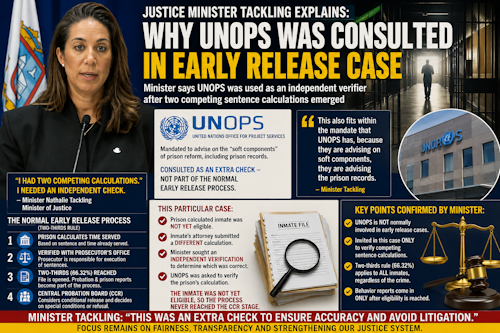 PHILIPSBURG:--- Minister of Justice Nathalie Tackling has publicly explained why the United Nations Office for Project Services (UNOPS) was consulted in a disputed early-release matter, saying she sought an independent verification after the prison and an inmate’s attorney presented competing calculations of when the inmate would become eligible for release.
The explanation came Wednesday during the Council of Ministers press briefing, following several SMN News articles raising questions about early release, detention capacity, the calculation of sentences and UNOPS’ advisory role within the Ministry of Justice.
Tackling declined to discuss the identity or specific circumstances of the inmate but gave her most detailed explanation yet of the process followed in the case.
According to the Minister, the normal process does not involve UNOPS.
When directly asked whether UNOPS ordinarily participates in evaluating whether an inmate qualifies for early release, Tackling answered: “Correct,” confirming that it does not.
However, she said the particular matter was different because the inmate’s attorney submitted a calculation that conflicted with the calculation made by the prison.
Minister: Two competing calculations led by UNOPS review
Tackling said the normal process begins with the prison keeping track of where each inmate stands in his or her sentence.
That calculation is verified with the Prosecutor’s Office, which is responsible for the execution of prison sentences.
According to Tackling, under the normal legal framework, an inmate must serve two-thirds of the prison sentence before the formal conditional-release process begins.
Once the prison determines that the two-thirds point has been reached, a file is initiated. Probation services and prison reports then become part of the process, and the Central Probation Board, referred to during the briefing as the CCR, considers whether special conditions should be attached to the release or whether there is a reason not to release the inmate despite eligibility.
The case that generated the recent controversy, Tackling said, never reached that stage.
“In this particular case, a request was received on behalf of a particular inmate by their attorney,” the Minister explained.
She said the prison calculated that the inmate was not yet eligible for early release.
But the applicant submitted a different calculation.
Faced with the two competing calculations, Tackling said she decided to seek an independent check.
“Given the fact that now I have two competing things, let me find an independent authority to verify whether or not the prison's calculation is correct,” she explained.
Why UNOPS?
This is where Tackling directly addressed the question that has surrounded the case: Why was UNOPS brought into an individual sentence-calculation dispute when it is not normally part of the early-release process?
The Minister said she considered the verification to fall within UNOPS’ existing mandate because the organization advises on the “soft components” of prison reform, including prison records.
She characterized the referral as an “extra check” and an additional precaution intended to establish which calculation was correct and avoid unnecessary litigation.
According to Tackling:
“This also fits within the mandate that UNOPS has, because they are advising on soft components; they are advising the prison records.”
She said the check was performed because there were “two competing calculations.”
The Minister's explanation therefore confirms two important points: UNOPS is not part of the normal early-release procedure, but Tackling deliberately brought the organization into this particular calculation dispute as an independent verifier.
Tackling: Inmate was not yet eligible
Tackling also rejected the suggestion that behavior reports, rehabilitation assessments, or probation reports should already have been considered in the case.
Those assessments, she said, only become relevant after the inmate has first reached the legal eligibility point.
“In this case, the person was not yet eligible for early release, so we don't reach the stages yet of prison reports, probation services, none of that yet comes into the picture,” Tackling said.
The Minister stressed that good or bad behavior does not determine when an inmate becomes legally eligible under the normal two-thirds system.
“The law says you have to sit two-thirds of your sentence, regardless of how you behave,” she said.
Tackling placed the applicable percentage at 66.32%, saying it applies across the prison population regardless of the type of crime committed.
She argued that this removes subjectivity from the process and prevents a Justice Minister from deciding eligibility based on the inmate's identity or the nature of the crime.
“It makes everybody equal in the eyes of the law, regardless of what type of crime you committed,” Tackling said.
Behavior can subsequently affect whether an eligible inmate is actually granted conditional release. Tackling gave the example of an inmate who attacks guards or is violent toward other prisoners potentially being denied release after reaching the two-thirds point.
Earlier release possible only under detention-capacity policy
Tackling also clarified another issue that has featured prominently in the public debate: release before the ordinary two-thirds threshold.
She said the law currently does not allow an inmate simply to be rewarded for good behavior by being released before reaching that point.
The exception, according to Tackling, arises when the country faces a detention-capacity problem.
“But getting out earlier than that two-thirds is not something that the law allows currently, unless it's a detention capacity issue, in which case, then we get into that train policy that everybody talks about,” Tackling said.
Under that capacity mechanism, she said, the threshold could potentially move downward, referring during the briefing to an example of 60%.
However, Tackling said this does not mean an inmate can simply “jump ahead” of others already ahead in the release sequence.
Minister acknowledges 300 years of sentences waiting
The Minister was then confronted with the larger contradiction facing the justice system: approximately 300 years of court-imposed prison sentences remain waiting to be executed, while the system simultaneously considers releasing prisoners early to create detention space.
Tackling said the figure of approximately 300 years remains the number consistently provided to the Ministry by the Prosecutor's Office.
She also referenced recent media exchanges with the Prosecutor's Office over its record-keeping, saying she had seen the questions “going back and forth” and noting that the Prosecutor's Office does not keep certain data in a particular way.
“That's still the number that they are holding on to. It's still around that 300-year mark,” Tackling said.
Asked whether the enormous backlog weakens the deterrent effect of criminal sentences, Tackling acknowledged that it does.
The problem, she said, exists on both sides.
On one end, convicted persons may wonder when they will ever actually be called to prison to serve their sentences.
But Tackling warned that releasing prisoners after serving only 40% or 50% of their sentences would create the opposite problem.
“Then it also takes away the value of a prison sentence,” she said.
Serious Crimes and Long Sentences Limit Available Space
Tackling said another difficulty is that many inmates currently incarcerated are serving sentences for serious crimes.
Their long sentences mean it takes considerable time before they reach the two-thirds threshold, leaving the government with very few inmates who can legally be considered for release at any given moment.
She described situations where the Prosecutor urgently needed detention space, but even reducing the threshold to 60%, 59% or 58% would have produced only two available spaces at Point Blanche Prison.
“We're playing with a very small amount of spaces,” Tackling said.
Tackling: Prosecutor Must Establish Acute Need
The Minister also drew a firm distinction between her powers and those of the Prosecutor's Office.
“As Minister of Justice, I'm not responsible for the execution of sentences. I don't choose who goes to prison, when they go to prison. That is the public prosecutor's prerogative,” Tackling said.
She said Article 137 provides her with the mechanism she referred to as the “train policy,” under which the ordinary two-thirds threshold can temporarily be lowered to create detention capacity.
But Tackling said she cannot independently establish that there is an acute need for prison space.
According to her explanation, the Prosecutor must first indicate that space is urgently required.
“The prosecutor needs to tell me, well, I have this issue on the front. I need to create space right now, today, tomorrow, and then we can temporarily let some people out to create that space,” she said.
Tackling also confirmed that time spent in pretrial detention is included when calculating time served.
Minister’s Response Clarifies — But Also Confirms Exceptional UNOPS Involvement
Wednesday’s explanation provides important clarity to an issue that has generated significant public discussion.
Tackling's position is that the inmate concerned never reached the substantive conditional-release assessment because, based on the prison's calculation, the legal eligibility threshold had not yet been reached. Therefore, behavior reports, probation assessments, and the CCR process did not yet apply.
Her explanation also confirms, however, that UNOPS does not ordinarily participate in determining an inmate's early-release eligibility.
Its involvement occurred because Tackling faced two conflicting sentence calculations and chose the organization as an independent authority to verify the prison's calculation.
The Minister maintains that this additional verification fell within UNOPS' prison-reform advisory mandate and was intended as an extra precaution to avoid unnecessary litigation.
That distinction is now central to the issue: the Minister says UNOPS did not decide whether an inmate should be released; it was asked to verify which sentence calculation was correct.
Whether that exceptional involvement, and UNOPS' precise authority to perform such verification in an individual inmate matter, fully settles the questions raised over the process remains a matter for further scrutiny.
But for the first time, Tackling has now publicly set out why she brought UNOPS into the matter and why, according to her, the normal early-release process never formally began.