~ Cg. 261,211 budgeted for 2026 agriculture activities, as TEATT identifies maintenance, pumps, seedlings, and school-break interruptions as challenges.~
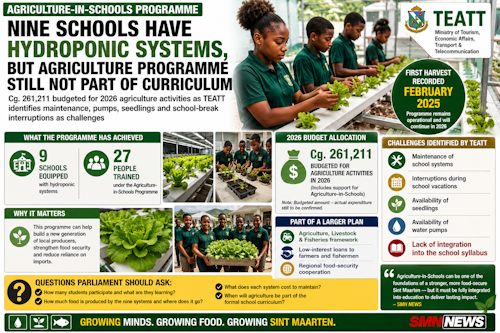 PHILIPSBURG: --- Government has installed hydroponic systems in nine Sint Maarten schools and trained 27 people under its Agriculture-in-Schools program, but TEATT acknowledges that the initiative has still not been integrated into the school curriculum.
The programme is one of the more tangible components of Government's economic-diversification and food-security strategy.
TEATT's parliamentary working document states that the first harvest was recorded in February 2025, while the programme remains operational and is expected to continue during 2026.
Government has budgeted Cg. 261,211 for agriculture activities in 2026, part of which is intended to support Agriculture-in-Schools. The document cautions that this is a budgeted amount and that actual expenditure still has to be confirmed.
The programme is not without difficulties.
TEATT identifies maintenance of the school systems, interruptions during school vacations, availability of seedlings and water pumps, and the lack of integration into the school syllabus as challenges.
That last issue deserves particular attention.
If Government intends Agriculture-in-Schools to help change Sint Maarten's relationship with food production, the programme's long-term value will depend on whether students are learning agriculture as part of their education or whether hydroponic installations simply exist on school properties as individual projects.
The government is also planning a much larger Agriculture, Livestock and Fisheries framework, providing low-interest loans to farmers and fishermen and pursuing regional food-security cooperation.
The school programme could therefore become one of the foundations of a new generation of local producers.
But Parliament should demand measurable educational outcomes: how many students actually participate, how much food the nine systems produce, what happens to the harvests, how much each installation costs to maintain, and when agriculture will be incorporated formally into the curriculum.