~ECYS says AI framework is already in development, but data collection and additional research pushed a mature draft into next year while schools increasingly confront new technology~
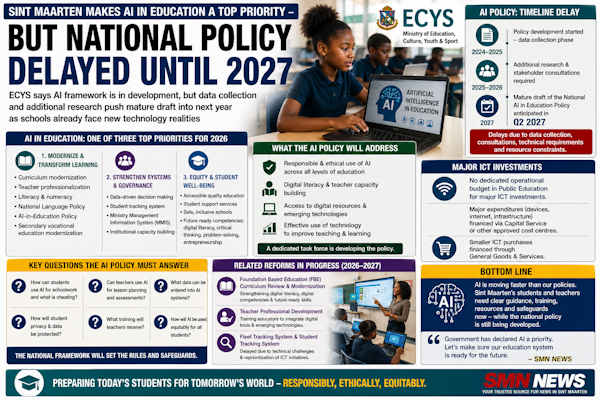 PHILIPSBURG:--- Government has identified artificial intelligence as one of Sint Maarten's major education priorities, but its own responses to Parliament show that the National Artificial Intelligence in Education Policy has suffered delays and is not expected to reach the mature-draft stage until the second quarter of 2027.
The disclosure is contained in the Ministry of Education, Culture, Youth and Sport's responses during scrutiny of the draft 2026 National Budget.
The proposed policy is significant because the Government intends it to establish the national framework governing the responsible and ethical integration of artificial intelligence across all levels of education in Sint Maarten.
ECYS says the policy will identify priorities for digital literacy, teacher capacity, digital resources and the effective use of technology in teaching and learning. A dedicated task force is responsible for developing it.
Yet the policy is not ready.
Policy Delayed
The Ministry identifies the National Artificial Intelligence Education Policy as one of several education programmes that experienced implementation delays and corresponding under-expenditure between 2024 and 2026.
ECYS attributes delays across the affected education initiatives to stakeholder consultations, procurement, legislative development, technical requirements, and shortages of financial and human resources.
For the AI policy specifically, the Division Education Innovation says the project was delayed because it needed additional time to collect the data necessary to support its development.
Government says the project is now in progress.
Elsewhere in its answers, ECYS provides a more precise timeline.
Additional research, stakeholder consultation and policy development remain necessary, with a mature draft anticipated by the second quarter of 2027.
That means Sint Maarten could move through the entire 2026-2027 school year before Government reaches even that stage of the national framework.
Government Calls AI One of Its Top Education Priorities
The delay stands out because ECYS itself places AI policy development among its three principal education priorities for 2026.
The first priority combines curriculum modernization, teacher professionalization, literacy and numeracy interventions, the National Language Policy, development of the AI-in-Education Policy and modernization of secondary vocational education.
Government's broader objective is to develop what it describes as future-ready competencies, including digital literacy, critical thinking, problem-solving and entrepreneurship.
The Ministry therefore clearly considers artificial intelligence more than an optional technology project.
It is being incorporated into the country's broader attempt to prepare students for a changing society and labour market.
What Will the AI Policy Actually Do?
Government's answers provide the first clear indication of the intended scope.
The national policy is supposed to establish the strategic framework for using AI responsibly and ethically throughout education.
It is also expected to address teacher capacity, digital literacy, access to digital resources and the use of emerging technologies to improve teaching and learning.
That creates potentially significant policy questions that will ultimately have to be answered.
How may students use generative AI when completing assignments?
What constitutes cheating when AI is involved?
May teachers use AI to prepare lessons or assess student work?
What student information may be entered into AI systems?
How will children's data and privacy be protected?
What training will teachers receive?
And how will Government ensure that students without adequate devices or internet access are not disadvantaged?
The budget document reviewed by SMN News does not provide answers to those specific questions. They are among the issues a comprehensive ethical and responsible AI framework would logically need to confront.
Curriculum Modernization Running Alongside AI Policy
The AI project is not being developed in isolation.
Government has secured financing through the Temporary Work Organisation (TWO) to review and modernize the Foundation Based Education curriculum.
ECYS says that exercise will consider strengthening digital literacy, digital competencies and other future-ready skills to better prepare students for an increasingly digital society and labour market.
The FBE evaluation and curriculum-modernization programme is itself a multi-year reform extending throughout 2026 and 2027.
Teacher professional development is another part of the strategy.
The Ministry says it continues investing in training educators to integrate digital tools and emerging technologies into classroom instruction.
That is critical because an AI policy written on paper will have little practical value unless teachers understand both the opportunities and risks created by the technology.
No Dedicated Major ICT Budget Within Public Education
One of the more revealing disclosures concerns the technology infrastructure required to support Government's digital ambitions.
The Division of Public Education does not have a dedicated operational budget allocation for major ICT investments.
According to ECYS, major expenditures for classroom technology and internet connectivity are instead financed through the Capital Service or other approved cost centres, while smaller ICT purchases may be funded through General Goods and Services.
That deserves scrutiny as Government simultaneously promotes AI, digital transformation and future-ready education.
Before AI can be integrated equitably into classrooms, schools need reliable internet, suitable devices, trained educators and adequate technical support.
AI Not the Only Education Technology Project Delayed
The AI policy is part of a wider group of delayed technology and education-reform projects.
Government confirms that technical implementation difficulties and reprioritization of ICT initiatives delayed both the Fleet Tracking System and Digital Student Tracking.
The Fleet Tracking System is expected to continue through 2026, after which implementation of Digital Student Tracking is supposed to resume.
ECYS also reports delays with its Ministry Management Information System, or MMIS, because of difficulties identifying candidates for statistician, economist and legal-consultant positions.
Government says no confirmed cost overruns have been identified in these delayed education programmes. Instead, associated allocations have been carried forward according to revised schedules, meaning the financial variances primarily reflect delayed implementation rather than increased overall costs.
Technology Is Moving Faster Than Government Policy
The central challenge facing ECYS is timing.
Government wants responsible and ethical AI integration, improved digital literacy and teachers capable of using emerging technologies effectively.
But the mature draft of the policy designed to govern that transformation is not expected until Q2 2027.
ECYS stresses that the AI policy and several other unfinished programmes should not be considered failures. The Ministry describes them as long-term reforms whose results can only properly be measured after implementation.
That explanation does not eliminate the need for urgency.
Artificial intelligence will not wait for Government's policy-development timetable.
Students and teachers already have access to powerful AI tools capable of generating essays, answering questions, translating languages, producing images, summarizing documents and assisting with research.
The longer the national framework takes, the longer schools may have to confront those questions without the completed national policy Government itself considers necessary.
For Parliament, the issue should therefore not simply be when the document will be finished.
MPs should demand to know what interim guidance is being provided to schools while the policy is developed, how teachers are being trained, how student privacy will be protected, what safeguards will govern AI use, how academic integrity will be addressed and what financial resources will be required to implement the policy once it is finally approved.
Government has already declared artificial intelligence one of the priorities shaping Sint Maarten's educational future.
The challenge now is ensuring that the country's education policy catches up with the technology before the technology reshapes the classroom without it.