~TEATT targets yacht arrivals, vessel registrations and marine services but admits several reforms still cannot be financially quantified ~
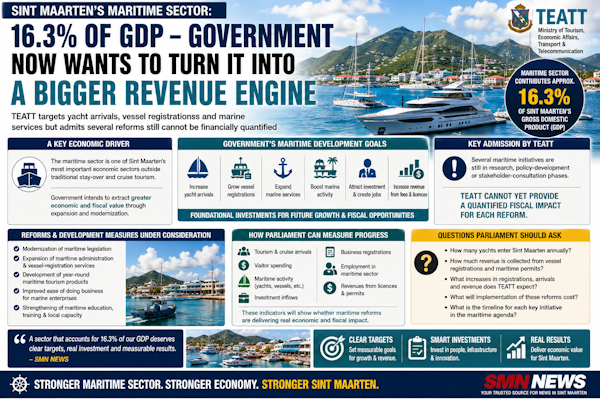 PHILIPSBURG:--- Sint Maarten's maritime sector contributes approximately 16.3 percent of Gross Domestic Product, making it one of the country's most important economic sectors outside traditional stay-over and cruise tourism, according to TEATT's draft responses on the 2026 Budget.
The government now intends to extract greater economic and fiscal value from the sector by expanding yacht arrivals, marina activity, marine services, vessel registrations, and other maritime-related business activity.
The Ministry lists maritime development alongside tourism expansion, investment promotion, business facilitation and economic diversification as what it calls foundational investments.
But TEATT also makes an important admission: these measures should not be viewed as immediate solutions to the country's fiscal pressures.
The government expects them to create future revenue opportunities by increasing visitors and spending, attracting investment, creating jobs and expanding the tax base over time.
Additional reforms under consideration include modernizing maritime legislation, expanding maritime administration and vessel-registration services, and developing year-round maritime tourism products.
However, several of these initiatives remain in research, policy-development or stakeholder-consultation phases.
Consequently, TEATT says it cannot yet provide a quantified fiscal impact for each reform.
That is where Parliament's oversight becomes important.
If a sector already represents 16.3 percent of GDP, Government should be able to establish measurable targets for additional vessel registrations, yacht arrivals, marine-service activity, employment and fees.
TEATT itself says Parliament can measure progress by monitoring tourism and cruise arrivals, visitor spending, maritime activity, investment inflows, business registrations, employment and revenues from licenses and permits.
The next step should therefore be numbers.
How many yachts currently enter Sint Maarten annually? How much does Government collect from vessel registrations and maritime permits? What increase does TEATT expect from its reforms? And what will implementation cost?
Without those baselines, a sector responsible for roughly one-sixth of the economy risks becoming another policy area where Government promises growth without Parliament having a clear financial benchmark against which to measure delivery.