~Justice Minister appoints and dismisses members, selects leadership, controls disclosure, and employs CCR Deputy Chair Vidjai Jusia as her Cabinet legal advisor.~
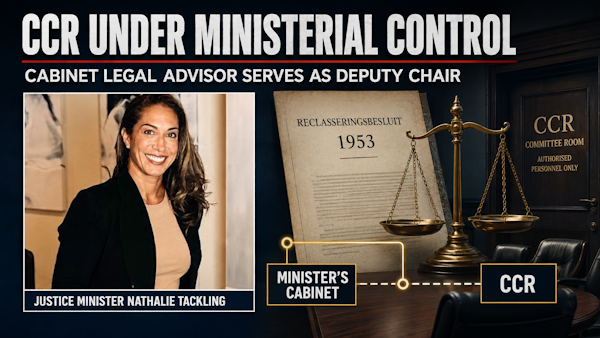 PHILIPSBURG:--- Justice Minister Nathalie Tackling’s long-delayed answers about the Central Probation Board have not resolved concerns about the integrity and independence of Sint Maarten’s conditional-release system. They have instead exposed a structure in which the Minister controls appointments, dismissals, leadership, administration and disclosure, while her own Cabinet legal advisor simultaneously serves as the board’s deputy chairperson.
After remaining silent for more than three weeks, the Ministry finally confirmed that V.K. (Vidjai) Jusia, legal advisor in Tackling’s Cabinet, is a member and deputy chairperson of the Centraal College voor de Reclassering—the CCR.
The Ministry insists that the dual role is neither unlawful nor automatically improper because Jusia joined the CCR in December 2020, before taking up his Cabinet position and before Tackling became Justice Minister in November 2024.
That explanation addresses chronology. It does not remove the present-day conflict concern.
Today, Jusia is simultaneously a senior member of the body producing recommendations for the Justice Minister and a legal advisor working inside that Minister’s Cabinet.
The issue is not simply how he first entered the CCR. The issue is whether someone can participate in formulating supposedly impartial advice and also work within the political and administrative office of the person who receives, assesses and decides what to do with that advice.
Regulation exposes extent of ministerial control
The Reclasseringsbesluit 1953 confirms that the CCR is not structured as an independent authority operating at arm’s length from the Minister.
Article 9 gives the Justice Minister the power to appoint and dismiss every CCR member. The Minister also designates the chairperson and deputy chairperson and assigns the board’s secretary.
Article 19 authorizes the Minister to establish additional rules concerning the CCR’s functions and how those functions are exercised.
Article 18 goes even further: matters handled by the CCR cannot be made public without written and reasoned permission from the Minister.
The same Minister who receives the CCR’s advice therefore appoints and can dismiss its members, chooses its leadership, provides its secretary, may regulate how it operates and controls whether its work can be disclosed publicly.
That is not institutional independence. It is ministerial control with an advisory board attached.
The Ministry itself admitted that the CCR “is not an independent authority in the same constitutional sense as a court or the Ombudsman.”
That admission is crucial. The board advises on decisions affecting the liberty of prisoners, yet it has no separate constitutional independence, no external supervisor and no statutory protection against Cabinet personnel becoming members.
The applicable regulation is available through the official government publications repository.
Ministry relies on legality while avoiding appearance of conflict
The Ministry repeatedly emphasizes that the Reclasseringsbesluit does not prohibit a government employee or ministerial advisor from serving on the CCR.
That may be correct. However, the absence of a prohibition in a regulation originating in 1953 is not proof of sound modern governance.
The regulation also does not require:
- Conflict-of-interest declarations;
- A standard disclosure form;
- Documented conflict assessments;
- A statutory recusal procedure;
- Specific professional qualifications;
- A quorum;
- A voting system;
- Public minutes;
- Publication of recommendations; or
- Independent external supervision.
The Ministry says a CCR member with an actual or perceived conflict “should not” participate. It says members are expected to disclose relevant circumstances and rely on their own integrity and professional judgment.
But “should” is not the same as “must.”
These safeguards are not clearly established in the regulation. They appear to depend on internal practices, the judgment of individual members and intervention by the CCR chairperson.
The Ministry did not disclose whether Jusia has ever recused himself from a case, whether any recusal was formally recorded, or whether he has ever participated in CCR advice and then advised Tackling’s Cabinet concerning the same prisoner or issue.
Without that information, the public is being asked to trust an internal separation that it cannot independently verify.
Conflict already raised in court
The Ministry claims it has never received a formal complaint concerning the CCR’s independence or impartiality.
However, it acknowledged that the dual role was challenged in court proceedings during 2025.
A defense attorney argued that a conflict existed because a CCR member also held a position in the Minister’s Cabinet. According to the Ministry, the court did not address that argument separately and did not overturn the Minister’s decision on that ground.
That is not the same as a judicial finding that no conflict existed.
The Ministry also confirmed that Jusia’s dual role was discussed internally within the CCR, including with its chairperson and other members. The board decided that the arrangement did not create an automatic conflict because Jusia had served since 2020.
Again, the CCR effectively assessed the integrity of its own composition, behind closed doors, without an external supervisor and without publishing a conflict assessment.
No specific qualifications required
The Ministry confirmed that the law establishes no specific professional qualifications for CCR membership.
The board must contain between three and seven members, appointed for six-year terms and eligible for immediate reappointment.
The only express incompatibility in Article 9 is that a member cannot simultaneously serve as a board member of a recognized probation organization or act as a general or special probation supervisor.
The Ministry says the CCR should be multidisciplinary and collectively possess experience in criminal justice, psychology, rehabilitation, education and social support.
However, those are policy considerations—not enforceable statutory qualifications for individual appointments.
A body helping to shape decisions about prisoners’ liberty operates under a regulation that specifies how many members it must have and how long they may serve but does not prescribe the competence each member must possess.
Current membership selected by ministerial decision
The CCR was reconstituted by Ministerial Decision MB2026/413 of March 16, 2026, for a six-year period.
Its current composition is:
- Rueben Thompson—member and chairperson;
- Vidjai Jusia—member and deputy chairperson;
- Janique Baly-Kolfin—member;
- Ludwina Hodge-Sprok—member; and
- Georgiyanne Richardson—secretary.
The Ministry said members serve in their personal capacities and do not represent their employers.
That technical distinction does not erase their professional positions or the influence those positions may create. Saying Jusia does not formally “represent” the Cabinet while sitting on the CCR does not change that he works as a legal advisor in the Minister’s Cabinet.
The previous membership changed after Maricia Ellis and former chairperson Bert Hofman stepped down for health reasons and secretary Geertje van Haperen moved to Bonaire. Thompson joined in January 2025 and became chairperson when the board was reconstituted in March 2026.
Prisoners normally judged from written files
The Ministry confirmed that the CCR usually assesses prisoners through written files containing reports from the prison and Judicial and Institutional Services.
Prisoners are not automatically heard before recommendations affecting their liberty are formulated.
A direct interview may be arranged when the CCR considers one necessary, particularly when contemplating a negative recommendation. The Ministry says the process is administrative rather than judicial and that no law requires an oral hearing in every case.
However, Article 14 of the Reclasseringsbesluit gives CCR members and the secretary access to prisons and prisoners, provided the chairperson authorizes the visit.
The CCR therefore possesses the legal ability to hear directly from prisoners. Whether it chooses to exercise that ability is left to the same board operating without statutory hearing standards.
No mandatory voting rules or quorum
The Ministry confirmed that the law does not establish whether CCR recommendations must be unanimous or may be adopted by majority vote.
There is no statutory quorum and no prescribed voting procedure.
The CCR reportedly attempts to reach recommendations by consensus. The Ministry describes this as a working method rather than a legal requirement.
This means the public cannot determine from the regulation:
- How many members must participate in a case;
- Whether every member reviewed the complete file;
- Whether disagreement existed;
- Whether a recommendation was unanimous; or
- Whether the deputy chairperson’s participation was decisive.
The Ministry says recommendations are collective and issued in the CCR’s name. Collective authorship, however, can also conceal individual participation and disagreement.
Public barred from CCR matters without Minister’s permission
The Ministry told SMN News that public minutes are not legally required because CCR files contain sensitive criminal, medical and personal information.
Confidentiality concerning prisoners is necessary. But confidentiality does not require secrecy about governance.
Article 18 prevents disclosure of matters handled by the CCR without written, reasoned permission from the Minister. Meanwhile, Article 17 requires the CCR to submit an annual report to the Minister every January in triplicate.
The Ministry did not say whether those annual reports are published, submitted to Parliament or independently reviewed.
There is a clear difference between protecting a prisoner’s medical information and concealing statistics, attendance records, recusal numbers, governance rules and compliance information.
The Ministry has used confidentiality to explain why case information is not public, but it has not explained why anonymized operational data remain unavailable.
Ministry cannot produce five years of statistics
Despite the CCR’s written recommendations, confidential registers and annual reporting obligation, the Ministry could not say how many early-release recommendations were submitted during the past five years or how often Justice Ministers rejected CCR advice.
The figures are not maintained as consolidated statistics.
The Ministry says it must reconstruct them by reviewing individual records held by the prison, the CCR and the Ministry. It has requested underlying figures from the prison and promised to provide them after verification.
This is an extraordinary administrative failure.
A statutory board advising on conditional releases cannot promptly say how many recommendations it issued or how often ministers rejected its advice. The Ministry is therefore unable to provide basic performance data needed to assess consistency, fairness and political intervention.
Tackling said that since she became Minister in November 2024, she has not departed from any CCR recommendation.
That statement raises another question: if every recommendation has been followed, how independently did the Minister assess those files, and how many of those recommendations involved participation by her own Cabinet legal advisor?
Mandatory CCR advice and the Ministry’s two-stage interpretation
The Ministry sought to distance the CCR from a recent disputed Article 1:37 decision by dividing the early-release process into two stages.
It said the first stage concerns whether Article 1:37 is activated because of prison overcrowding and which percentage will apply. The Prosecutor’s Office supplies information concerning sentence execution and detention capacity, while the prison director supplies occupancy figures, capacity information and sentence calculations.
The Minister then decides whether Article 1:37 will be applied. Prisoners are ranked according to who is proportionally closest to their statutory release date.
The Ministry said the CCR does not participate in this eligibility stage. It becomes involved only after a prisoner qualifies, when it advises whether release should proceed and what conditions should apply.
Article 1:37 does state that the Minister may authorize earlier conditional release because of a shortage of prison places, beginning with the person proportionally closest to statutory release. It also gives prisoners a right to challenge certain Article 1:37 decisions before the court. Sint Maarten’s current Criminal Code confirms those provisions.
However, Article 32 of the Reclasseringsbesluit states that the Minister places the prison director’s proposal or report, with its supporting documents, before the CCR for advice.
The Ministry says this requirement is only triggered after eligibility has been established. That two-stage interpretation is not expressly described in the Reclasseringsbesluit itself.
The Ministry may have a legal argument based on how Article 1:37 interacts with the newer Criminal Code, but it has not produced a court ruling or separate regulation establishing that its interpretation is the only permissible one.
An outdated framework is being asked to carry modern integrity demands
The government is relying on the Reclasseringsbesluit 1953—a regulation originating in the former Netherlands Antilles and republished in 1960—to defend the structure of a modern Sint Maarten body advising on prisoners’ liberty.
The published text still says the CCR is established in Willemstad, Curaçao.
Sint Maarten constituted its own CCR by ministerial decision in November 2010, but the underlying regulation has not been modernized to provide the transparency, independence and conflict-of-interest safeguards expected of a contemporary justice system.
That is the core problem revealed by Tackling’s answers.
The system may comply with the bare wording of an old regulation, but legality is the minimum standard—not the final test of integrity.
A Justice Minister should not be satisfied merely because no provision written more than 70 years ago expressly prohibits her Cabinet legal advisor from serving as deputy chairperson of the board advising her.
Public confidence requires more:
- A binding conflict-of-interest code;
- Mandatory disclosure and recusal rules;
- Publication of anonymized statistics;
- Clear quorum and voting procedures;
- Independent supervision;
- Published annual reports; and
- A strict prohibition against the same individual participating in CCR advice and advising the Minister on the resulting decision.
Tackling’s answers were intended to defend the system. Instead, they revealed a board appointed by the Minister, dismissible by the Minister, administered through the Minister, restricted from disclosure without the Minister’s permission and now partly led by the Minister’s own legal advisor.
That may satisfy the wording of the Reclasseringsbesluit 1953.
Whether it satisfies the public’s right to an impartial, transparent and credible justice system is an entirely different question.