~TEATT Minister Grisha Heyliger-Marten tells Parliament GDP growth means little if residents cannot feel the benefits; gasoline up 38.37%, GEBE fuel clause up 40.4%~
 PHILIPSBURG:--- Sint Maarten may be recording economic and tourism growth, but Minister of Tourism, Economic Affairs, Transport and Telecommunication Grisha Heyliger-Marten has acknowledged a far less comfortable reality confronting households: economic growth is not necessarily translating into economic well-being.
Presenting TEATT’s 2026 Budget to Parliament, Heyliger-Marten said real GDP growth for 2025 is estimated at 3.4%, supported largely by continued strength in stay-over and cruise tourism. Inflation averaged approximately 0.92% year-on-year in 2025, but that relatively favorable picture changed dramatically during the second quarter of 2026.
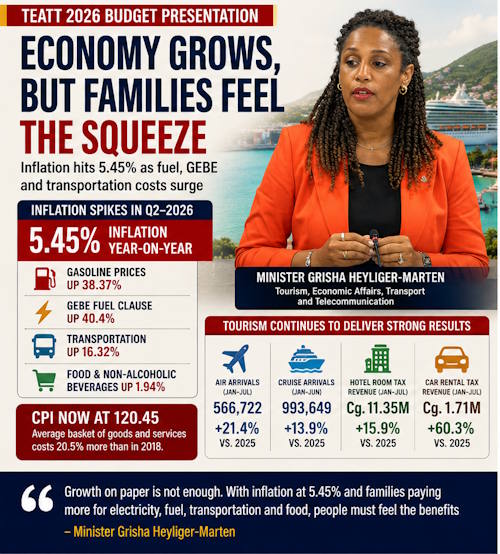
Between April and June, consumer prices rose 4.03% from the previous quarter and 5.45% from the same period in 2025.
These increases are hitting some of the most unavoidable household expenses.
According to the Minister’s presentation, gasoline prices rose 38.37% during the quarter, the GEBE fuel clause rose 40.4%, transportation rose 16.32%, and food and non-alcoholic beverages rose 1.94%.
Those numbers contrast sharply with the headline economic growth figures.
Average Basket Costs 20.5% more than in 2018
The Minister revealed another figure that should command attention.
Sint Maarten’s Consumer Price Index has reached 120.45, meaning the average basket of goods and services costs approximately 20.5% more than it did in 2018.
Heyliger-Marten acknowledged directly that families are paying more for many of the same basic necessities, businesses are confronting higher operating expenses, and household purchasing power is being squeezed.
While some of those pressures originate internationally — including conflicts, global fuel-price movements, shipping costs and supply-chain disruptions — the Minister acknowledged that Sint Maarten’s heavy dependence on imports makes the country particularly vulnerable to external shocks.
The government cannot control international oil prices or global shipping costs, she said, but it is responsible for how it responds locally.
That includes monitoring price movements, enforcing legislation, strengthening the Maximum Price System and ensuring consumers receive timely and understandable information.
Tourism Is Booming
The pressure on households becomes even more striking when compared with Sint Maarten’s tourism performance.
Air arrivals for January through July increased by more than 21%, representing almost 100,000 additional visitors compared with the corresponding period in 2025. Cruise arrivals increased approximately 14%.
Government revenues are benefiting.
Hotel room tax collections increased 15%, producing approximately Cg. 1.5 million more, while car-rental tax revenues increased by more than 60%.
The accompanying TEATT budget presentation provides even more precise figures: air arrivals increased from 466,800 to 566,722, cruise arrivals from 872,359 to 993,649, hotel room tax collections from approximately Cg. 9.87 million to Cg. 11.35 million, and car-rental tax from approximately Cg. 1.06 million to Cg. 1.71 million.
But timeshare tax collections fell 11.9%, from approximately Cg. 2.04 million to Cg. 1.80 million.
Heyliger-Marten said Sint Maarten is outperforming many regional competitors and argued that the Government must now shift its focus from simply increasing visitor numbers to increasing “tourism value”—getting visitors to spend more and ensuring more tourism dollars remain within the local economy.
Growth on paper is not enough
The most significant admission came in the Minister’s closing assessment of the economy.
“Growth on paper is not enough,” Heyliger-Marten told Parliament.
She said that with inflation at 5.45% and families paying more for electricity, fuel, transportation and food, Government cannot simply point to GDP growth and declare victory.
That statement goes directly to the question many residents will ask when presented with impressive tourism-arrival numbers and growing Government tax collections:
If tourism is booming, visitor numbers are climbing, and Government is collecting substantially more from hotels and car rentals, when will ordinary households feel the benefits?
Heyliger-Marten herself framed the challenge clearly: economic growth must ultimately become economic opportunity, and residents must be able to feel it.
For the Government, that may become one of the most important tests of the 2026 Budget.