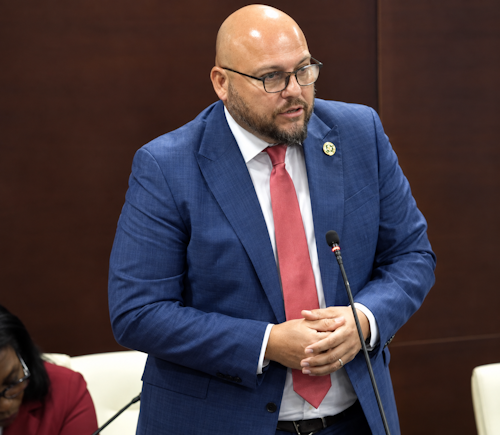
 PHILIPSBURG:--- Member of Parliament Chris Wever used the 2026 budget debate to press the Council of Ministers on a wide range of unresolved issues, warning particularly that government cannot deliver effectively when its own human-resource machinery is understaffed and questioning why qualified Sint Maarteners seeking HR positions are apparently not even receiving responses.
During his first-round intervention in Parliament, Wever directed questions to several ministers on the Court of Guardianship, government staffing, the proposed medical registry, sports infrastructure, tax collection, the planned Clem Labega Square parking facility and financial support for institutions serving children with special needs.
Wever said he deliberately limited his intervention because other MPs had already raised numerous questions, but said several matters still required clarification.
Wever: P&O Is the “Heartbeat” of Government
One of Wever's strongest interventions was directed at Prime Minister and Minister of General Affairs Dr. Luc Mercelina over staffing at Personnel and Organization (P&O).
Wever described P&O as the “heartbeat of the organization,” arguing that government ministries cannot function properly without an adequately staffed central personnel operation.
He noted that Parliament had already received information that recruitment measures were being considered, but demanded concrete details on what the government intends to do in 2026.
The MP said people with professional HR backgrounds had personally contacted him after applying for positions and receiving no callback or indication that their applications were being considered.
That, Wever suggested, raises an obvious contradiction: government says it desperately needs personnel while qualified people are apparently already applying.
“If persons who are professional and in that field are not getting a return call,” Wever questioned, while government reportedly has only two personnel officers, then how serious is the recruitment priority?
He stressed that qualified Sint Maarteners exist who could potentially fill the vacancies.
Government Recruitment Process Too Slow
Wever went further, asking whether government must fundamentally change how it recruits personnel.
He pointed to previous overseas recruitment efforts, including a P&O job fair in the Netherlands, but said government loses valuable time because its hiring procedures can drag on.
He asked whether an appropriately authorized P&O official could lead overseas recruitment delegations with enough authority to identify suitable candidates and move immediately toward employment, rather than allowing candidates to get trapped in a lengthy bureaucratic process.
Wever even questioned whether government could reach the point where a suitable candidate could effectively be selected and a contract signed during the recruitment exercise.
His central argument was that the P&O shortage does not remain confined to General Affairs. It ultimately affects every ministry, because ministries depend on the personnel apparatus to recruit the workers needed to execute government policy.
Questions Raised Over Clem Labega Parking Plan
Wever also turned his attention to the proposed parking facility associated with Clem Labega Square.
Referring to renderings that have circulated publicly, the MP questioned what research was conducted to determine whether a single-level parking facility would provide sufficient capacity considering population growth and the location involved.
He asked whether the government had considered a multi-story parking structure and demanded clarity on the overall parking plan.
Wever also noted that what has been publicly presented is a rendering and asked whether an actual architectural-design tender would follow and, importantly, when the public could expect that tender process to begin.
Who Owns the. SX Domain?
Another deceptively short question from Wever was directed to the Minister of TEATT: Who owns the .SX internet domain?
Wever did not reveal his full line of questioning. Instead, he indicated that the government's answer would determine the follow-up question he intends to raise during Parliament's second round.
That leaves the ownership and management of the country-code domain poised to return to the parliamentary floor.
Court of Guardianship Function Book
Justice Minister Nathalie Tackling was asked to update Parliament on the Court of Guardianship.
Wever welcomed the budget increase for the institution but immediately questioned whether its organizational foundation was keeping pace with the additional resources.
He asked specifically for the status of the Court of Guardianship's function book and the timeframe for completing it.
Proposed Registry Could Affect Recruitment of Foreign Doctors
Wever's questions to VSA focused on the proposed medical-professional registry and its implications for Sint Maarten's healthcare system.
He asked for the current status of the proposed registry, whether it is expected to be approved, and the implementation timeframe.
The issue was connected directly to staffing of the new hospital.
Wever recalled that during a recent parliamentary tour of the new General Hospital, MPs heard about the desire to allow qualified doctors currently practicing in Colombia and elsewhere to also practice in Sint Maarten.
His question therefore went beyond administrative procedure: how quickly can the regulatory system be put in place to facilitate access to qualified medical professionals from jurisdictions outside the traditional recruitment pipeline?
Sports Complex Improving — But Hurricane-Damaged Bleachers Remain
ECYS Minister Melissa Gumbs was questioned about the status of the Raoul Illidge Sports Complex.
Wever acknowledged visible work taking place at the facility and commended the National Sports Institute for the improvements.
However, he singled out one problem familiar to spectators attending sporting events: damaged bleachers that he said have remained in poor condition since the last hurricane.
The MP noted that government had presented information about facility upgrades but said he did not recall the bleachers being specifically included.
He also referred to the project's previous connection to the National Recovery Program Bureau and asked government to provide both the present status and a timeframe for restoring the bleachers to full capacity.
Wever pointed to improvements elsewhere at the complex, including work on the outdoor boxing area, while arguing that spectators should also have proper facilities from which to support Sint Maarten's athletes.
Wever Questions Tax Treatment of Pensioner Already Paying
The Finance Minister faced a different issue — the treatment of a pensioner who, according to Wever, had already entered into a tax-payment arrangement and was complying with it.
Wever told Parliament that the senior citizen was later reassessed at a higher amount and was apparently told the previous arrangement was no longer sufficient.
According to the case presented by the MP, the pensioner was being required to accept a new, higher payment arrangement or potentially face a lien against property.
Wever questioned the fairness of changing the terms for someone who had been honoring an already agreed payment arrangement.
“What can this person do?” he asked, while challenging the government to explain how such treatment can be considered fair to a compliant taxpayer on a pension.
Special Needs Must Be Put “to the Forefront”
Wever closed his intervention with an issue he said he has repeatedly championed since entering Parliament: special needs.
The MP said he had heard little about special needs during the ministerial presentations accompanying the budget debate.
He proposed examining tax relief for institutions serving students with special needs, allowing those organizations to retain more of their resources and reinvest the money in specialized teachers and services.
Wever linked the proposal to the wider discussion of tax incentives for people or institutions that donate to qualifying organizations.
His proposal effectively asks the government to consider using fiscal policy as a mechanism to strengthen special-needs education.
He acknowledged that ECYS is working on a special-needs policy and examining funding possibilities, but argued that institutions serving special-needs students should also be considered for government subsidies.
Sint Maarten already subsidizes numerous institutions, Wever argued, and special-needs organizations should not remain on the margins of that system.
His message to government was straightforward: special needs must be brought “to the forefront.”
Taken together, Wever's intervention placed a common question underneath several seemingly unrelated budget issues: does government have the administrative capacity, staffing and spending priorities necessary to turn its budget allocations into functioning public services?
From an understaffed P&O department and unresolved function books to medical registration, hurricane-damaged sports infrastructure, treatment of pensioners and support for special-needs institutions, Wever's questions now require the Council of Ministers to provide Parliament with specific answers, timelines and — where possible — concrete action.