~Minister tells Parliament economic growth must reach households, says TEATT is pursuing measurable tourism returns while advancing long-delayed reforms across transportation, vending, economic policy and regulatory institutions.~
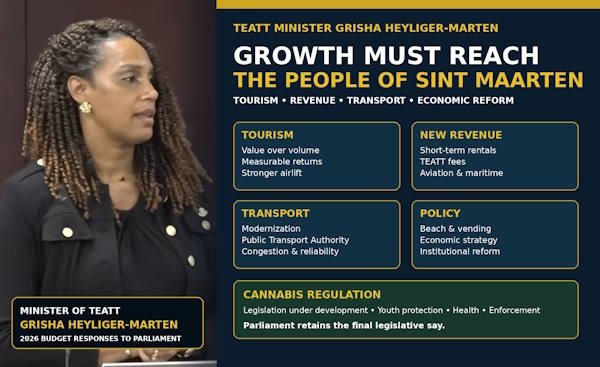 PHILIPSBURG:--- Minister of Tourism, Economic Affairs, Transport and Telecommunication (TEATT) Grisha Heyliger-Marten used her responses during Parliament’s continuing debate on the 2026 national budget to present a ministry attempting to tackle several major policy files simultaneously—from tourism and airlift to public transportation, economic diversification, new revenue measures, cannabis regulation and the creation or reform of regulatory authorities.
Her central argument to Parliament was that positive economic indicators cannot substitute for improvements residents can actually feel.
Sint Maarten may be recording strong tourism activity and increased collections in tourism-related areas, but Heyliger-Marten acknowledged the obvious contradiction confronting Government: a growing tourism economy does not automatically mean families have more disposable income or businesses are experiencing lower operating costs.
“Tourism growth and household well-being are not the same,” was the thrust of the Minister’s position as she responded to MPs.
That distinction is significant because Parliament is considering a 2026 budget projecting Cg. 647.1 million in revenue, Cg. 635.9 million in operating expenditures and Cg. 164.6 million in capital investments.
For TEATT, therefore, the political test is no longer simply whether visitor numbers increase. The question is how the country's main economic engine translates into jobs, opportunities, business activity and improved living standards.
Tourism: Heyliger-Marten wants value, not simply volume
The Minister told Parliament that her approach is increasingly focused on extracting greater economic value from each visitor rather than treating arrival numbers alone as the measure of tourism success.
That strategy is also influencing where TEATT puts its tourism marketing money.
Heyliger-Marten pointed to an Expedia campaign that generated more than US $38 million in tracked booking value from about US $168,000 to US $170,000 in expenditure, according to figures the Minister presented publicly.
The Ministry says that works out to approximately US $224 in tracked bookings for every US $1 invested.
The argument behind the shift is straightforward: digital campaigns can be measured. Government can track exposure, clicks, bookings, room nights and return on advertising expenditure instead of simply spending promotional dollars without being able to clearly quantify the result.
Heyliger-Marten also pointed to the introduction of Southwest Airlines service from Orlando and Baltimore/Washington as part of the broader airlift strategy.
But the Minister's presentation went beyond airlift.
Her stated objective is to move Sint Maarten from “chasing volume to creating value.”
That means attracting visitors who spend more throughout the local economy, strengthening opportunities for local businesses and ensuring tourism's economic benefits do not remain concentrated in only a handful of sectors.
TEATT looking for new Government revenue
The Ministry is simultaneously examining several possible sources of additional Government income.
These include stronger compliance with Airbnb and other short-term accommodations, adjustments to existing TEATT fees, tourism certification charges, and possible aviation and maritime fees.
Importantly, Heyliger-Marten told Parliament that these potential revenues were not included as projected revenue in the 2026 budget.
The Minister also cautioned MPs against treating dates attached to various TEATT initiatives as guaranteed completion dates.
Cannabis regulation, transportation reform, the Strategic Economic Plan, Beach and Vending Policy, Residential Economic Policy, Sports Tourism Policy, Hosting Policy and Festivals and Events Policy are all moving at different stages.
Some require legislation. Others require research, financing, consultation or coordination with other ministries.
The same applies to institutional projects involving the Sint Maarten Tourism Authority, the Agriculture, Livestock and Fisheries Agency, EDC reform, the Competition Authority, and the Public Transportation Authority.
Heyliger-Marten's position was that creating an authority on paper is meaningless if Government does not first establish how it will operate, how it will be financed and what governance structure will control it.
That is an important admission considering how many major Government initiatives have remained on the country's agenda for years.
The challenge for TEATT will therefore be to show which of these projects move from policy presentations and budget documents into implementation.
Public transportation remains a major test
Transportation remains one of the most visible areas in which the public will judge the Ministry.
Sint Maarten continues to struggle with congestion, an aging public transportation framework, and longstanding calls for modernization.
The TEATT legislative and policy agenda includes public transportation reform and a Public Transportation Authority, meaning the Ministry is acknowledging that the existing structure requires fundamental change rather than minor adjustments.
That makes implementation crucial.
Residents do not experience transportation policy through PowerPoint presentations or draft legislation. They experience it while waiting for buses, sitting in traffic, and trying to move between communities.
The same applies to the Ministry's Beach and Vending Policy. Heyliger-Marten has already inspected the Philipsburg Boardwalk with the Inspectorate of Economic and Transport Affairs to examine enforcement, vending and visitor-experience concerns during a busy cruise day.
The issue now is whether those inspections translate into enforceable policy.
Cannabis becomes the most politically explosive TEATT file
Although cannabis is only one part of TEATT's legislative programme, it has quickly become one of its most controversial.
Heyliger-Marten pushed back against suggestions that cannabis regulation had become TEATT's overriding priority simply because it appeared prominently in a legislative presentation.
“A bullet point at the top of a slide does not equal the top priority of this ministry,” she told Parliament, arguing that MPs were interpreting the order of the presentation as a ranking that Government itself had not made.
The Minister maintained that the proposed legislation remains under development and is not yet before Parliament.
She told MPs that when the legislation eventually arrives, Parliament will have every opportunity to examine it, question Government and ultimately approve or reject it.
Heyliger-Marten also sought to draw a sharp distinction between regulating cannabis and promoting cannabis use.
Cannabis, she has argued, is already being consumed in Sint Maarten. The policy question is therefore whether Government continues allowing an illicit market to operate largely outside regulatory control or establishes safeguards governing matters such as access, testing, labeling, enforcement and public health.
She identified youth protection, mental health, consumer safeguards, reducing illicit activity, enforcement and possible opportunities for local farmers and entrepreneurs among the issues being examined.
Native Nation does not make Sint Maarten's laws, Minister says
Heyliger-Marten also addressed criticism surrounding Native Nation SXM.
Her response was unequivocal: Native Nation does not make Sint Maarten's laws, determine Government policy, issue licenses or decide whether Parliament ultimately adopts cannabis legislation.
According to the Minister, the entity was engaged for technical expertise, while Government remains responsible for policy and Parliament retains its constitutional legislative authority.
She was considerably more cautious, however, when MPs questioned Government's possible financial exposure should Parliament ultimately reject the legislation.
Heyliger-Marten acknowledged that Government must honor lawful contractual obligations but declined to declare that any particular amount would automatically become payable if Parliament votes against cannabis legislation.
That issue is unlikely to disappear.
MPs have already raised questions about what Government agreed to, what has been paid, what remains outstanding, and whether rejecting the eventual legislation could trigger additional costs.
Those questions will require documentary answers, not political assurances.
GEBE and cost of living remain inseparable from economic policy
Heyliger-Marten's economic argument also runs directly into another problem Government cannot escape: energy.
Earlier this year, the Minister publicly challenged GEBE's fuel-clause increase and called for greater transparency, compliance and lower electricity costs.
That position matters because Government can promote tourism, entrepreneurship and investment, but businesses cannot easily translate economic growth into competitiveness when electricity and other operating costs remain high.
Likewise, households will have difficulty feeling the benefits of economic growth when significant portions of their income continue disappearing into utilities, groceries, transportation, and housing.
This is where Heyliger-Marten's own standard—economic opportunity people can feel—becomes the benchmark against which TEATT will ultimately be measured.
A massive agenda; now comes the delivery test
Heyliger-Marten has presented Parliament with an ambitious TEATT programme.
Tourism marketing is being redirected toward measurable returns. Airlift is being strengthened. Government is examining new revenue streams. Transportation reform is being pursued. Vending and beach policy are being addressed. Cannabis legislation is under development. Economic policies and several regulatory authorities remain in the pipeline.
The Minister's argument is that these initiatives cannot all be completed simultaneously and that Government must first ensure that institutions and policies are legally, financially and operationally viable.
That explanation is reasonable.
But Parliament's next question should be equally straightforward:
Which initiatives will actually be delivered, by when, at what cost and with what measurable benefit to the people of Sint Maarten?
Because after years of plans, policies, proposed authorities, studies and legislative intentions across successive governments, TEATT's success will ultimately not be judged by the length of its agenda.
It will be judged by what gets done.