~MP Dimar Labega withdraws several planned motions after ministers commit to action, but demands quarterly accountability and moves ahead with six-month poverty-reduction deadline.~
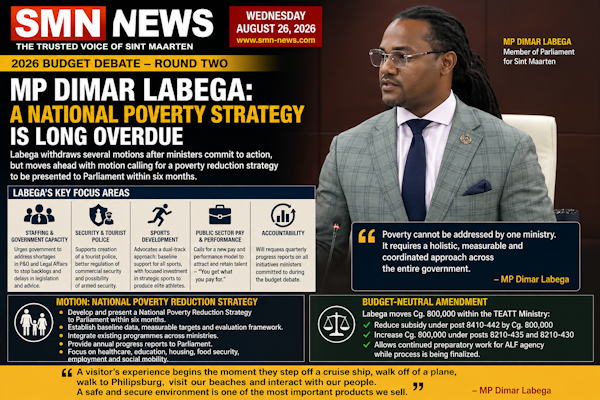 PHILIPSBURG:--- Member of Parliament Dimar Labega used the second round of the 2026 budget debate to press government on several major policy fronts, including poverty reduction, public-sector reform, security, sports development and the chronic shortage of personnel within government.
Rather than simply submitting every motion he had prepared, Labega told Parliament that several initiatives he intended to propose had effectively been embraced by ministers during their responses. He therefore decided not to proceed with those motions, but warned that he intends to demand quarterly progress reports to determine whether government actually follows through.
The major proposal Labega did move forward with was a national poverty reduction strategy, calling on government to develop and present a coordinated plan to Parliament within six months.
Labega argued that Sint Maarten has numerous individual government programmes that may address poverty, but still lacks one measurable national framework tying those initiatives together.
Labega: Government Ministries Cannot Continue Working in Silos
Labega began by describing a fundamental weakness in government: limited human capacity in crucial departments.
He singled out Personnel & Organization (P&O) and Legal Affairs, arguing that shortages in these departments affect virtually every ministry.
According to Labega, when MPs question ministers about matters requiring cooperation across ministries, they are frequently told that a particular component falls under another ministry. But he said many of the government's major projects depend on the same limited pool of personnel.
“With P&O, the government is on the staff and backlog. With legal affairs, legislation and advice are held up,” Labega said.
He warned that ministries simultaneously pushing their own legislation through an already understaffed system could create further bottlenecks.
Labega therefore urged the Council of Ministers to collectively prioritize legislation, deciding which laws must be advanced first rather than having every ministry push legislation simultaneously through departments that lack sufficient personnel.
That argument goes directly to the government's ability to execute the 2026 budget. Appropriating money is one thing; having the personnel, legislation and administrative capacity to implement the policies funded by that budget is another.
Tourist Police and Armed Commercial Security
Labega also turned his attention to crime and the security of Sint Maarten's tourism product.
He said that before the budget debate, he prepared a motion calling for consideration of a public-support entity to assist the Police Force of Sint Maarten.
However, Justice Minister Nathalie Tackling said the matter is already a priority and that the government is exploring the concept of a tourist police, while also looking at proper regulation of the commercial security sector and the possibility of armed security guards.
Because the Minister indicated that work is already underway, Labega said he would not submit the motion.
But he is not dropping the issue.
He announced that he will request quarterly progress reports.
For Labega, security is not simply a Justice Ministry issue; it is an economic issue.
“A visitor's experience begins the moment they step off a cruise ship, walk off of a plane, walk to Philipsburg, visit our beaches and interact with our people,” he told Parliament.
“A safe and secure environment is one of the most important products we sell as a tourism destination.”
Labega Wants Elite Sports Programme Without Abandoning Other Sports
Labega said he had also prepared a motion on the direction of sports development.
Again, he decided against submitting it after determining that ECYS Minister Melissa Gumbs' plans were aligned with what he was proposing.
The concept, however, is significant.
Labega advocated a dual-track national sports policy.
Under his proposal, all sports would continue receiving baseline government support, while selected strategic sports would receive concentrated investment aimed at producing elite athletes and internationally competitive national teams.
Labega made it clear that the proposal was not intended to strip smaller sports of opportunities or government support.
Rather, he argued that Sint Maarten has limited public resources and must decide how to invest them strategically to increase international sporting success and national visibility.
Again, instead of presenting the motion, Labega said he intends to seek quarterly updates on the government's progress.
“You Get What You Pay For” — Labega Targets Government Salaries
Labega also addressed the government's difficulty attracting and retaining qualified personnel.
He said he had prepared a motion asking the Minister of General Affairs and Minister of Finance to explore a new public-sector pay and performance model.
His argument was straightforward: government cannot complain about poor performance, vacancies and difficulty attracting skilled professionals while ignoring whether public-sector compensation remains competitive.
“We all know the old saying, you get what you pay for,” Labega told Parliament.
“If we want highly effective government that cuts down on those long lines, stops financial waste and collects taxes fairly to fix our roads and schools, we must be willing to pay for that talent.”
Labega said the proposed model would have examined increasing salaries in line with the cost of living and offering competitive compensation for crucial, difficult-to-fill positions.
However, Prime Minister Dr. Luc Mercelina informed Parliament that this issue is already a priority and that work has begun.
Labega therefore withdrew the planned motion but again placed government on notice that he intends to request quarterly reports on progress and challenges.
Labega Draws Line: Poverty Motion Will Go Forward
One issue, however, was one on which Labega was unwilling to rely solely on ministerial assurances: poverty.
He said he had deliberately asked ministers how their various policies would translate into reducing poverty.
Individual ministries pointed to education, employment creation, agriculture, healthcare and other initiatives.
But Labega said the missing piece is a single inter-ministerial roadmap.
He embraced the government's own acknowledgment that poverty cannot be addressed by one ministry, quoting the position that poverty reduction requires a “holistic, measurable and coordinated approach across the entire government.”
Labega's conclusion was that scattered programmes are not enough.
Sint Maarten needs a national strategy.
Six Months to Produce National Strategy
Labega's motion calls on government to develop and present a National Poverty Reduction Strategy to Parliament within six months.
The motion recognizes that the cost of living continues to place pressure particularly on low-income families, pensioners, single parents and vulnerable persons.
It also treats poverty as more than simply insufficient income.
Labega's motion connects poverty to access to:
- healthcare;
- education;
- housing;
- food security;
- employment opportunities; and
- social mobility.
The motion notes that the 2026 budget contains initiatives across government that could contribute to poverty reduction, including workforce development, SME support, agricultural development, food security, healthcare reform and employment creation.
The problem, according to Labega, is that those initiatives are spread across ministries without a clearly articulated national poverty-reduction framework.
His proposal therefore goes beyond another government report.
It calls for a baseline assessment of poverty and vulnerability in Sint Maarten, measurable poverty-reduction targets, a monitoring and evaluation framework, identification of existing programmes that contribute to poverty reduction and an explanation of how those programmes will be integrated into the national strategy.
Government would also have to provide annual progress reports to Parliament, showing targets achieved, challenges encountered, and budget allocations used, along with recommendations for policy adjustments.
That could give Parliament something it currently lacks: a mechanism to measure whether hundreds of millions in public spending are actually improving the economic circumstances of vulnerable households.
Labega Moves Caribbean Guilders 800,000 in Budget-Neutral Amendment
Labega also submitted a budget-neutral amendment concerning the TEATT Ministry.
His amendment arose from questions surrounding the ALF agency, whose legislative trajectory remains under development.
According to Labega, the full subsidy amount cannot be effectively deployed in 2026 while that process remains incomplete.
He therefore proposed reducing the subsidy by Cg. 800,000, while preserving the government's ability to continue preparatory work through targeted project-based allocations.
Crucially, the amendment does not increase overall expenditure.
Labega described it as budget neutral, with Cg. 800,000 in increases under posts 8210-435 and 8210-430 fully offset by a Cg. 800,000 reduction under post 8410-442.
From Motions to Measurable Accountability
Labega's intervention ultimately placed a broader challenge before the Mercelina Cabinet.
Several ideas he was prepared to bring through parliamentary motions — tourist policing and security reform, elite sports development and public-sector compensation reform — were not submitted because ministers told Parliament they were already working in those directions.
Labega said his position has been consistent: when government is actively pursuing a motion's objective, he is prepared to refrain from presenting it.
But that decision comes with a condition.
He wants proof of progress.
Labega made clear that he intends to pursue quarterly reporting on the initiatives he withheld, effectively turning government's promises during the budget debate into benchmarks that can be revisited throughout the year.
On poverty, however, Labega went further.
With households continuing to struggle with the cost of living, he wants government to stop treating poverty reduction as a collection of unrelated programmes scattered across ministries and instead establish one national framework with measurable targets, deadlines and annual reporting.
The test will now be whether Parliament backs that demand — and, if it does, whether government can deliver the national poverty strategy within the proposed six-month deadline.