~MP Viren Kotai presses for proof of landfill payments and contracts; VROMI confirms heavy-equipment work was paid without a formal written agreement and says other companies are also working without contracts.~
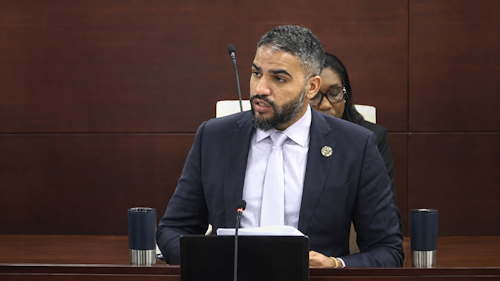 PHILIPSBURG:--- Member of Parliament Viren Kotai has opened another uncomfortable chapter in the debate over government contracting after questions he posed to the Ministry of VROMI produced an admission that several companies are currently providing services without formal contracts.
Kotai’s questions initially focused on landfill operations and the use of government-owned heavy equipment, but VROMI's answers broadened the issue far beyond one contractor.
The Ministry acknowledged that no formal written agreement existed between the government and Fleming Waste Solutions for operating government-owned heavy machinery at the landfill, even though payments had been processed.
That admission raises obvious questions about how public money was authorized, what legal basis existed for the payments, who approved the arrangements, and how many similar situations may still exist across VROMI.
Kotai Asked for the Paper Trail
Kotai specifically asked Parliament to obtain evidence of the first payment and the agreement in place at the time between the government and the contractor operating the government-owned machinery at the landfill.
VROMI’s answer was direct.
The Ministry said there was no formal written agreement on record for the heavy-equipment work.
It nevertheless confirmed that payments had previously been processed through an advice mechanism and said such payments are now handled formally through the government’s financial-management system.
That answer is significant because it establishes that services were being paid for even though the ministry says the formal written contractual framework was absent.
The Ministry has defended the situation as part of an inherited administrative problem that it is now trying to correct through stricter procedures.
VROMI: Several Companies Still Working Without Formal Contracts
Kotai then asked the broader question:
Are there other companies working without contracts?
The answer was yes.
VROMI acknowledged that several companies are currently providing services without formal contracts.
The Ministry said it is actively attempting to regularize those arrangements by establishing formal service-level agreements to improve governance, accountability and compliance with procurement and operational standards.
That admission should immediately concern Parliament.
The issue is no longer limited to one contractor at the landfill.
It raises the possibility that government ministries are receiving services and incurring financial obligations without fully executed written agreements setting out scope, duration, payment terms, performance standards, liability and accountability.
How Did Government Get Here?
VROMI said the current situation grew partly out of older working arrangements and payment procedures.
According to the Ministry’s explanation, Fleming had been working with government since 2022 and received a contract in 2023 for certain landfill activities — but not for operating the government-owned heavy equipment that became the focus of Kotai’s questions.
Payments for that work were processed through the older manual route, which VROMI said also contributed to delays.
The Ministry has argued that the present effort to formalize contracts should not be interpreted as hostility toward contractors, but as an attempt to restore compliance with financial law and protect public funds.
That explanation may be valid, but it does not eliminate the central question Kotai has exposed:
How many services has government been paying for without formal contracts, and for how long?
Outstanding Invoices Add Another Layer
Kotai did not stop at existing contracts.
He also asked whether former or active contractors have outstanding payments and which invoices have already been executed versus those still awaiting payment.
VROMI confirmed that outstanding invoices from various contractors remain pending formal completion and regularization.
The Ministry said resolving older cases is especially difficult where supporting documents are missing, work was not formally budgeted, or the legal basis was unclear.
It cited older examples of payments and obligations dating back several years, including infrastructure and drainage-related works.
That means VROMI is not merely dealing with current contracting.
It is also trying to untangle years of accumulated administrative and financial practices.
Kotai’s Questions Put Procurement Accountability Back on the Table
The most important consequence of Kotai’s intervention is that it puts procurement accountability back at the center of the VROMI debate.
If services are being performed without signed contracts, Parliament should know:
Who authorized the work?
Who verified that the services were completed?
Who approved payment?
Was the work tendered?
Was a legal opinion obtained?
Was the expenditure budgeted?
Were competing companies given an opportunity?
And if the arrangement was not properly formalized, who bears responsibility when payment disputes arise?
These are not minor administrative questions.
They go directly to protecting public funds.
Government Says It Is Cleaning Up the System
VROMI has attempted to present the current situation as part of an administrative cleanup.
The Ministry said the mandatory use of the government financial system, stricter procurement procedures and formal service-level agreements are intended to stop the kind of informal arrangements that existed previously.
That is an important corrective step.
But Parliament still needs a full picture of the problem's extent.
Kotai’s questions have now established that the problem is not hypothetical.
The Ministry itself has admitted that multiple companies are currently operating without formal contracts and that government still has unresolved contractor invoices requiring regularization.
Parliament Should Demand the List
The next step should be obvious.
Parliament should demand a complete list of:
- all companies currently providing services without fully executed contracts;
- the ministries or departments involved;
- the value of each arrangement;
- how long each company has been providing the service;
- the legal basis being used to authorize payment;
- all outstanding invoices;
- and the timeline for regularizing every agreement.
Without that information, Parliament cannot properly determine the financial exposure created by informal contracting arrangements.
Kotai’s questions have now moved the issue from suspicion to documented admission.
The Ministry of VROMI has confirmed that services have been provided and paid for without a formal written agreement in at least one major landfill case — and that several companies are still operating without formal contracts today.
That leaves Parliament with a much larger question:
How widespread is this practice across government, and how much public money is tied up in arrangements that were never properly formalized?