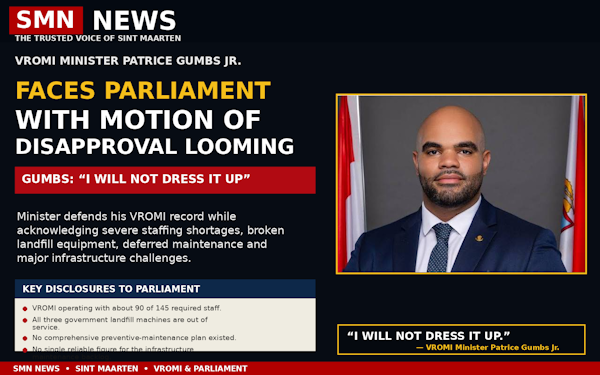
~Minister admits VROMI is operating with only 90 of 145 required staff, all three government landfill machines are out of service, no comprehensive preventive-maintenance plan existed, and the government cannot put a single reliable figure on its infrastructure maintenance backlog.~
 PHILIPSBURG: --- VROMI Minister Patrice Gumbs Jr. returned to Parliament Thursday under intense political pressure, answering a barrage of questions about garbage, landfill operations, procurement, roads, long-lease collection, housing, wastewater, drainage and the ministry’s capacity as Parliament moves toward dealing with motions submitted during the 2026 budget debate, including a motion of disapproval directed at his functioning.
Gumbs did not attempt to portray VROMI as a ministry without problems.
Instead, some of his strongest answers expressed just how serious those problems have become.
The minister told Parliament that VROMI is functioning with approximately 90 employees against an established staffing requirement of 145. He acknowledged a substantial backlog of building permits, said some pending applications stretch back years, and stated that the earliest known unprocessed permit dates to 1978.
“I will not dress it up,” Gumbs told Parliament as he addressed the ministry's capacity problem.
But while Gumbs acknowledged institutional weaknesses, he simultaneously defended his administration's approach, arguing that Sint Maarten cannot simply accelerate development approvals without asking whether its roads, sewage systems, drainage, landfill and other infrastructure can withstand continued growth.
That defense now comes at a critical moment for the minister.
Gumbs walk into Parliament facing political judgment
Thursday's session continued a budget debate that began August 20 and stretched across several sittings.
During Wednesday's second round, MPs presented 15 draft motions and 10 draft amendments. The Council of Ministers received those motions and amendments for the government's reaction. Parliament adjourned Wednesday night specifically to allow Gumbs to return Thursday and answer the outstanding VROMI questions.
The result was a detailed defense of a ministry that Gumbs says is attempting to reform systems while simultaneously confronting years of inadequate capacity, deferred maintenance and rapidly increasing pressure from economic development.
Yet several facts the minister disclosed are likely to give MPs already questioning his performance more ammunition.
All three government landfill machines are down
Perhaps nowhere was the operational crisis clearer than at the landfill.
Gumbs confirmed that all three pieces of government-owned heavy equipment at the landfill are currently out of service and awaiting repairs.
The minister said there is presently no indication that the machines are beyond repair. VROMI is working with the National Recovery Program Bureau to have them assessed, repaired and returned to service through Trust Fund resources.
But another admission followed.
When questioned about preventive maintenance, Gumbs acknowledged that no comprehensive preventive-maintenance plan existed for the equipment.
The minister said preventive maintenance is essential because equipment failures directly undermine the country's ability to manage waste safely and efficiently. VROMI now intends to establish regular inspections, servicing, documentation of equipment conditions and timely repairs or replacement.
Even more strikingly, Gumbs said the ministry had no previous maintenance schedule on file, apart from general manufacturer recommendations.
For a country repeatedly confronted with landfill and garbage problems, those admissions raise an unavoidable question:
How did government reach the point where every piece of its landfill equipment could be out of service without a comprehensive preventive-maintenance system already in place?
Private contractor brought in after government machines failed
With government equipment down, VROMI brought in a third-party contractor using its own machinery to keep landfill operations functioning.
Gumbs described the initial arrangement as short-term and said the ministry is working toward a more formal contractual arrangement because government equipment is expected to remain unavailable for an extended period.
He said that once the government equipment is repaired, the ministry intends to publicly tender the services.
Later in his presentation, however, Gumbs could not provide Parliament with a definitive contract value because the procurement and contracting process had not yet been finalized.
That is likely to attract further scrutiny given MPs' broader concerns about procurement within VROMI.
Audit Chamber has written VROMI about procurement
Gumbs also confirmed something significant concerning the General Audit Chamber.
VROMI received a copy of a letter from the Audit Chamber requesting information concerning procurement.
The ministry is now finalizing its response.
Gumbs declined to provide Parliament with the letter, saying correspondence sent by the Audit Chamber directly to ministers is confidential and that the Audit Chamber itself would determine whether the matter ultimately appears in a published audit.
The confirmation is politically important because the debate directly challenged procurement practices.
When questioned about work being executed without public tenders, Gumbs stressed that VROMI is not free to bypass procurement rules.
He acknowledged that public tendering is the general rule for government works, subject to legally permissible exceptions, including works below the applicable threshold, assignments covered by existing contracts, and legally authorized deviations for urgent circumstances.
And Gumbs made another point unmistakably clear:
Having money in the capital budget itself does not give VROMI permission to avoid a tender.
“CAPEX by itself is not a legal exemption from tendering,” the minister said in substance, explaining that budget approval does not constitute permission to deviate from public-tender requirements.
That statement could become particularly important if Parliament subsequently examines individual VROMI contracts and procurement decisions.
Fleming Waste Services questions left unanswered
MP Darryl York confronted the minister with specific questions concerning Fleming Waste Services, including an alleged promised service-level agreement, outstanding invoices, reported litigation and whether the company had been removed or sent home from the landfill.
Gumbs did not answer the substance of those questions.
He said that because there was potential litigation surrounding the matter, it would not be prudent to discuss the specifics on the floor of Parliament while the issue was being addressed through the appropriate channels.
MP Lyndon Lewis subsequently intervened, saying he understood the restrictions surrounding litigation but urged the minister to put pride aside and seek a solution, noting that a local company was involved.
The underlying questions surrounding Fleming therefore remain unresolved in the minister's public answers.
Waste crisis has “Outgrown” existing system
Gumbs did, however, concede that the country's waste-management structure requires significant correction.
When asked whether course correction was necessary, the minister said yes — not because VROMI is doing nothing, but because the scale of the waste problem has outgrown the way it is presently managed.
He pointed to a new waste ordinance, plans for an independent waste authority and a new financing framework as the mechanisms needed to move Sint Maarten away from what he characterized as a predominantly reactive approach toward prevention, maintenance, enforcement and accountability.
The draft waste ordinance is expected to reach Parliament in the fourth quarter.
Gumbs also said VROMI has tendered solid-waste collection for 2026-2029, covering collection areas, stray garbage along main roads, bins and public communication concerning collection schedules.
The minister further pointed to additional enforcement officers and ongoing recruitment of environmental inspectors.
The political question is whether Parliament believes those measures demonstrate adequate progress — or whether they come too late.
Sewage System: One pump working, another failing
Gumbs also presented troubling information about wastewater infrastructure.
An inspection on February 16 found that only one of three pumps was fully functioning, while another was failing. Staff reportedly warned of the risk of total system failure.
A subsequent assessment of the wider network found four of 13 pump stations in bad condition and one non-operational, with restoration estimated at approximately Cg. 480,000.
Gumbs then delivered one of his strongest defenses of infrastructure spending.
According to the minister, reducing maintenance expenditure on infrastructure that must continue operating cannot properly be described as savings.
“A savings taken out of the maintenance of a system that keeps running is not a savings; it is a postponement.”
The consequence, he argued, is deferred maintenance — and eventually the bill arrives.
That argument cuts both ways.
It supports Gumbs' contention that VROMI inherited infrastructure suffering from years of deferred maintenance.
But Parliament can equally ask what concrete systems his administration has now established to prevent another generation of deferred maintenance.
Road repair budget fell dramatically
The road-maintenance figures supplied by Gumbs also tell their own story.
According to the minister, the budget for roads was:
- 2022: Cg. 2.534 million
- 2023: Cg. 2.509 million
- 2024: Cg. 615,000
- 2025: Cg. 615,000
- 2026: Cg. 957,103
That means the amount cited for 2024 and 2025 was less than one-quarter of the 2022 allocation.
Against widespread public complaints about deteriorating roads, drainage and infrastructure, those figures help explain the scale of the challenge — but they also underline why MPs are demanding answers about priorities and execution.
Minister: VROMI cannot even calculate entire maintenance backlog
Perhaps one of the most consequential admissions came near the conclusion of Gumbs' presentation.
The minister contrasted Sint Maarten with Curaçao, arguing that development must be measured against infrastructure capacity.
He cited a Curaçao study showing pressures involving wastewater, landfill capacity, airports and coastal conditions, arguing that the danger comes from allowing development to proceed incrementally without measuring the cumulative impact.
Gumbs then turned the comparison back on Sint Maarten.
According to the minister, VROMI itself has acknowledged in writing that population growth, aging infrastructure and financial limitations are compounding the country's problems.
And when asked what the deferred maintenance of roads, sidewalks, drainage and retaining walls actually costs, VROMI has no single reliable figure.
Gumbs argued that Curaçao can identify specific infrastructure limitations because it measures them.
Sint Maarten, he said, has not sufficiently done so.
That admission goes to the heart of the challenge confronting VROMI:
How can government establish the true cost of repairing the country's infrastructure when the responsible ministry cannot yet quantify the full backlog?
Gumbs Rejects “Build at any cost” approach
The minister's broader defense is that economic development cannot be measured simply by the number of building permits processed.
He told Parliament that the issue is not merely how quickly VROMI stamps an approval, but what is being approved, at what scale, and whether the country underneath that development can support it.
That is a legitimate policy argument.
Sint Maarten has limited land, aging infrastructure, wastewater problems, drainage challenges, traffic congestion and waste-management constraints.
But Gumbs is also the minister politically responsible for the ministry charged with confronting many of those problems.
And that is why the looming parliamentary judgment matters.
Motion of disapproval turns answers into a test of confidence
Gumbs' Thursday presentation therefore amounted to more than another round of budget answers.
It became a defense of his stewardship.
The minister pointed to reforms underway: a waste ordinance, a proposed independent waste authority, a land-issuance policy, housing initiatives, drainage planning, renewable-energy considerations, digitization and infrastructure projects.
But MPs also heard that all three landfill machines are down; no comprehensive preventive-maintenance plan existed; VROMI is operating with only 90 of the required 145 employees; the Audit Chamber has requested procurement information; significant sewage infrastructure is deteriorated; and government cannot put one reliable number on the country's total deferred infrastructure-maintenance burden.
Those are not opposition allegations.
They came from the minister's own answers.
Whether Parliament views those admissions as evidence of a minister finally confronting long-neglected structural problems — or evidence that VROMI under Gumbs has failed to deliver quickly enough — will ultimately be decided politically.
But Gumbs himself supplied perhaps the most fitting description of the condition confronting his ministry:
“I will not dress it up.”
With a motion of disapproval hanging over him, Parliament will now determine whether acknowledging the problems and promising structural reform are enough — or whether MPs believe the time for explanations has run out.