~About Cg 2.4 million can be allocated to agriculture, but established farmers receive no direct subsidy, and the draft provides no 2027 targets for controlling invasive animals.~
 PHILIPSBURG:--- Government has placed food security among its economic-development priorities for 2027, but its draft budget leaves critical questions about farmer support and invasive-species control unanswered.
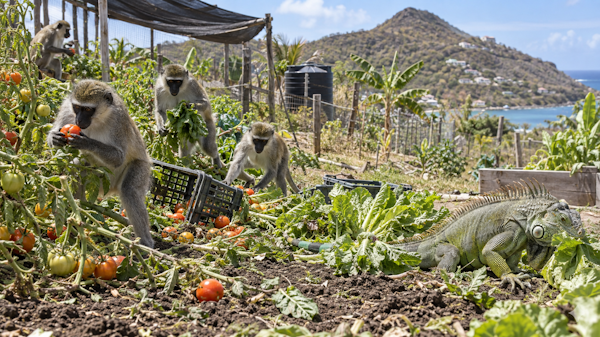
An SMN News review of the 337-page draft found between Cg 2.392 million and Cg 2.453 million in identifiable agriculture-related spending. However, the document contains conflicting figures, provides no direct subsidy for established farmers, and does not explain how the government will protect local food production from monkeys and invasive green iguanas.
The agriculture envelope comprises between Cg 1.192 million and Cg 1.253 million in ordinary spending, together with Cg 1.2 million in capital funding for the proposed Agriculture, Livestock and Fisheries Agency, known as the ALF Agency.
The ordinary allocation represents less than 0.2 percent of the government’s Cg 662.2 million ordinary budget and approximately 2.7 to 2.9 percent of TEATT’s Cg 43.9 million budget.
The identified allocations include Cg 300,000 for agricultural research, a Farm-to-Fork roadmap and an online agriculture platform; Cg 392,000 for an agricultural microloan programme administered through Qredits; and Cg 400,000 in initial support for the ALF Agency.
The Qredits programme is intended to train applicants and help them qualify for microloans at two per cent interest. It is the only financial programme in the draft aimed directly at persons interested in agriculture and fisheries.
However, these are loans that must be repaid—not subsidies.
The draft contains no grant or subsidy specifically reserved for farmers who are already producing crops or raising livestock. Established farmers are mentioned as stakeholders in the proposed Farm-to-Fork programme and agriculture knowledge platform, but no direct financial assistance is promised to them.
Conflicting agriculture figures
The draft also contradicts itself on funding for Agriculture in Schools.
The detailed subsidy schedule and TEATT’s budget-comparison table list Cg 100,000 for the programme, down from Cg 261,211 in 2026. That would represent a 62 percent reduction.
However, TEATT’s policy-activities table lists Cg 161,000 for what appears to be the same programme. The Cg 61,000 discrepancy means the final agriculture total cannot yet be stated with certainty.
Another Cg 400,000 entry is similarly unclear. Its description refers to supporting agriculture projects in schools, while its expected result concerns establishing an Investment Promotion Agency. SMN News did not include that amount in the agriculture total because the draft does not reliably establish its purpose.
A borderless monkey problem
The uncertainty over agriculture funding comes as farmers and residents continue to face damage from invasive monkeys—an islandwide problem that the border between Dutch Sint Maarten and French Saint-Martin cannot contain.
The Nature Foundation’s original monkey-management proposal estimated approximately 450 monkeys on the Dutch side alone. It called for a five-year programme using traps or tranquilizer darts, followed by veterinarian-administered euthanasia. Its bare-minimum funding scenario was NAf 100,000 annually. Nature Foundation’s monkey-management proposal
A French-side Nature Reserve report said 14 traps were deployed and 108 monkeys were captured and euthanized between January and November 2023. It also reported a government objective of euthanizing 450 monkeys by 2025.
French and Dutch-side representatives subsequently discussed developing a coordinated approach across the island. However, the project was still undergoing financial and technical evaluation, and alternatives remained under consideration. French-side Nature Reserve report
The sources reviewed did not identify a current islandwide population count, a French-side count, or a verified total of monkeys removed through 2026.
The Nature Foundation said in 2023 that Sint Maarten’s programme was limited by available funding, local law and technical capacity. Sterilization was reportedly not funded, and releasing sterilized non-native animals would conflict with the local legal framework.
The Foundation also said the programme was expected to end in 2026, after which its results and possible long-term alternatives would be assessed. Nature Foundation’s 2023 statement
Despite that approaching deadline, the 2027 draft budget does not mention monkeys, culling, euthanasia or a successor programme. It provides no 2027 population target, removal target, timetable or cross-border strategy.
Iguana response remains undefined
The position on invasive green iguanas is even less clear.
The Nature Foundation lists green iguanas among four target species under a government-funded invasive-species project. The other targets are monkeys, mongoose and coralita vine.
The Foundation reports US$55,000 in annual funding for the overall project and describes activities such as research, monitoring and mitigating human-wildlife conflict. It does not state how much is spent on iguanas or provide an iguana population estimate, containment target, removal method or timetable. Nature Foundation invasive-species project
The 2027 draft contains a general Nature Foundation service agreement under VROMI. One policy table lists Cg 536,000, while the government’s contracts schedule lists Cg 546,840. Neither figure is broken down between monkey management, iguana control or the Foundation’s other environmental responsibilities.
VROMI also intends to operationalize an updated Nature Policy Plan for 2025-2030 and revise the Nature Protection Ordinance. However, the budget does not explain what either measure will require for monkeys or iguanas.
The government is therefore budgeting for agricultural research, loans, and a new agency while leaving unanswered how crops will be protected from invasive animals.
Until the conflicting figures are corrected and species-specific plans are published, the central food-security question remains unresolved: How will Sint Maarten expand local agriculture if farmers are expected to finance production themselves while facing wildlife losses that the government has not clearly budgeted to control?