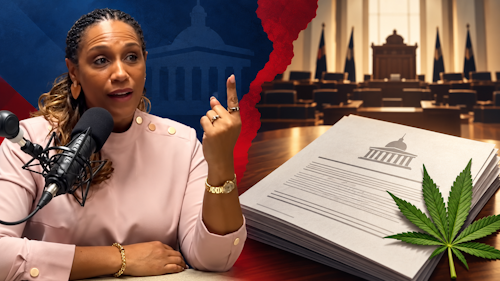
~Says Cannabis Consultant Bears the Risk if Parliament Rejects Legalization. TEATT minister defends proposed ten-year wholesale concession and says MP Ludmilla de Weever missed opportunities to discuss the agreements with her.~
PHILIPSBURG:--- Minister of Tourism, Economic Affairs, Transport and Telecommunication Grisha Heyliger-Marten says Native Nations would bear the financial loss if Parliament rejects proposed cannabis legislation. In a wide-ranging interview on Live with Lady Grace in the Breakfast Lounge, she also challenged coalition MP Ludmilla de Weever’s public questioning of the agreements, saying she had offered to discuss them directly.
Heyliger-Marten described the agreement signed before she took office in May 2024 as a consultancy arrangement. According to the minister, Native Nations is responsible for funding work on the proposed law, while government must take the draft through its legal and public consultation processes and submit it to Parliament. Parliament remains free to reject it, she said, and the consultant could not recover its expenditure from government if that happens.
The original arrangement also offered Native Nations a five-year exclusive wholesale concession if legislation passes, the minister said. She explained that the company later requested ten years, citing the cost of a proposed production facility. Her government considered the extension subject to additional conditions.
Those conditions, as Heyliger-Marten described them, include a cannabis regulator, participation by at least 16 local farmers whose qualifying crop would be purchased, and community contributions of $750,000 annually over ten years. She also said the proposal calls for 2% of gross earnings to support the regulator. These are elements of the minister’s account of the proposed arrangement; they do not mean a cannabis industry or its projected benefits have been approved.
Heyliger-Marten said Native Nations envisages an enclosed cultivation facility that could also accommodate a farmers’ market and visitor tours. She said the proposed law had not yet reached Parliament and suggested it could arrive in the first quarter of 2027 after further review. She gave no assurance that a parliamentary majority would support it.
The minister then addressed questions De Weever raised during the 2026 budget debate. Heyliger-Marten said she was surprised by the intervention because De Weever had previously contacted her directly and because the original procurement process had already drawn questions from opposition MPs, including Heyliger-Marten herself.
“I’ve always been transparent,” the minister said. She said she sought legal advice, submitted the earlier and revised agreements for parliamentary review, and set aside time for MPs to meet with her. According to Heyliger-Marten, De Weever did not attend those sessions. The minister acknowledged that scheduling prevented one meeting and said she offered another opportunity.
De Weever’s questions remain consequential regardless of whether she met the minister privately. MPs must assess what an exclusive concession would mean for local businesses, public health, enforcement and Parliament’s freedom to legislate. The precise terms of both agreements, and any legal advice governing their disclosure, are central to that scrutiny. Heyliger-Marten’s interview provided her account of those terms, while the proposed law remains subject to parliamentary debate.