MP seeks regular financial reports and measurable results on healthcare, GEBE, tourism, justice and education
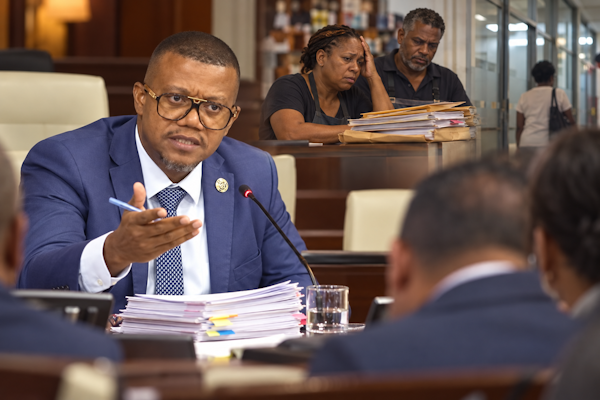 PHILIPSBURG:--- MP Francisco Lacroes questioned how the government can project a surplus in its draft 2027 budget while leaving bills unpaid, pressing Finance Minister Marinka Gumbs for a full account of outstanding obligations and the risks that could upset the government’s forecasts.
Speaking during Monday evening’s Central Committee debate, Lacroes asked ministers to attach dates and measurable results to their plans. He said he had submitted questions in writing before the meeting and had removed those already answered in the draft budget.
“Let’s pay the people”
Lacroes asked how much government currently owes suppliers, how long those bills have been outstanding and when they will be paid. A projected surplus means little to him if businesses are still waiting for payment for goods and services already delivered.
He requested measures to stop new arrears from accumulating and asked Finance to report regularly to Parliament on progress. Lacroes also proposed monthly updates showing how much remains available in each ministry’s budget, so MPs can see how allocations are spent throughout the year.
The MP asked what assumptions support the projected 2027 surplus and what government would do if tourism growth, economic activity or revenue collection falls below expectations. He sought contingency plans for unexpected costs, including those arising from a hurricane, and asked what level of cash reserves government considers necessary.
Healthcare funds and financial exposure
Lacroes requested a plan to address deficits in the social insurance and healthcare funds. He asked how much government owes the funds, how it intends to repay that debt and whether it has obtained independent legal advice on transfers between them.
He also asked government to quantify the financial risks associated with GEBE, TELEM and the Postal Services. Under what circumstances, he asked, might one of those entities require public funds, and what would that mean for future budgets?
His other finance questions covered unspent investment allocations, the timetable for possible gaming and tourist taxes, the long-term sustainability of the General Pension Fund APS, and Sint Maarten’s potential financial exposure in the Ennia matter. Lacroes requested quarterly reports covering revenue, cash reserves, payment arrears, healthcare funds, investment projects and major financial risks.
GEBE bills and the government building
Lacroes questioned a GEBE fuel-cost increase that he said appeared to have been applied retroactively to his bill. If customers were charged for a period before an increase properly took effect, he said, they should receive their money back. The relevant billing dates and tariff notice would need to be examined to establish whether that happened.
He also requested the status of GEBE’s audited financial statements for 2023, 2024 and 2025, along with updates on governance recommendations and unresolved issues following the utility company’s cyberattack.
Turning to the government administration building, Lacroes asked for a detailed report on mold, air quality and workplace conditions. He wants the government to identify what has been found, what remediation has taken place, and when any remaining work will be completed.
Tourism growth and local businesses
Lacroes asked the TEATT minister to set out 2027 targets for visitor arrivals, spending, stay-over tourism and cruise tourism. He sought timelines for the tourism master plan, an airlift strategy and an assessment of how much tourism Sint Maarten can accommodate.
He raised concern that, during the high season, some people may provide yacht services without the required local business licenses or tax compliance. He asked the government to strengthen enforcement so properly registered local companies are not put at a disadvantage. His remarks raised an allegation for ministers to address; the intervention did not establish how widespread the practice is.
Lacroes also called for faster processing of business and managing-director licenses. Delays can prevent a company from operating and cost government a year of license revenue, he argued. He requested measurable goals for economic inspections, consumer protection, agriculture, fisheries, small-business support and the Department of Statistics.
Police, prison and emergency response
While praising the visibility of police officers on the streets, particularly in St. Peters, Lacroes urged Justice Minister Nathalie Tackling to settle outstanding payments to justice personnel.
He asked for a firm timetable to complete and open the new Pointe Blanche prison, the number of staff it will require and a contingency plan if the project is delayed. He also sought updates on vacancies across police, customs, immigration and the prison, as well as plans for body cameras, breathalyzers and speed-enforcement equipment.
Lacroes asked whether the department could appraise and sell aging police vehicles to help finance replacements. He raised concern about ambulance availability and requested an account of unresolved labor, pension, overtime and compensation matters involving emergency personnel. The number of working ambulances he mentioned was his estimate during the debate, not a confirmed fleet count.
On disaster readiness, he asked about the condition of shelters, emergency communications and public-warning systems. He also warned that stacks of scrap vehicles and metal near the dump could present a hazard during a hurricane and asked who is responsible for addressing it.
Schools, sport and public health
Lacroes asked Education Minister Melissa Gumbs for measurable targets on student performance, study financing, school transport, repairs and maintenance. He questioned whether the country’s list of preferred fields of study matches occupations for which employers currently recruit workers from abroad.
He sought an update on training sports federations to apply for government funding, saying that work should be done in time to identify any changes needed to the budget. He also asked which sports facilities and athlete-development programs remain unfunded or only partly funded.
On public health, Lacroes asked for the government’s plan to meet the needs of an aging population. He also asked Parliament to receive research on obesity and raised a possible tax on sugary products for consideration.
Across the ministries, Lacroes sought a consistent answer: what will be completed in 2027, when will it happen, and how will Parliament know whether it worked?