VROMI has signed off, but Fire Department clearance remains outstanding; the first phase is targeted for completion in September 2027.
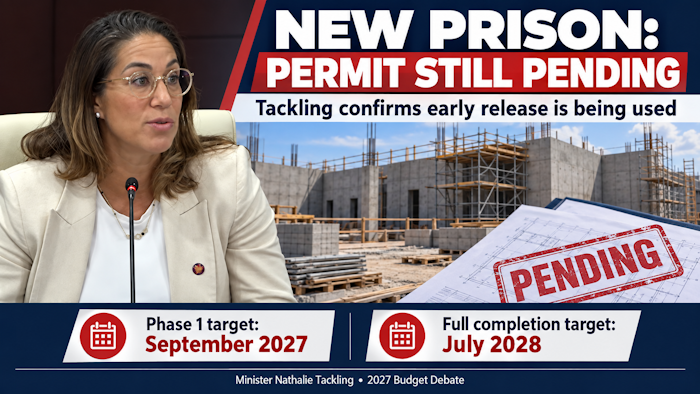 PHILIPSBURG:--- Sint Maarten’s new Pointe Blanche prison has not yet formally received its building permit, Minister of Justice Nathalie Tackling confirmed during Parliament’s Central Committee discussions on the draft 2027 budget.
Responding to MP Ardwell Irion, Tackling said the Minister of VROMI had signed off on the permit. However, its official receipt remained pending because the Fire Department had not yet provided clearance.
The Minister noted that the Fire Department had previously reviewed the prison’s design before the tender went out.
Her response draws an important distinction: VROMI has signed off, but the formal building-permit process remains incomplete.
Tackling also explained that the construction company needs four permits, three of which it has already obtained. The outstanding permit concerns the second construction stage, not the immediate phase. The construction company and VROMI are working to secure it.
September 2027 Target Remains
Despite the outstanding formal building permit, Tackling maintained that the first construction phase is scheduled for completion in September 2027, followed by the operational transition into the new accommodation.
That phase is intended to increase permanent prison capacity from 86 to 120 places.
The second phase is scheduled for completion in July 2028, bringing the facility to its full design capacity of 196 places.
The UNOPS-led construction program is delivering the redevelopment. Tackling described the overall project as valued at approximately US$54 million and said construction costs had been covered and disbursed through previous budgets.
The immediate accountability question is when the remaining Fire Department clearance will be secured and the formal permit received. Tackling’s responses did not provide a date for that step.
Early Release Already Being Applied
Responding to MP Omar Ottley about measures to relieve detention pressure before the new facility is completed, Tackling confirmed that the government is using the release options available under the law.
She identified regular conditional release under Article 131 and the additional release mechanism under Article 137 of the Criminal Code.
“We are using Article 137 of the Criminal Code, and this is a constant assessment, not a one-time decision,” Tackling said.
According to the Minister, the assessment is triggered when the Public Prosecutor indicates an acute shortage of detention capacity. Authorities then weigh the need to accommodate pretrial detainees, including the seriousness of their alleged offenses, against the position of inmates approaching release.
The Prosecutor is therefore involved from the beginning, she explained.
Her response confirmed that Article 137 is being used, but did not identify how many inmates have been released through that mechanism or provide a breakdown of the assessments.
Sixteen Temporary Places Planned in Simpson Bay
Government is also developing temporary accommodation for up to 16 low-risk inmates at the Foreigner Detention Center in Simpson Bay.
Tackling put the construction budget for that measure at approximately US$900,000, comprising US$440,000 from Sint Maarten and US$460,000 from the Netherlands.
She identified detention elsewhere within the Kingdom as another option when local facilities cannot accommodate an inmate, provided space is available.
The contingency approach therefore combines continued operation of the existing prison, temporary accommodation in Simpson Bay, detention elsewhere when possible, and the additional capacity expected from the new prison’s first phase.
Rehabilitation Must Continue During Construction
Tackling stressed that improving detention conditions and rehabilitation services does not depend entirely on the final construction deadline.
Existing and developing activities include education, vocational learning, physical activity, health and mental-health screening, family engagement and digital learning.
Recruitment is underway for 22 correctional officers expected to start in October 2026, with a further intake of 15 planned for early 2027. Temporary staffing support from Suriname is helping maintain operations while permanent recruitment and training continue.
The Minister also acknowledged that references in the budget document suggesting rehabilitation and reintegration work had been completed in 2025 were typographical errors. That work is continuing through 2026 and into 2027.
Government has outlined several measures to manage detention pressure. Delivering them now requires clear progress on the outstanding permit, temporary accommodation, staffing and construction milestones.
With the first new accommodation still targeted for September 2027, Parliament needs regular reporting on those commitments—and a definite answer on when the prison’s formal building permit will finally be received.