Minister Tackling confirms outstanding management arrangements, major probation shortages and only five foster parents currently available for placements.
 PHILIPSBURG:--- Sint Maarten’s youth crime prevention efforts face significant implementation obstacles, according to responses delivered by Minister of Justice Nathalie Tackling during Parliament’s Central Committee discussions on the draft 2027 budget.
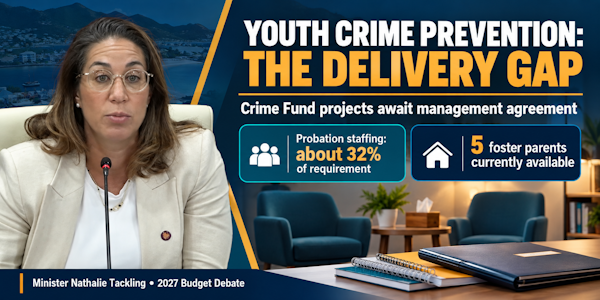
Crime Fund projects await a signed management agreement, probation services operate with about one-third of their required officers, and the pool of available foster parents remains limited.
The Minister’s answers expose the practical challenge behind government’s prevention commitments: approved priorities require personnel, functioning management arrangements and measurable results before they can deliver meaningful protection.
Crime Fund Projects Await Management Agreement
Tackling confirmed that the memorandum of understanding with the Sint Maarten Development Fund to manage Crime Fund projects had not yet been signed.
She said the parties agreed on the text during the week of the budget discussions, and signing would follow as soon as possible. However, the listed projects could not begin until the agreement was finalized so they could be properly managed.
The Minister also confirmed that no separate 2027 Crime Fund policy plan accompanied the draft budget, citing the short interval between the 2026 and 2027 budget debates.
The Ministry intends to continue with projects and outcomes identified in the 2026 plan. Tackling said she would prepare a more detailed plan after the management agreement is signed and the project submission handbook is finalized.
An updated plan could follow for 2027 if warranted. Otherwise, a new policy plan would accompany the 2028 budget.
Her explanation identifies the administrative prerequisites, but leaves Parliament needing definite commencement dates for the projects already prioritized.
Probation Has About One-Third of Required Staffing
Tackling said probation services have approximately five and a half full-time-equivalent officers available against a workload-based requirement of at least 17.
She put current capacity at approximately 32% of the requirement, with a shortfall of roughly 12 full-time officers.
In 2025, the department handled approximately 1,232 active probation products and services and received 709 new assignments from judicial authorities. These included 321 court reports and risk assessments, 166 supervision cases, 121 community service orders and 101 behavioral intervention cases.
These figures represent services and assignments, rather than a count of individual offenders.
Limited detention capacity has increased reliance on community supervision and alternatives to detention, Tackling explained. That shift places greater responsibility on probation personnel to assess risks, monitor compliance, respond to breaches and support reintegration.
The Minister acknowledged that staffing shortages affect the frequency and quality of client contact, timely responses to noncompliance, report preparation and the ability to expand safe alternatives to detention.
The immediate priority is recruiting two additional probation officers and filling policy and project positions. Further recruitment would be phased toward the minimum requirement of 17 probation officers.
Child Protection Positions Await Approval
The Court of Guardianship also faces staffing pressure.
Tackling clarified that it has 12 staff members against a proposed establishment of 19.5 full-time-equivalent positions, placing it at approximately 61.5% of the proposed capacity.
Several new positions cannot be filled until the relevant legal framework and function book are formally approved.
Additional funding could support recruitment, she said, but those prerequisites must first be completed.
The Minister said the department meets reporting deadlines set by the Prosecutor’s Office and Court when cases are referred on time and through agreed channels. Nevertheless, she acknowledged considerable pressure on an organization responsible for child protection, abuse and neglect, family matters, child support and youth probation.
Only Five Foster Parents Currently Available
Tackling said 10 foster parents are registered, but only five are currently available and actively providing placements.
The others are unavailable because of personal circumstances, limited capacity or an inability to accommodate a child’s particular age, needs or risk profile.
A foster-care awareness and recruitment campaign is planned for the third week of November, with particular attention to placements for adolescents and children with behavioral or emotional needs.
However, Tackling warned that awareness alone would not produce enough additional homes. The foster-care allowance remains a major obstacle to recruitment and retention because families shoulder everyday costs including food, clothing, transport, school supplies and utilities.
She said implementing the planned allowance increase before the campaign would be essential to strengthening recruitment and supporting existing foster parents.
HALT Evaluation Details Still Being Finalized
The Minister's responses indicate the HALT youth initiative is expected within the first half of 2027.
Its monitoring framework includes recidivism indicators, standardized data collection, a performance dashboard and annual evaluation. Reducing repeat offending among participating young people is an intended outcome.
However, the implementation documents do not yet include a finalized guideline defining the measurement period, what constitutes reoffending, and how the recidivism rate will be calculated.
Tackling said those parameters would be formalized as the pilot becomes operational and shared with Parliament once completed.
Prevention Must Move from Plans to Services
Tackling argued that existing prevention projects should be implemented and evaluated before additional initiatives place further strain on the justice system.
That position makes delivery the central accountability test. Parliament needs clear dates for the Crime Fund agreement, project implementation, staffing approvals and recruitment, alongside confirmation of the foster-care allowance increase and HALT’s evaluation standards.
The Minister has identified the gaps. Closing them requires sustained implementation, because prevention depends on the people and services available to intervene before vulnerable children and young people become more deeply involved in the justice system.