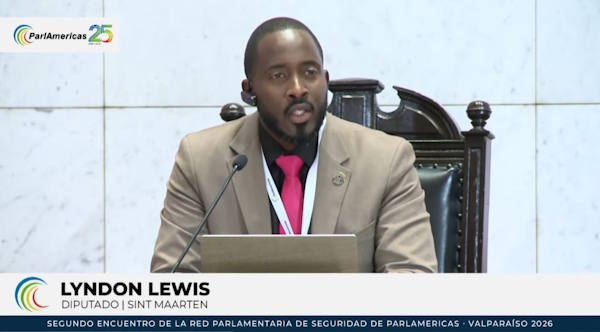
 PHILIPSBURG:--- Nation Opportunity Wealth (NOW) Member of Parliament (MP) and Chairman of the Justice Committee, Lyndon Lewis, called for stronger regional cooperation, better-equipped justice institutions, and practical legislation to address cybercrime and organized crime during his contribution to discussions on democratic security at ParlAmericas in Chile.
Drawing on his experience at the Immigration and Border Protection, Police Force of Sint Maarten, National Detective Agency, his tenure as Minister of Justice, and his current role as a Member of Parliament, MP Lewis was invited to the ParlAmericas National Congress in Chile as a Panelist on the topic of Democratic Security in Latin America and the Caribbean.
MP Lewis highlighted the growing challenges facing democracies throughout the Americas and the Caribbean. These challenges include criminal influence over public institutions, rapidly evolving digital threats, limited institutional resources, and declining public trust.
“Democratic security means that people can live safely, exercise their rights, participate freely in public life, and trust that public institutions serve them fairly,” Lewis stated.
He emphasized that organized crime threatens more than individual criminal offenses, warning that intimidation, corruption, illicit financing, and the manipulation of public systems can weaken the foundations of democratic government. He explained that addressing these threats requires independent institutions, transparent decision-making, and consistent parliamentary oversight.
MP Lewis also highlighted the particular challenges facing Sint Maarten and other small Caribbean jurisdictions, where limited budgets and specialist personnel must meet increasingly complex security demands.
“A small jurisdiction still needs a functioning justice system and credible cybersecurity arrangements. Those responsibilities do not disappear because the population is smaller,” MP Lewis said.
He advocated regional approaches that let smaller jurisdictions access shared forensic services, specialist expertise, and training, along with clear procedures for cross-border investigations and preserving electronic evidence.
On legislative design, MP Lewis stressed that stronger laws must be backed by realistic implementation plans. He urged parliaments to consult investigators, prosecutors, the judiciary, businesses, technical specialists, civil society, and victim-support organizations before introducing reforms.
“We cannot assume that passing legislation means the country is prepared,” MP Lewis stated.
MP Lewis called for legislative proposals to include clear responsibilities, adequate funding, training, equipment, and measurable reporting requirements. He also emphasized the importance of tracing criminal proceeds, protecting witnesses, improving reporting channels for victims, and reviewing laws after enactment to see whether they deliver meaningful results.
Throughout his contribution, MP Lewis underscored that public safety and democratic safeguards must advance together. He maintained that investigative powers should be clearly defined, proportionate, and subject to appropriate authorization and independent oversight, while protecting legitimate expression, journalism, and political participation.
Concluding his remarks, MP Lewis outlined three questions that should guide parliamentary consideration of security reforms:
MP Lewis' contribution placed Sint Maarten's and smaller Caribbean jurisdictions' needs within the wider regional discussion, emphasizing that effective democratic security requires capable institutions, practical cooperation, and accountability to the people those institutions serve.