Ali calls for an apology, Mottley demands justice, and Caribbean reparations bodies prepare to press their case at Commonwealth summit
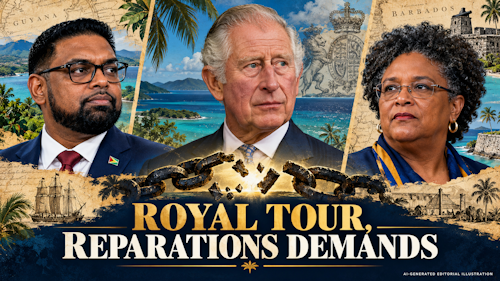 PHILIPSBURG:--- King Charles III’s Caribbean tour is unfolding against organized demands for Britain to confront its colonial past, with regional leaders and reparations advocates pressing for an apology, accountability and practical measures to repair the damage caused by enslavement.
The nine-day tour began in The Bahamas on Tuesday, October 27, includes a state visit to Guyana, and will conclude in Antigua and Barbuda, host of the Commonwealth Heads of Government Meeting (CHOGM). Buckingham Palace confirms that the tour runs through November 4. Barbados is not on the schedule.
The Bahamas visit runs from October 27–29. Guyana’s government has confirmed a two-day state visit beginning Thursday, October 29, at the invitation of President Dr. Mohamed Irfaan Ali. Queen Camilla will join the King in Antigua and Barbuda for the final leg, including the Commonwealth gathering scheduled for November 1–4.
Behind the ceremonial welcomes, preparations for the reparations debate are already taking shape through national advocacy, correspondence with the Palace and coordinated regional action.
In The Bahamas, National Reparations Committee Chair Dr. Niambi Hall Campbell-Dean has called for the King to acknowledge responsibility through an apology and engagement with the reparations movement.
Speaking to Our News ahead of the visit, Campbell-Dean connected reparations to present-day development challenges. The committee was preparing a presentation to Cabinet explaining how reparatory justice could support national development, while campaigning to secure the issue’s place on the CHOGM agenda.
Those preparations reflect a push to turn public attention surrounding the royal visit into political action. They do not establish that the Bahamian government has secured a reparations agreement or a dedicated negotiating session.
In Guyana, President Ali has made clear that acknowledging slavery’s horrors must be followed by further action.
“Now, moving to the apology is the next step,” Ali told ITV News, according to AFP’s reporting of the interview.
ITV reported that Ali identified two steps beyond the King’s previous expressions of regret: a formal apology and reparatory justice. He also recognized Charles’s environmental advocacy, including his commitment to rainforest protection and Indigenous peoples.
The position allows Guyana to welcome the monarch while maintaining its demand for historical accountability. ITV also documented a pro-reparations rally ahead of the visit, illustrating the public pressure accompanying the diplomatic program.
Barbados Prime Minister Mia Amor Mottley, although her country is not on the itinerary, has delivered an unequivocal statement on the regional case.
“We are not asking for charity. We are asking for justice,” Mottley wrote in an earlier public statement published on her LinkedIn account.
She rejected suggestions that Caribbean people owed Britain for the institutions that oppressed their ancestors and warned against using the region to serve British political arguments.
“The Caribbean will not be used as a prop for anyone’s politics,” she stated. These remarks predate the current tour and reflect her broader position on reparatory justice.
Barbados has also served as a regional hub for preparations. CARICOM’s Reparations Commission announced an October 22 media briefing after relaunching its revised Ten-Point Plan at the Third CARICOM Regional Conference on Reparations in Barbados.
The briefing aimed to outline planned CHOGM engagements and strategies to advance reparatory justice through the Commonwealth and the United Nations. This provides documented evidence of coordinated preparations ahead of the King’s arrival at the summit.
In Antigua and Barbuda, the Reparations Support Commission has appealed directly to the royal household.
According to Antigua News, Chairman Ambassador Dorbrene E. O’Marde wrote to the King’s Private Secretary, Sir Clive Alderton, on October 21, urging Charles to help move Commonwealth discussions toward meaningful action.
The commission welcomed the visit but criticized resistance to a formal apology. It argued that institutions could accept moral responsibility for historical wrongdoing without assigning personal guilt to their present members. The correspondence was addressed to Antigua and Barbuda’s Governor-General and Prime Minister.
Charles acknowledged past suffering during his opening appearance in The Bahamas and indicated that Commonwealth leaders would discuss slavery’s legacy. However, ITV reports that the British government has not advised him to offer an apology or reparations.
That leaves a central issue unresolved as the tour continues: whether renewed recognition of historical injustice will produce formal dialogue and concrete commitments Caribbean leaders and reparations bodies are seeking.