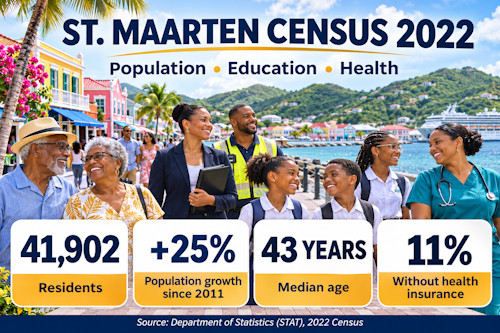
 PHILIPSBURG:--- The Department of Statistics (STAT) has released three reports from the 2022 Population and Housing Census, providing an updated picture of Sint Maarten’s population and important insights into education, health and living conditions.
Census interviews began in September 2022, with final visits conducted in April and May 2023. More than 32,000 people participated, contributing to the statistics describing the 41,902 residents living on the Dutch side of the island.
Sint Maarten’s population grew by approximately 25%, from 33,609 in 2011 to 41,902 in 2022.
Nearly half (49%) of all residents live in Cul de Sac and Lower Prince’s Quarter. The population is also ageing, with the median age increasing from 35 years in 2011 to 43 years in 2022, and the proportion aged 65 and older rising from approximately one in 20 (5%) to one in seven (14%).
Sint Maarten remains culturally diverse, with two-thirds of residents born abroad. The Dominican Republic (9.5%), Haiti (6.6%), Jamaica (6.0%) and Saint Martin (5.6%) are among the most common places of birth outside Sint Maarten. English remains the main language spoken at home, followed by Spanish and French Creole.
The Census also found approximately 84 men for every 100 women. Nearly one in three (31%) households consist of a single person, while almost half (49%) of adults have never married. More than one-third of never-married adults live with or have a partner.
Religious affiliation has also changed, with the proportion identifying as Roman Catholic declining from approximately 42% in 1992 to 26% in 2022, while the proportion reporting no religious affiliation increased from 11% to 19%.
Approximately 97% of children aged 4 to 17 attend school, with similar attendance rates for girls and boys. About one in five (22%) young people aged 18 to 24 remain in education. Educational attainment varies by age, with approximately four in ten (41%) residents aged 65 and older having primary education or less, compared with fewer than one in ten (9%) among those aged 25 to 34.
Among residents aged 25 and older, approximately one in four (25%) women hold a college or university degree, compared with one in five (20%) men. Among those aged 25 to 34, the proportions are approximately one in three (32%) women and fewer than one in five (18%) men.
Education is also associated with employment and income: residents with a college or university degree are more likely to be employed and earn a typical monthly income of approximately NAf 4,500, compared with about NAf 1,500 for those with primary education or less.
Four in five residents (80%) rated their health as good or very good, while approximately 2% rated it as bad or very bad. Health insurance coverage has improved considerably since 2001, when about three in ten (30%) residents had no coverage. By 2022, this had declined to approximately one in nine residents (11%), or 4,600 people. Nevertheless, gaps remain, particularly among working-age men and people with low or no income. Most insured residents are covered by SZV.
More than one-third (35%) of residents reported living with a long-term illness, with high blood pressure, allergies and diabetes being the most common single conditions. Around one in five (22%) residents have some difficulty with everyday activities, such as seeing, walking or remembering. These difficulties are more common among older residents and women.
Approximately one in 14 (7%) residents experienced hunger during the preceding year because they lacked sufficient money to buy food. The situation varied considerably by district, affecting approximately one in seven (15%) residents in Great Bay and more than four in ten (45%) in Pond Island. Residents who experienced hunger were also more likely to lack health insurance.
The Census further found that approximately 5% of residents smoke. Among those who answered questions about sports and physical activity, around six in ten (60%) reported participating in no sport or physical activity. This proportion increased to approximately eight in ten (79%) among residents aged 75 and older.
The 2022 Population and Housing Census provides an important statistical foundation for understanding demographic change and the social and economic conditions of Sint Maarten’s population. Its findings can support policymakers, government departments, researchers, businesses and other stakeholders in identifying emerging needs and developing evidence-based policies and programmes.
STAT encourages the public and stakeholders to explore the findings and use the available statistics to deepen their understanding of Sint Maarten.
The full reports on Demography, Education and Health, including detailed statistical tables, are available on the Department of Statistics website: https://stats.sintmaartengov.org/
For additional information, please contact the Department of Statistics at This email address is being protected from spambots. You need JavaScript enabled to view it..