Prime Minister defends higher allocations as a correction of longstanding weaknesses, with electricity and water budgeting up 161 percent and firefighter breathing equipment expected in early 2027
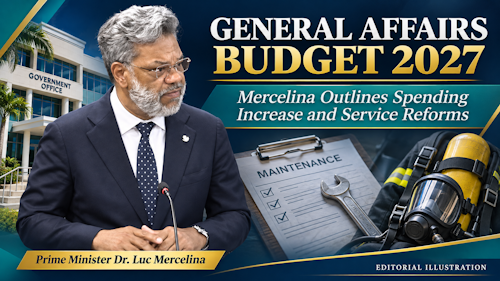 PHILIPSBURG:--- Prime Minister Dr. Luc Mercelina has proposed increasing the Ministry of General Affairs budget from 82 million guilders in 2026 to about 95 million guilders in 2027, arguing that the government must confront the real costs of its operations while repairing neglected facilities and strengthening understaffed departments.
Presenting the draft budget to Parliament as Minister of General Affairs, Mercelina described the increase as an investment in the support services the entire government depends on.
His presentation combined claims of progress with striking acknowledgments of longstanding failures: government-building elevators had gone without proper maintenance for at least five years, more than a quarter of the building’s lighting required replacement, and the department overseeing substantial public assets lacked dedicated maintenance positions in its formal staffing structure.
The prime minister said the proposed increase—described in his presentation as about 15 percent—would support staffing, reduce the backlog, and enable more realistic budgeting of operating expenses.
“These investments are not intended to expand the Ministry for the sake of expansion,” he told Parliament. “They are intended to address persistent weakness and to strengthen the Ministry’s ability to perform its core responsibilities.”
Utility allocations rise sharply to reflect actual costs
Among the largest percentage increases Mercelina highlighted are a 72 percent rise in the communication allocation and a 161 percent rise in the electricity and water allocation.
He attributed those changes to persistent underbudgeting, saying actual expenditure had exceeded the amounts provided for many years.
Government incurred and paid the bills, he explained, but the budget did not adequately reflect the costs.
The proposed increases therefore should not be read as equivalent increases in consumption or utility rates. According to Mercelina, they are intended to bring the allocations closer to expected expenditure, taking previous costs and inflation into account.
“Rather than continuing the budget amounts that we know are insufficient, we have included allocations that more accurately reflect actual expected expenditures,” he said.
The explanation acknowledges a recurring weakness in financial planning: operating costs were being paid even though the approved estimates did not realistically represent them.
Mercelina said Parliament and oversight bodies had repeatedly raised concerns about that mismatch.
Substantial assets, inadequate maintenance structure
The prime minister placed the scale of government’s property responsibilities at an estimated US$100 million in owned properties, with annual rental payments exceeding US$1 million.
He also identified an insured inventory valued at approximately US$60 million and annual insurance costs of about US$500,000.
Those figures describe the responsibilities outlined in the presentation and should not be added together as a single asset valuation.
Despite the portfolio's scale, Mercelina said Facility Affairs lacked a dedicated maintenance capability to systematically preserve government assets.
Its function book does not include a maintenance employee, an insurance specialist or a procurement and contract-management team, he said.
Information on contracts, assets, maintenance needs and lifecycle costs was fragmented and incomplete.
The prime minister acknowledged that these deficiencies had been raised repeatedly, including by MPs, but had largely remained unresolved.
Elevators lacked proper maintenance for at least five years
Mercelina said assessments found that elevators in the Government Administration Building had not received proper maintenance for at least five years and possibly much longer.
Necessary repairs and safety checks have now been completed, regular maintenance has resumed, and the process of obtaining international safety certification has begun, he told Parliament.
His statement did not indicate that certification has already been obtained.
Assessments also found that more than 25 percent of the building’s lighting required replacement. More than 300 light bulbs have been replaced in recent months.
“In a very literal sense, we have been putting lights back on in the government administration building,” Mercelina said.
Problems involving bathrooms, security systems and air-conditioning infrastructure are also being addressed.
While these are basic operational matters, their inclusion in the presentation illustrates how far routine upkeep had fallen behind.
Mercelina said correcting the accumulated problems would require sustained work over several years.
Administrative backlog target set for second quarter
With support from the Temporary Work Organization, TWO, project-management capacity has been introduced to improve oversight and address longstanding Facility Affairs problems.
Mercelina said a third, local project manager had recently joined the team to focus on financial and administrative backlogs and procurement.
The team is expected to complete most of the administrative backlog by the second quarter of 2027.
A small maintenance team has also been established with VROMI’s support.
The ministry is exploring technical traineeships with NIPA and opportunities to improve existing employees’ skills.
Mercelina framed the objective as a transition from reactive repairs and fragmented oversight to professional, accountable property management.
The second-quarter target gives Parliament a point against which to assess whether the administrative work is being completed.
Civil servants still awaiting service-related payments
Within Personnel and Organization, P&O, Mercelina said the longstanding jubilee backlog had been reduced to 44 outstanding cases.
The department expects to clear the remaining government-wide backlog by early 2027.
These cases concern obligations to employees who have completed years of government service.
“Reducing this backlog is not simply an administrative achievement,” he said. “It is part of restoring confidence in government’s ability to meet its obligation to its employees.”
The commitment creates another early-2027 test of whether additional capacity produces completed cases rather than further delays.
Recruitment delays undermine government’s staffing efforts
Mercelina acknowledged that the government’s recruitment process itself has become an obstacle to filling vacancies.
“Qualified professionals should not have to wait months or, in some cases, more than a year to hear back from government when they are ready and able to contribute,” he said.
The ministry is engaging a recruitment specialist, supported by a 2026 budget amendment tabled by MP Veronica Jansen-Webster.
A new local P&O section head is expected to begin later this month. Preparations have also started to engage an external recruitment agency to support recruitment across government.
Mercelina said additional funding alone cannot resolve shortages in a competitive labor market. Government must improve its ability to attract, recruit and retain qualified people.
The practical measure of success will be whether these changes shorten response times and fill critical positions.
Three external lawyers engaged to support legislation
The prime minister also outlined efforts to strengthen Legal Affairs and Legislation.
Three external legislative lawyers were engaged last month to provide part-time drafting and review support, he said.
Mercelina credited an amendment by MP Sjamira Roseburg adopted during the 2026 budget debate with making that support possible.
A plan has also been signed with TWO to establish an external legal-support pool, with recruitment commencing the previous week.
Other work includes standardizing legal advice, improving coordination and preparing a legislative calendar identifying priorities for each ministry.
Mercelina described the initiatives as the most significant strengthening of legislative capacity in the past decade.
Their intended purpose is to reduce bottlenecks in preparing and reviewing legislation, a function that affects policy implementation throughout government.
Walk-in days assist more than 4,300 people
On public services, Mercelina highlighted 29 special Civil Registry walk-in days during 2026, which assisted more than 4,300 people.
He said the additional service opportunities helped residents who could not obtain regular appointments.
The prime minister credited staff who worked evenings, weekends and overtime despite personnel shortages and recurring ICT problems.
Intake hours at the Public Service Center have also been extended following the recruitment of two receptionists who began work during the week of the presentation.
Those improvements provide measurable examples of increased access, although the presentation also acknowledged the staffing and technology pressures employees continue to operate under.
Firefighter equipment ordered after years of delay
The Fire Department’s budget is set to increase by approximately 16 percent.
Mercelina identified replacement breathing equipment as one of its most urgent needs, describing it as essential for firefighters entering burning buildings and rescuing people.
The equipment has been ordered and a down payment made, with delivery expected during the first quarter of 2027.
“Frankly, this investment should have been made many years ago,” he said.
The order marks a concrete procurement step, but the equipment still has to be delivered.
Mercelina said the government continues discussions with Fire Department employees and WICSU-PSU. Preparations for a benchmark study have begun, and operational improvements have been identified.
He described a properly staffed, trained, and equipped Fire Department as essential and nonnegotiable.
Government seeks two-year extension of reform cooperation
Mercelina identified three priorities for 2027: strengthening government capacity, national development and strategic partnerships, and disaster management and crisis response.
Capacity measures include further support for P&O, Legal Affairs, Facility Affairs and ICT, alongside a digital human-resources management system and modernization of internal processes.
He said the government has submitted a proposed two-year extension of the country-package cooperation framework to Parliament for approval, seeking to continue critical reforms and technical assistance.
Preparations also continue for a Kingdom Summit that St. Maarten will host, bringing together the four Kingdom prime ministers.
Mercelina argued that cooperation is necessary for a small country seeking to build the institutional capacity required for development.
Higher spending brings clear delivery expectations
The presentation provides several commitments Parliament can track: clearing the remaining jubilee cases by early 2027, receiving firefighter breathing equipment in the first quarter, and completing most Facility Affairs administrative backlogs in the second quarter.
Other promises require sustained follow-through, including faster recruitment, stronger legal support, improved ICT and systematic maintenance of public property.
Mercelina maintained that the investments approved during the previous budget cycle are beginning to produce results, while acknowledging that major weaknesses remain.
For the public, the test of the proposed 95 million guilder budget will be whether those investments translate into reliable services, safer facilities and fewer delays.
The prime minister’s own examples establish why that test matters: government cannot deliver consistently while essential equipment is overdue, maintenance is neglected and qualified applicants wait months for a response.