Finance Minister outlines a 14 million guilder modernization program, but admits manual processes, fragmented systems and staffing shortages remain major obstacles.
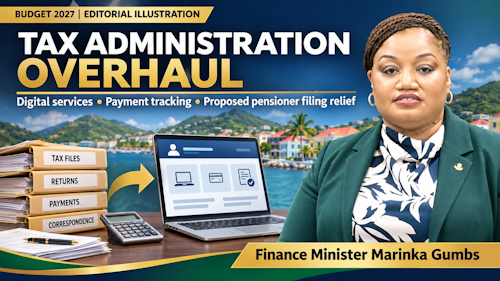 PHILIPSBURG:--- Finance Minister Marinka Gumbs has outlined plans to modernize St. Maarten’s Tax Administration through a new business taxpayer portal, improved payment processing, stronger compliance monitoring and reduced filing burdens for qualifying AOV pensioners.
Presenting the draft 2027 budget, Gumbs acknowledged that many tax administration processes remain manual, increasing workloads and the risk of errors, while fragmented systems undermine the quality of information available to government.
The proposed response includes approximately 14 million guilders for tax administration modernization, comprising 11 million guilders in capital expenditure and 3 million guilders in ordinary expenditure, financed through TWO support.
For taxpayers, the practical question is whether that investment will produce easier access to information, more accurate account records and faster resolution of administrative problems.
Gumbs said the coming year would focus on implementation and results. Her presentation also committed the administration to publishing operational goals and quarterly progress reports, giving Parliament and the public a basis to assess delivery.
New Portal Intended to Give Businesses Better Access
A central element is a new business taxpayer portal that would allow taxpayers to access filing information, review their compliance status and interact more efficiently with the administration.
The minister said the government has chosen a modular approach rather than introducing one fully integrated system at once.
The planned modules cover taxpayer management, business taxes, personal taxes, collections and payments. Supporting functions include audit, case management, risk management and a data warehouse.
The wider modernization will take several years. Gumbs nevertheless identified a series of improvements intended to begin in 2027.
The portal’s introduction will therefore need to be assessed against specific functions and delivery dates, rather than treated as evidence that the entire tax system has already been modernized.
Payment References Target Administrative Confusion
Gumbs announced plans to introduce standardized payment references to improve how tax payments are processed and allocated.
The objective is to match payments more quickly and accurately, reduce reconciliation problems, and give taxpayers greater certainty about their payment status.
This addresses an essential part of public confidence in the tax system: taxpayers need reliable confirmation that payments have reached the correct account and obligation.
A digital interface will have limited value if the underlying records remain inaccurate or payments cannot be traced efficiently. The proposed processing changes are therefore central to the reform’s practical success.
Filing Relief Proposed for Pension-Only AOV Recipients
The minister also outlined an intention to reduce unnecessary filing requirements for qualifying senior citizens whose sole income is their pension.
By using available third-party information, the administration aims to adopt a more selective approach to requesting returns.
The proposal concerns administrative filing relief. It does not amount to an announced blanket tax exemption for pensioners or the cancellation of existing obligations.
Gumbs did not provide detailed eligibility rules, an implementation date or instructions explaining how qualifying pensioners would be notified.
Those details will determine whether the proposal delivers meaningful relief and prevents seniors from becoming uncertain about whether they must still file.
Stronger Compliance Focus on Wage and Turnover Taxes
Alongside service improvements, the Tax Administration intends to introduce a 2027 compliance baseline program, particularly targeting timely filing and payment of wage tax and turnover tax.
Gumbs said the approach would strengthen control over taxpayer registration, filing, payment processing and compliance monitoring, while historical tax years would continue to be addressed systematically.
The ministry is also working to validate and clean the taxpayer register through cooperation with other institutions, including the Chamber of Commerce.
Reliable registration data is necessary for accurate assessments, effective enforcement and credible revenue forecasting.
The proposed program combines two responsibilities: making it easier for taxpayers to comply and improving the administration’s ability to identify those who do not.
Public Reporting Will Test the Promises
Gumbs said management dashboards would monitor filing compliance, payment compliance, arrears, collections, assessments and objections.
She also committed to publishing operational goals and quarterly progress reports.
That commitment gives Parliament an opportunity to demand measurable indicators, including whether payment allocation improves, objections are processed more efficiently, and digital services become available as promised.
Reporting collections alone would provide an incomplete picture. A service-oriented administration must also demonstrate that it handles taxpayer records and disputes accurately and promptly.
Staffing Remains the Main Constraint
Despite the planned technology investment, Gumbs identified staff capacity as the ministry’s principal constraint.
Finance expects approximately 134 full-time equivalent employees at the start of 2027, against a formal establishment of 214 positions.
The proposed budget provides room for 163 FTEs, including 29 funded vacancies.
The shortages are particularly acute in management and specialist functions. Gumbs said only two management positions are officially filled, with another occupied on an acting basis.
The ministry also needs analytical and policy expertise, bailiffs, tax assessors and specialists in international tax compliance.
Technology may reduce repetitive work, but implementing new systems still requires staff who can manage data, resolve errors, supervise collections and assist taxpayers.
New Tax Offices Are a Separate Investment
The minister separately outlined 27.3 million guilders for housing the Tax Administration, financed through borrowing.
The intention is to bring the Tax Administration and Receiver’s Office together at one location and provide space for additional employees.
That building investment is distinct from the externally financed modernization program.
Parliament must consequently assess both the accommodation case and the service improvements expected from the ICT expenditure. A consolidated office and new software will ultimately be judged by the quality of the administration operating within them.
Gumbs’ presentation offers concrete promises that reach beyond revenue collection: clearer taxpayer information, better payment records, less unnecessary paperwork for qualifying pensioners and greater public accountability.
The 2027 test will be whether taxpayers experience those improvements—and whether the promised progress reports make delays and shortcomings visible.