NOW MP praises Labega for putting the country above the coalition, questions the benefits of reform spending, and warns that polished presentations cannot substitute for delivery.
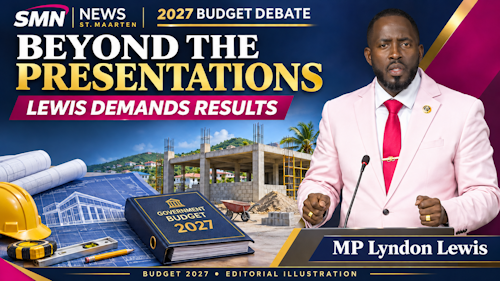 PHILIPSBURG:--- NOW MP Lyndon Lewis challenged Prime Minister Dr. Luc Mercelina and the Council of Ministers during the 2027 budget debate, accusing the government of producing attractive presentations without delivering improvements residents can feel.
Using an architectural comparison, Lewis said the government had repeatedly presented drawings while the country continued waiting for execution.
“We need contractors. We need construction workers, great construction workers to start to execute what is on the architect’s drawing,” he said.
His criticism extended across successive budgets considered during his parliamentary tenure. Submitting another budget, including one prepared in advance, was insufficient if implementation continued to lag, he argued.
Lewis questioned the Prime Minister’s account of tangible improvements, pointing instead to electricity costs, struggling government workers and unresolved public service problems.
Labega’s Criticism Undercuts the “Playing Opposition” Argument
Lewis singled out Democratic Party MP Dimar Labega for praise after Labega criticized Finance Minister Marinka Gumbs.
He argued that a coalition member raising similar concerns made it harder to dismiss opposition criticism as political theater.
“But today, I felt like MP Labega was sitting on the seat of opposition,” Lewis said.
He then questioned whether opposition MPs were merely grandstanding or identifying genuine shortcomings.
“But today, I live to see my colleague of the coalition put his country above the coalition,” he said.
The remarks gave Labega’s intervention significance beyond the disagreement between two Democratic Party politicians. Lewis presented it as evidence that concerns about government’s performance crossed the parliamentary divide.
That does not establish that Labega had withdrawn support from the coalition. Lewis was interpreting the substance and tone of his colleague’s contribution.
What Happens When External Funding Ends?
Addressing the Prime Minister, Lewis requested a clearer accounting of Netherlands-supported reform projects.
He asked for their current status, the expected benefits for residents, and the costs the government would inherit after implementation.
“What are the perceived benefits?” he asked.
“Then what is the cost after implementation?”
His concern was that government might accept externally financed systems or programs without adequately explaining whether St. Maarten could sustain their running costs.
Lewis said he wanted to see how the projects benefited the people, rather than hear implementation described as an achievement in itself.
The question links long-term affordability to project delivery: an initiative can be financed during development while still creating future staffing, maintenance, and operational obligations.
Publish the Studies and Show Their Results
Lewis also demanded information about reports and studies associated with World Bank spending.
“How much money has been spent on reports and studies?” he asked.
“How many studies and actual reports have been written?”
He requested copies or publication on a website and asked which studies were actually being used.
“Please show us the results of these studies and reports,” he said.
His contribution did not establish how much had been spent or that particular studies were unnecessary. It demanded an inventory, public access and evidence that the work had informed decisions.
Beautiful Tourism Plans Must Become Visible Improvements
Lewis described TEATT Minister Grisha Heyliger-Marten’s presentation as powerful and visually compelling.
However, he used that praise to reinforce his wider criticism: attractive plans must become physical and economic improvements.
Referring to the presentation’s vision for Front Street, he said he wanted to see it materialize rather than remain something he could only imagine.
“I want to see the dreams become a reality in this country,” he said.
His remarks distinguished enthusiasm for a proposal from satisfaction with its implementation.
Offer to Collaborate Comes With a Political Warning
Despite his criticism, Lewis said he was available to help ministers address bottlenecks.
“If any Minister needs my assistance, my second pair of eyes to look over, let’s collaborate,” he said in the supplied transcript.
“Let’s work together for the betterment of this country.”
He argued that effective performance by an individual minister or MP should be welcomed because it benefits the country.
Lewis closed with a warning about continued underperformance while also saying he wanted the parliamentary term to run its course.
“I would love my plaque to say 2024 to 2028,” he said.
“But if we continue like this, this thing got to get thrown down.”
The statement was a political warning, not an announced motion or evidence that the coalition had lost its majority.
His challenge to government was nevertheless unmistakable: defend the budget through demonstrable results, transparent spending, and services that residents can recognize.