MP says retirees should live to enjoy money owed to them, presses Mercelina to hear facilities staff and asks ECYS how its new care center will serve struggling students.
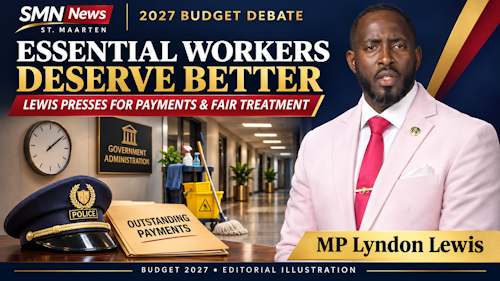 PHILIPSBURG:--- MP Lyndon Lewis challenged government over the treatment of essential workers during the 2027 budget debate, calling for faster settlement of Justice Ministry payments and stronger attention to low-paid facilities employees.
Lewis argued that workers who keep public institutions operating should not remain trapped in inadequate pay arrangements or wait years to receive outstanding entitlements.
“It is ridiculous and shameful in 2026 that we treat our essential workers in government this way,” he said.
His intervention placed the working conditions of cleaners, security personnel and other frontline employees alongside the government’s promises of improved public services.
Ten-Year Justice Payment Arrangement Challenged
Lewis criticized an arrangement he described as spreading outstanding Justice Ministry payments over ten years.
He linked the obligations to the lengthy process of establishing the ministry’s organizational and function-book arrangements, crediting former Justice Minister Anna Richardson with finalizing that work in 2023.
“That is not fair,” he said of workers being paid over an extended period.
Lewis argued that governments have often failed to serve uninterrupted four-year terms, raising concerns about workers relying on commitments that stretch across several administrations.
He said that, had he remained Justice Minister, securing payment for Justice workers and pensioners would have been a priority.
His criticism encompassed police, prison personnel, Customs, Coast Guard personnel and other workers within the justice chain.
The contribution did not provide a verified breakdown of outstanding amounts, individual entitlements or the terms applying to each category.
It demanded that government give the obligations greater financial priority.
Retirees Should Receive Their Money While Alive
Lewis spoke particularly strongly about pensioners who, he said, die before receiving payments due to them.
“They are not getting to enjoy the money that they have worked for for so many years,” he said.
He argued that delayed settlements have consequences beyond accounting. For retired workers, a payment received years later may no longer provide the security or benefit it was meant to deliver.
He questioned why the budget did not contain the revenue-generating measures needed to move more decisively toward settling these obligations.
That was a criticism of government’s priorities and funding strategy, rather than a detailed alternative repayment proposal.
Facilities Workers Take Complaints to Parliament
Lewis said he had met facilities department employees during Parliament’s preparation week and heard concerns about their treatment.
He alleged that some employees in the Prime Minister’s ministry were taking home less than minimum wage and criticized the continued use of low salary scales.
The contribution did not provide payslips or distinguish gross salary from take-home pay after deductions. His statement therefore requires a government response and examination of the relevant payroll circumstances before any conclusion about minimum-wage compliance.
His broader demand was that the Prime Minister engage directly with employees below management level.
“Walk down to your departments and see your people,” Lewis said.
“Hear the cries of your people.”
He argued that cleaners, security guards and other frontline workers should have access to those responsible for their working conditions, rather than feel compelled to seek assistance through an MP.
Public Service Reform Must Include Its Workforce
Lewis challenged the contrast between the government’s service improvement agenda and workers’ reported experiences.
Better systems and organizational plans, he argued, cannot be separated from the people expected to operate them.
His remarks also carried a political warning: employees and other residents who supported parties during elections should not find their concerns inaccessible to elected leaders afterward.
The ministerial response will need to address the specific claims about pay and working conditions while explaining what steps are available to resolve outstanding grievances.
New Student Care Center Faces Questions About Access
Turning to ECYS Minister Melissa Gumbs, Lewis requested operational details about the planned Educational Care Center for students with behavioral challenges.
He asked how the center would accommodate the number of students needing assistance and whether attendance would involve designated time slots or a full-day classroom setting.
“Will services be provided through one-on-one sessions, group settings, or a combination of both?” he asked.
Those questions concern the initiative's practical reach: how students will access it, how support will be delivered, and how capacity will match demand.
Support for Learning Difficulties Also Requested
Lewis asked whether professional assessments and specialized support could also be made available to students experiencing specific learning difficulties.
He identified dyslexia, dysgraphia and dyscalculia, questioning whether students could receive access to specialists, assessments and individualized learning strategies.
He framed the issue around children whose academic difficulties may remain unidentified or inadequately supported.
He asked whether the center could support them as well. It did not establish that expanding the center’s mandate would necessarily be the appropriate model for every student.
The minister must clarify which services the center is designed to provide and how it will meet other educational support needs.
Across the workforce and education questions, Lewis demanded that the government explain how its plans will reach the people relying on them: workers waiting for fair treatment, retirees awaiting payments, and students needing timely support.