SAM leader says he cannot honestly claim residents’ lives have improved over the past two years, while urging government to confront infrastructure costs, tax reform and poor workmanship.
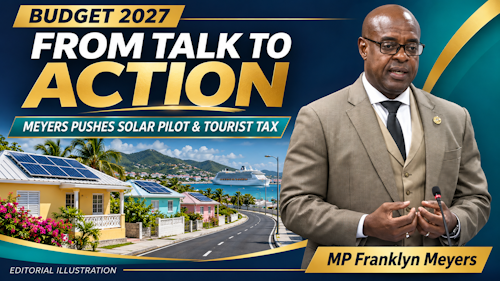 PHILIPSBURG:--- MP Franklyn Meyers has announced plans to bring a motion proposing GEBE-financed rooftop solar installations, while calling for a tourist tax and a development-related environmental charge to help finance St. Maarten’s infrastructure needs.
Speaking during the 2027 budget debate on November 4, the Soualiga Action Movement leader congratulated Finance Minister Marinka Gumbs for delivering the budget on time but challenged the government to move beyond recurring discussions of unresolved problems.
GEBE, roads and garbage collection, he said, remain concerns residents raise wherever elected representatives go.
“We cannot continue to do the same thing over and over again and expect a different result,” Meyers said.
His intervention was especially pointed when he assessed the promises politicians made to improve people’s lives.
“I can honestly say in the past two years, based on the situation and the circumstances that’s going on, I cannot honestly say to those people, we have done that,” he said.
GEBE Should Finance a Small Solar Pilot
Meyers said his proposed motion would include a pilot under which GEBE finances solar installations on homes.
He suggested starting in a limited area, identifying the emergency homes in Belvedere as an example, so the utility could assess the practical strengths and weaknesses before considering expansion.
His proposal differed from the APS-financed rooftop solar idea he said Parliament Chair Sarah Wescot-Williams had discussed.
“But my proposal was to have GB finance solar to the homes and use small areas to start with as a pet project,” he said, referring to GEBE.
The objective would be to learn from implementation on a manageable scale.
The proposal remains an intended parliamentary initiative. Meyers did not present a financing model, installation budget, repayment terms, eligibility requirements or arrangements for ownership and maintenance.
Those details would be necessary to determine whether the program could reduce household costs sustainably and how it would affect GEBE’s finances.
Tourist Tax Must Move Beyond Discussion
Meyers argued that St. Maarten’s resident population cannot indefinitely carry the infrastructure costs associated with a large visitor economy.
He cited approximate population and visitor figures to illustrate the imbalance. His contribution did not provide the underlying statistical definitions or distinguish among visitor categories, so those estimates should not be treated as a complete measurement of infrastructure demand.
His policy argument was that tourism creates additional costs for roads, waste services and the wider environment, and government needs revenue arrangements that recognize those pressures.
“It’s time that we stop talking about the tourist tax and implement it,” he said.
Meyers did not specify a rate, collection mechanism or proposed commencement date.
He demanded implementation of a measure that has repeatedly featured in public financial discussions, rather than another general commitment to consider it.
Environmental Charge Proposed for Development
Meyers also advocated a development-related environmental tax.
He argued that new residential projects generate demands extending beyond the construction site, including transport, public services and infrastructure.
Using a hypothetical condominium development, he described how additional households could create new requirements for school transportation and other government services.
“It’s time that we start to implement a development environmental tax,” he said.
The illustration was an argument about financing growth, not a technical assessment of a particular project.
Meyers did not outline how such a charge would be calculated, what developments would qualify, whether exemptions would apply or how the proceeds would be allocated.
Those questions would determine its effect on investment, housing costs and public infrastructure.
Tax Reform Needed as Businesses Face Cost Pressures
Alongside calls for additional revenue sources, Meyers urged government to simplify the existing tax system.
He said electricity bills and taxation were squeezing businesses, limiting their ability to improve operations, increase wages and provide benefits.
When businesses are forced to reduce employment, he argued, the consequences eventually return to government through greater social and economic pressure.
“Our tax system in St. Martin is too cumbersome for this little island,” he said.
“We need to deal with it, post-haste.”
Meyers recalled earlier tax reform discussions during his own ministerial tenure, arguing that the subject had repeatedly cycled through debate without producing sufficient change.
His contribution therefore distinguished between asking visitors and developers to contribute toward public costs and continuing to pressure the existing business base.
Poor Roads Require Scrutiny of Contractors Too
Meyers challenged the tendency to direct every complaint about deteriorating roads solely at the minister currently holding office.
He argued that contractors, materials and workmanship also require scrutiny.
Government pays companies to undertake road projects, he said, yet when roads deteriorate, public attention often focuses on the minister rather than whether the original work met an adequate standard.
“These are the questions that we have to start to ask,” he said.
He cited crooked road markings as an example of work that should not simply be accepted.
Meyers also compared road deterioration with the performance of airport pavement to argue that quality materials are available. That comparison did not constitute an engineering assessment: roads and runways have different specifications, loading conditions and maintenance requirements.
His broader demand was for stronger attention to the quality of work government purchases.
The speech did not identify a specific failed contract, provide material test results or establish that a contractor breached its obligations.
Traffic Requires Cooperation With the French Side
Meyers called for discussions with French-side authorities about vehicle imports and possible duties.
He argued that measures taken on only one side of the island could be undermined by different arrangements across the border.
His concern was the growing number of vehicles using infrastructure with limited capacity.
Building additional roads, he suggested, cannot be the only response, particularly when government already struggles to finance maintenance and improvements.
The proposal was for coordinated examination of the issue. He did not present an agreed bilateral policy or a detailed vehicle import charge.
Tourism Competes With the World
Meyers urged government to assess St. Maarten’s tourism product from the traveler’s perspective.
“Why St. Martin? Why should I pick St. Martin to come to on vacation?” he asked.
He argued that the destination competes with both neighboring islands and countries farther afield, as travelers have increasingly varied choices.
That competition, he said, makes the quality of roads, traffic conditions and the overall visitor experience economically significant.
He argued that protecting tourism requires investment in the visitor experience, alongside promoting the destination.
A Costed National Improvement Plan
Meyers proposed that the Council of Ministers establish a focused mechanism to assess the financial injection required to address major national needs.
He identified road infrastructure, public health, and tourism marketing as areas that should be costed.
The government should then present Parliament with a clear explanation of the resources needed to move the country from its present position to defined objectives.
He said he had potential participants in mind but would approach ministers privately rather than name people he had not consulted.
The proposal sought to connect national ambitions with an identifiable financing requirement.
End the Cycle of Talking and Moving On
Throughout his contribution, Meyers described a pattern in which issues such as solar energy, waste-to-energy and sewage receive extensive discussion before fading from attention without being resolved.
“We have become a nation of talkers,” he said.
“We need to become a nation of doers again.”
He acknowledged that political instability limits the time governments have to implement programs. Drawing on his experience, he contrasted that with the continuity available during an earlier extended period of governing.
Nevertheless, he argued that present political constraints cannot justify avoiding decisions essential to the country’s future.
His announced solar motion now provides a concrete point of follow-up. Parliament will be able to assess the proposal’s terms, while the government must explain whether it will act on the wider calls for visitor contributions, development-related financing, tax reform and stronger infrastructure oversight.