MP Chris Wever asks the government to turn its 2027 plans into practical help for households, clearer procurement rules, and measurable improvements in public services.
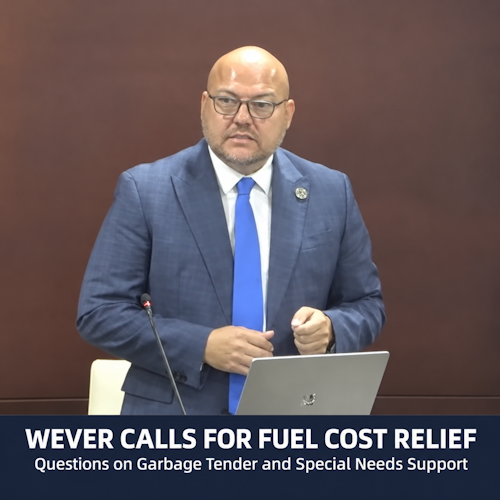 PHILIPSBURG:--- MP Chris Wever has called on the Council of Ministers to examine a temporary cap on GEBE’s fuel charge while the fuel pricing investigation is completed, arguing that consumers need relief during a period of financial uncertainty.
Speaking during Parliament’s debate on the draft 2027 national budget, Wever also questioned the rules and fairness of the garbage collection tender, proposed tax assistance for families and institutions dealing with special needs, and sought answers on social assistance funding, housing, traffic and the protection of personal information under digital government.
Wever congratulated Finance Minister Marinka Gumbs on presenting the budget on time, but directed his contribution toward what government could deliver with the resources and policies outlined.
“Those that know me know that I’m solution-based minded,” he said, explaining that his questions would focus on solutions.
Could government temporarily cap GEBE’s fuel charge?
Wever asked the Council of Ministers whether GEBE’s fuel charge could be frozen at approximately 30 cents while the investigation into fuel pricing runs its course.
He presented that figure as a starting point for examination, rather than a rate he had established as financially sustainable.
If 30 cents was not feasible, he suggested government determine whether another reduced level, such as 32 cents, could work.
Wever contrasted those figures with the approximately 45 cents he cited during his contribution and recalled that, during his time as a minister in the COVID period, a decision had been taken to freeze the charge at 18 cents.
He presented those figures in his parliamentary statement; he did not provide a current tariff calculation or a financial assessment of the proposed reduction.
He asked whether GEBE could provide some relief while remaining financially viable.
Using a hypothetical example, he asked whether the company could accept a smaller surplus rather than maintaining the same financial result while consumers struggled.
“For example, instead of 2 million profit, maybe they will make 1.5 million profit, but a profit is a profit,” he said.
The example did not disclose GEBE’s actual monthly earnings. It illustrated his request for the government to examine how much room, if any, existed to reduce the charge.
Wever framed the proposal as a temporary response to a crisis, saying uncertainty about the duration of the financial pressures justified exploring immediate assistance.
“So any little bit would help,” he said.
Garbage tender: Why did the rules change?
Wever directed a series of pointed questions to VROMI Minister Patrice Gumbs Jr. about the garbage collection tender.
He first asked whether the second process constituted a completely new tender or a retender, and what had changed between the two.
He specifically questioned his understanding that the original process limited a company to one parcel, while the later process allowed a company to receive more than one.
“Why is this?” he asked.
Wever also sought clarification on bidders' experience and equipment requirements.
“Is it possible for a company to win a tender without having equipment to be able to execute what is required?” he asked.
He followed that with a question about whether a new company without a history in garbage collection could qualify for multiple parcels.
Wever presented these as questions being raised by members of the public. His statement did not establish that a particular company lacked the qualifications or resources required under the tender.
The distinction matters because the minister’s response would need to explain what bidders had to demonstrate at the time of submission and what requirements applied before services could begin.
Should bidders bear the consequences of government delays?
Wever also questioned how the ministry handled bidders who requested supporting documents from government in time but received them shortly before the submission deadline.
He said he understood that some companies had requested tax documents in a timely manner but received them only minutes before the tender deadline.
“How can we then punish those companies when it was at no fault of their own?” he asked.
His intervention raised a practical fairness issue: whether the tender process adequately accounted for delays caused by the same government institutions from which bidders were required to obtain documentation.
Wever asked for clarification rather than presenting a ruling that any exclusion had been unlawful.
He also questioned the relationship between the funding available and the work expected of garbage collectors, saying he understood the allocation had been reduced.
“How is that even feasible and possible?” he asked, expecting contractors to do more work for less money.
Separately, he requested an update on roadside cleaning, citing growing vegetation and garbage along roads. He asked what had happened to the budget intended for that work and how it was being used.
Tax assistance for special needs families and institutions
Wever urged the Finance Minister to examine whether the tax system could provide direct assistance to parents raising children with special needs and institutions providing specialized education.
He made clear that his proposal concerned those directly carrying the costs, rather than tax treatment for third-party donors.
He referred to the expense of assessments, specialized school materials and qualified teachers, issues also raised during the education presentation.
Wever offered to work with the minister and explore whether Parliament needed to take action to make such assistance possible.
His proposal did not specify a deduction, credit, exemption or financial amount. It sought a commitment to examine which form of tax support could reach the affected families and institutions.
He also asked Education Minister Melissa Gumbs to explain the practical effect of the ministry's special needs roadmap.
What would change in special needs education? When could the roadmap realistically be completed and implemented? And, if implementation was possible in 2027, did the budget contain enough money to deliver it?
Those questions placed both the timetable and funding behind the roadmap under scrutiny.
Social assistance: How will the funding gap be covered?
Turning to VSA Minister Claret Connor, Wever cited a request of 12 million for financial assistance against an allocation of 8.2 million in the submitted budget.
He asked how the ministry intended to address the resulting 3.8 million gap and ensure that vulnerable individuals and families received the assistance to which they were entitled.
The question focused on how the ministry would reconcile the amount it sought with the resources actually provided, rather than assuming that the lower allocation would meet the identified need.
Digital government must account for personal data protection
Wever questioned Prime Minister Dr. Luc Mercelina about the safeguards accompanying the planned move toward digital government.
He asked whether government required a data protection officer and, if so, whether that position was funded in the 2027 budget.
If no funding had been included, he wanted to know what effect that omission would have on implementation.
Wever specifically requested that the answers come from the ICT department.
His questions linked the introduction of digital services to the staffing and responsibility needed to protect the personal information those services would handle.
He also challenged government to address recurring personnel shortages.
Wever asked whether the Personnel and Organization department, P&O, was receiving recruitment assistance and what government intended to do to compete with private employers.
He suggested exploring an increase in student debt assistance from the 50 percent arrangement he referenced to as much as 100 percent, conditional on positive evaluations and a defined commitment to remain in government service.
That suggestion was a recruitment and retention proposal, not an announced change in employment policy.
Is U.S. preclearance still a live possibility?
Wever welcomed the inclusion of U.S. preclearance in the government’s tourism vision but asked TEATT Minister Grisha Heyliger-Marten to clarify whether the United States remained interested.
He said he had understood there were discussions suggesting the U.S. was no longer interested in St. Maarten as a destination for the arrangement.
He asked the minister to establish the position, rather than treating that account as confirmed.
Wever expressed support for pursuing preclearance and its potential economic benefits.
He also asked whether the medical tourism plans included interest in a hotel near the hospital to accommodate that market.
Traffic proposals extend beyond new roads
Wever supported looking beyond road construction to address congestion.
He proposed examining designated school bus pickup locations, saying frequent stops over short distances appeared to contribute to slow morning traffic.
He also asked about water taxis as an alternative connection to the port, particularly in the context of possible future homeporting activity.
Referring to the Spatial Development Plan 2030, he questioned whether more parking garages could reduce the repeated stopping and turning associated with roadside parking, especially in Simpson Bay.
He suggested examining restrictions on main-road parking alongside alternative parking capacity and considering filter lanes.
Other transport concepts, including a metro rail system, should be tested for viability and feasibility, he said.
“One thing we cannot do is rely on the same road network,” Wever stated.
He also asked whether an earlier proposal involving the airport and hotel partners to improve the road near the runway toward Beacon Hill could be revived.
Housing, permits and unfinished public facilities
Wever renewed his request for an update on transferring certain Housing Foundation homes to the residents occupying them.
He referred to discussions during his ministerial tenure concerning homes in FOGA and emergency housing, saying the foundation had not objected at that time.
He asked whether the current minister had discussed the matter with the foundation and, if not, whether a meeting would be arranged and followed by an update to Parliament.
On the building permit backlog, Wever suggested exploring external assistance to conduct preliminary reviews while leaving final processing with VROMI.
He also commended the painting of pedestrian crossings but requested proper roundabout markings and stop lines at traffic lights. He expressed concern about safety and possible disputes arising from missing markings.
Within the education and culture portfolio, he requested a completion timetable for repairs to sports complex bleachers and an update on earlier plans to upgrade and expand the Culture Center.
Wever said a proper performing arts facility was needed and asked whether the minister had met with the center’s representatives to establish the next steps and clarify the funding position.
Across the ministries, his contribution sought a direct connection between budget plans and practical outcomes: lower household costs, support for special needs, fair procurement, functioning infrastructure and deadlines that Parliament could follow up.