Tintamarre financing remains unresolved, residents challenge fiber-coverage declarations, and antenna listings leave questions about actual service unanswered. Across Saint-Martin, incomplete lighting and surveillance projects expose coordination and delivery failures.
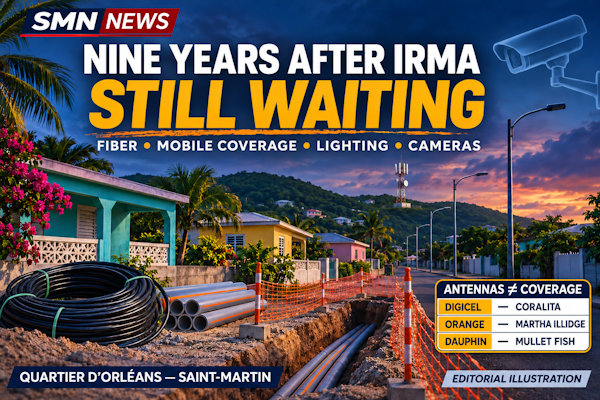 QUARTIER D’ORLÉANS, Saint-Martin:--- Nine years after Hurricane Irma, unfinished telecommunications infrastructure, gaps in public lighting and a surveillance reconstruction program extending through 2028 are raising serious questions about how Saint-Martin’s recovery has been managed.
French Quarter stands at the center of those concerns. Residents in underserved streets still await fiber-optic access, while questions persist about wireless alternatives, essential public services, and the attention the district receives outside election campaigns.
The issue reaches beyond any single company or administration. The Collectivité, the French State, Banque des Territoires, Tintamarre and telecommunications operators have different responsibilities within these projects. Together, they owe the public an account of money committed, money paid, construction completed and services still unavailable.
September assurances, but no Tintamarre item on November agenda
According to information obtained by SMN News, Tintamarre director Gilles Gumbs has expressed frustration over insufficient funding. Assurances were given that the matter would be addressed in September 2026 and placed before the Territorial Council.
SMN News has verified that the published agenda for the council meeting scheduled for November 13 contains no item specifically addressing Tintamarre’s financing.
That omission leaves the promised consideration unresolved. Who undertook to raise the matter? What decision is outstanding? When will the council be asked to consider it?
The absence of a listed item does not establish that no discussions or financing decisions have occurred elsewhere. It does make a public explanation necessary, particularly when unfinished infrastructure continues to affect households and businesses.
Public and private shareholders must account for their contributions
Tintamarre’s published ownership structure comprises the Collectivité de Saint-Martin and Banque des Territoires, each holding 40%, and Dauphin Telecom Infrastructures, holding 20%.
The company constructs and operates underground ducts through which telecommunications operators install fiber-optic cables. Where those ducts remain unfinished, operators may be unable to complete deployment.
Dauphin Telecom Infrastructures’ position as a shareholder raises a legitimate question: what has it contributed, and what additional financing commitments has it accepted?
The public deserves an account of subscribed capital, payments made, shareholder advances and any further contributions requested or agreed upon.
A 20% stake does not automatically oblige a shareholder to finance every cost overrun. Nevertheless, the partnership should explain how it has shared additional costs and financial risks.
Has Dauphin fulfilled every commitment under the shareholder arrangements? Was it asked to participate in the supplementary financing effort? If so, how did it respond? If no additional contribution was requested, why?
Its shareholder responsibilities must also be distinguished from the separate obligations of operators building networks and selling services.
What happened to the €7.2 million financing package?
The published account of the Executive Council’s December 12, 2024 decisions made the funding difficulties explicit.
Tintamarre’s original business plan assumed an average construction cost of €120 per linear meter. After procurement consultations, the reported average rose to €220—an increase of about 83%.
The project identified an additional requirement of €7.2 million. The proposed package comprised:
- €3 million in French State grants.
- €1.4 million in a shareholder advance from Banque des Territoires.
- €1.4 million in a shareholder advance from the Collectivité.
- €1.4 million in a Collectivité grant.
The Executive Council approved the Collectivité’s €1.4 million advance. The outstanding question is what happened to the complete package afterward.
Which contributions were formally approved? Which agreements were signed? How much was transferred, and when? What conditions remain unmet? What invoices or construction commitments remain outstanding?
An approved contribution and a payment received are different stages. Neither, by itself, establishes that infrastructure has been completed.
State subsidies and Banque des Territoires require separate explanations
The financing proposal identified the State’s €3 million grant separately from Banque des Territoires’ €1.4 million shareholder advance. It does not establish that the State subsidy was to pass through the bank.
If a separate arrangement exists under which State assistance is administered through Banque des Territoires or another institution, that agreement should be disclosed.
Was the State grant approved and paid? Has Banque des Territoires released its proposed advance? Were guarantees or additional conditions imposed? Does Tintamarre face repayment obligations that affect its ability to continue construction?
These are basic questions about a project supported by public money.
Tintamarre also advertised a construction framework in February 2026 with a maximum value of €11 million, excluding tax, over an estimated four years. That ceiling demonstrates planned procurement capacity, not proof that the entire amount was secured or spent.
The company and its partners should publish the contracts issued under that framework, outstanding works and a realistic completion schedule.
Fiber mapping must be tested against actual connection availability
The investigation also raises questions about whether coverage declarations accurately reflect conditions in French Quarter.
SMN News has received information identifying locations where fiber remains unavailable, despite mapping reportedly showing deployment as complete. Impasse Adams Alexandre is among the disputed locations.
The precise address-level declaration remains to be independently documented. However, ARCEP confirms that its fiber mapping relies on deployment information operators supply.
Its designation “Déployé (raccordable)” means optical continuity exists between the shared distribution point and the optical connection point, allowing a subscriber to order a connection. It does not mean every household has an active subscription, but it represents more than planned or unfinished infrastructure.
Where essential construction is missing, the operator responsible for the declaration should explain the status and correct inaccurate records.
Broad announcements identifying Quartier d’Orléans as a deployment area do not show that all its residential streets are served.
 Antennas are listed—but usable coverage remains the question
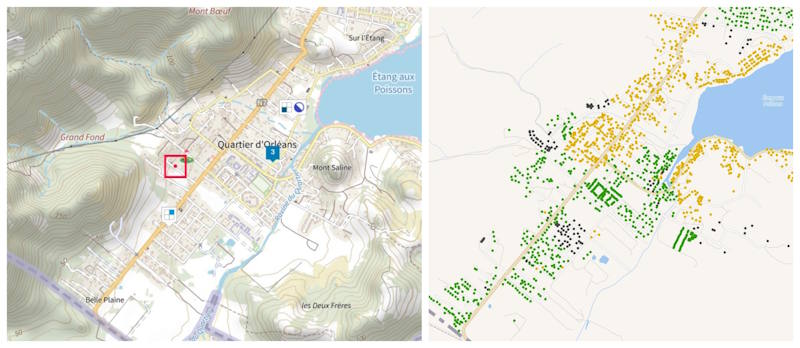
An examination of ANFR’s Cartoradio map identified three antenna structures in the French Quarter cluster:
- A 22-meter structure listed to Digicel on Route de Coralita, site number 469613.
- A 25-meter structure listed to Orange on Rue Martha Illidge, site number 673413.
- A 12-meter structure listed to Dauphin Telecom on Rue Mullet Fish, site number 893089.
These records establish listed structures. They do not, by themselves, establish working 5G coverage throughout French Quarter. In fact, there is no 5G anywhere near French Quarter.
Cartoradio distinguishes between authorized sites and sites in service. Its individual technical-detail panels did not load correctly during SMN News’s examination, preventing verification of the technologies and activation dates associated with those structures.
The database also states that operators supply radio-characteristic information.
Operators should therefore explain which technologies are active at each installation, when they entered service, and which residential areas remain without adequate coverage.
The Cartoradio site establishes the geographic area and antenna listings under examination. They are separate from ARCEP’s fiber map and cannot prove that underground fiber construction is complete.
What became of the wireless alternative?
SMN News has also received information that a wireless project intended to serve areas awaiting fiber was abandoned following opposition to an antenna in French Quarter, despite funding reportedly being available.
The project’s precise technology, financing and formal status require clarification. Earlier public records describe separate antenna controversies in 2020 and 2021, including a proposed shared 4G tower and a temporary Dauphin installation. Those disputes cannot automatically be treated as the same project.
The responsible institutions and operator should identify the project, disclose its financing, and explain whether it was canceled, suspended, or relocated.
Residents’ health concerns deserve clear scientific information and transparent assessment. Current scientific knowledge does not establish a causal relationship between radiofrequency exposure at levels ordinarily encountered by the public and cancer. That does not establish zero risk, but claims that a nearby antenna will cause cancer should be addressed through evidence.
If a viable, funded project was shelved, what prevented consultation or an alternative location from producing a solution? What service was offered instead to residents still awaiting fiber?
Streetlights remain a test of delivery
Public-lighting gaps also require a complete territorial accounting.
In October 2026, the Collectivité announced €929,420.54 in works covering Rue des Ground Doves, Rue Round The Pound and streets in French Quarter’s Spring subdivision.
The schedule extends through December 23 and includes Sparrows, Trush, Pigeons, Lil Dan Beauperthuy and Impasse Yellow Beast. Eiffage Énergie Systèmes and subcontractor Dortel Caraïbes were identified for the works.
Earlier rehabilitation announced in July 2023 covered other roads, including Coralita, Belle Plaine, Saint-Georges/Cross the Range and Delphin Gumbs/Elisabeth Gumbs, with a timetable extending through March 2024.
The announcements concern different streets and do not establish that earlier works failed. They provide commitments against which completion can be checked.
The Collectivité should publish an island-wide inventory identifying functioning lights, installations awaiting activation, outstanding repairs and streets still outside the program.
Camera completion moves from 2025 to 2028
The surveillance program presents a documented change in expectations.
In 2024, the Collectivité announced that rehabilitation, modernization and expansion of the system would begin in the second half of that year and be completed during 2025.
October 2026 reporting instead describes 80 cameras being deployed through 2028: 61 during 2026–2027 and another 19 during 2027–2028.
French Quarter is listed among the areas to receive coverage, alongside Marigot, Concordia, Grand Case, Sandy Ground, Baie Nettlé and other sectors. Reconstruction of the urban supervision center is also planned, while reporting identified an application for State financing.
Why did the timetable change? How much funding remains unsecured? How many cameras will each district receive, and when will they become operational?
Installation alone is insufficient. Connections, staffing, maintenance, and a functioning supervision center must accompany the equipment.
Security concerns make the delays more consequential
Robberies and burglaries have heightened safety concerns while households and businesses confront high living costs.
Financial pressure is part of that social context, but the available evidence does not show it caused an increase in crime. Comparable police statistics are needed to assess changes in offending and the factors involved.
Streetlights and cameras cannot prevent every offense. Nevertheless, incomplete security infrastructure raises legitimate questions about whether authorities have delivered the tools intended to support prevention, investigations and public safety.
Residents should not be left facing these concerns while essential projects remain caught between financing applications and revised schedules.
French Quarter treated as the stepchild
For residents still awaiting basic services, Quartier d’Orléans is being treated as Saint-Martin’s stepchild.
The reported absence of a proper La Poste/La Banque Postale office and an EDF customer-service office in the district, alongside unfinished telecommunications infrastructure and lighting gaps, reinforces that sense of abandonment.
That neglect is particularly difficult to accept when several elected representatives have roots in French Quarter. Their connection to the community should be translated into sustained attention, accessible services, and completed projects.
Instead, the distance between electoral promises and everyday conditions leaves a bitter impression: French Quarter becomes a priority when politicians need votes, while its unresolved needs slip down the agenda afterward.
Shared responsibility demands public answers
Infrastructure investment has occurred in French Quarter, including major wastewater works. The question is whether reconstruction has adequately reached the streets, homes and businesses still awaiting essential services.
The accumulated shortcomings expose failures of coordination, delivery and public accountability across institutions and project partners.
The Collectivité must explain its priorities and payments. The State must clarify its funding decisions. Banque des Territoires and Dauphin Telecom Infrastructures must account for their commitments. Tintamarre and network operators must provide accurate construction and coverage information.
Their responsibilities differ, but none should disappear amid the partnership's complexity.
Nine years after Irma, Saint-Martin needs a consolidated public account of money promised, money paid, works completed and services still missing—with firm dates and clearly identified responsibility for delivery.
French Quarter and other underserved neighborhoods deserve functioning infrastructure, backed by commitments that are fulfilled.