ECYS Minister clashes with York over structural repairs, promises stronger safety barriers at Marie Genevieve de Weever School and says special-needs reforms will extend beyond 2027.
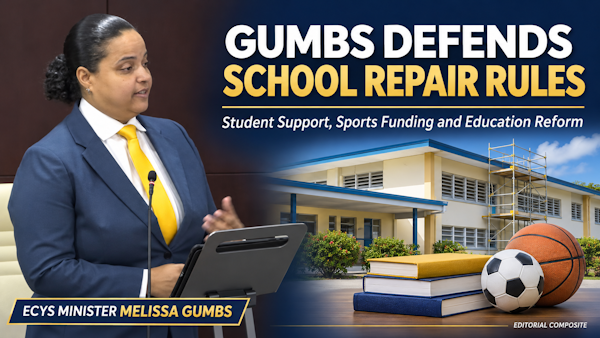 PHILIPSBURG:--- Minister of Education, Culture, Youth and Sport Melissa Gumbs defended restrictions on privately arranged structural repairs to public schools during the November 6 budget debate, arguing that government must retain responsibility for safety, insurance and technical oversight.
Her response triggered a direct dispute with MP Darryl York over what he had been told about proposed repairs at his former primary school. Gumbs said written correspondence clearly limited his initiative to non-structural work; York maintained that her initial guidance had allowed structural repairs subject to departmental supervision.
The exchange came during a broader presentation in which Gumbs outlined the planned Educational Care Center, special-needs education reforms, proposed sports funding mechanisms, school nutrition initiatives and rehabilitation schedules for public facilities.
She also rejected suggestions that Trust Fund projects should not be counted as government projects and warned that dismissing all work within ECYS disregarded the efforts of its civil servants.
School repair dispute centers on permission and liability
Gumbs said York had met with her to discuss his Adopt-a-School initiative, including proposed roof repairs at Marie Genevieve de Weever School.
According to the minister, York’s January 20, 2026 email acknowledged the meeting and confirmed that subsequent discussions with the head of the Division of Public Education had narrowed the proposed work to painting and installing water coolers.
Her Cabinet responded that afternoon, while she was on vacation, approving those non-structural works and expressly excluding structural and infrastructural repairs, she said.
The restrictions reflected the ministry’s responsibilities for safety, insurance and oversight.
“The correspondence is clear, and I believe the facts speak for themselves,” Gumbs told Parliament.
York interrupted to dispute that account.
Quoting what he said was the same email, he maintained that Gumbs had initially given her blessing and instructed him to coordinate with the department for approval. He said her advice on structural repairs was that proper departmental oversight was needed to avoid liability.
York interpreted that as permission to proceed with supervision. He said he subsequently learned that structural work was prohibited.
Gumbs maintained that she had explicitly explained the restriction during their meeting. She also stated that she usually recorded meetings with opposition MPs.
The supplied exchange ended while the disagreement continued. The correspondence and any recording were not reproduced in full during the remarks provided, leaving the competing accounts unresolved in this portion of the debate.
Stronger barrier promised at damaged school area
Separately, Gumbs responded to MP Egbert Jurendy Doran’s concern about damaged concrete and children accessing the affected area at Marie Genevieve de Weever School.
She said precaution tape had been installed as an immediate measure following an inspectorate recommendation.
Recognizing that tape was insufficient as a secure physical barrier, the Division of Public Education would arrange additional protection to restrict access pending repairs.
Gumbs said an early engineering assessment found the roof slab structurally sound but identified specific areas requiring corrective work.
A procurement process for a comprehensive structural condition assessment and prioritized repair plan had also begun, with submissions due on November 6.
That assessment would establish the building's detailed condition and the scope and priority of corrective works. Her response did not include a completion date for the repairs.
Educational Care Center will be a temporary intervention program
Answering MP Lyndon Lewis, Gumbs emphasized that the Educational Care Center, or ECC, would be a program rather than a separate school.
It would operate from the rebuilt Charles Leopold Bell School and serve students with significant, persistent behavioral challenges that require support beyond what their regular school can provide.
Students would remain enrolled at their existing schools and attend the ECC temporarily, with parental consent.
During placement, they would attend for the full school day, receiving educational instruction alongside targeted behavioral interventions.
Admissions would occur throughout the school year. Placement length would depend on progress and an individualized intervention plan, rather than a single fixed period for all students.
Support would combine individual and small-group sessions, with coordination among the ECC, parents, teachers and the care coordinator at the student’s regular school.
The objective, Gumbs said, was successful reintegration, not permanent removal from mainstream education.
Learning difficulties remain within existing support services
Lewis also asked whether the center could assist children with dyslexia, dysgraphia and dyscalculia.
Gumbs said students with those needs could already be referred through the existing care system, including the Student Support Services Division, known as SSSD, which she said began providing such services in September 2011.
Support could include professional assessments, individualized interventions and guidance to parents and schools.
She stressed that special educational needs were not confined to children with significant disabilities or those attending specialized institutions.
However, the ECC’s mandate focused on persistent behavioral challenges. Establishing parallel assessment services there could duplicate responsibilities, fragment care and stretch limited resources, she argued.
Her stated priority was to strengthen existing services and address staffing and service gaps.
ECC funding and staffing framework explained
Responding to MP Ardwell Irion, Gumbs said the ECC was budgeted under the Division of Public Education.
Personnel would be appointed under the applicable public education employment framework, using the existing function book as the basis for staffing.
Where specialized roles did not directly match existing job titles, they would be assessed against comparable positions, qualifications and responsibilities through the required classification procedures.
SSSD and the ECC care team would jointly review referrals and determine appropriate placements.
SSSD would also contribute professional oversight, multidisciplinary reviews and reintegration planning. Students would retain access to services such as speech and language support and special education assessments.
Gumbs rejected information presented concerning a psychologist allegedly working while on sick leave.
“There is no psychologist at SSSD working while on sick leave,” she said.
She acknowledged the social worker vacancy and said it would be addressed through recruitment and appointment procedures. No appointment date was given.
Special-needs roadmap will take more than one year
Gumbs said the special-needs education roadmap completed in 2026 would begin phased implementation in 2027, with full implementation extending beyond that year.
Its priorities included teacher training, differentiated instruction, curriculum adaptation, accessible facilities, assistive technology and stronger assessment and monitoring.
The minister identified draft budget provisions supporting parts of that work:
- 726,000 guilders for educational infrastructure and materials assessments, with a focus on special needs.
- 899,000 guilders for improving the teaching profession, including special education training.
- 212,000 guilders for student care and support services.
She cautioned that these were broader education allocations containing relevant components, rather than funds exclusively earmarked for special-needs education.
A separate funding framework for inclusive and special education was being finalized. Later phases would depend on priorities, capacity and future budget provisions.
Sports fund could draw revenue from fuel levy
Responding to Labega, Gumbs said ECYS was developing a permanent legislative framework for the sports fund, with a levy on gasoline and diesel under consideration as a principal revenue source.
The intention was to provide dedicated, sustainable sports funding and reduce dependence on annual budget allocations.
Policy, technical and legal work had addressed governance, administration, accountability and funding, she said.
A follow-up meeting with the law firm that researched and drafted the legislation was scheduled for the coming week to determine the final trajectory.
The minister did not announce an approved levy, a rate or an implementation date.
Lottery funding remains a policy concept
Gumbs also said the ministry was considering lottery-based funding for sports and culture, drawing inspiration from Aruba’s Fundación Lotto pa Deporte model.
She favored directing proceeds through a separate entity dedicated to those sectors, subject to governance, transparency and accountability requirements, rather than placing all proceeds in general government revenue.
However, she described the initiative as a policy concept, not an operational lottery or approved funding scheme.
Responding to MP Franklin Meyers’s broader call for a financial injection, Gumbs proposed examining professionally managed funds combining government resources with reputable regional and international financing.
Such funds could potentially support school maintenance, heritage, cultural expression and sports over the longer term.
Breakfast proposal developed, but VSA leads implementation
MP Sjamira Roseburg sought clarity on the breakfast initiative supported by a 50,000-guilder amendment to the 2025 budget and the future of approximately 60 participating students.
Gumbs said the allocation fell under VSA, which led the initiative in cooperation with ECYS.
An implementation update, including arrangements for those students, therefore had to come from VSA.
She said a structured healthy-breakfast proposal had been developed in 2025 with technical participation from both ministries, General Health Care and Public Education.
The proposal contemplated breakfast and a mid-morning snack for approximately 400 students, but further implementation required funding and operational assessment.
Separately, Gumbs said Public Education continued providing breakfast support to vulnerable students across public schools.
She likewise referred questions about the CRT pilot’s effectiveness, evaluation and proposed mentorship component to VSA, which was responsible for implementation. ECYS Youth Affairs had contributed during its development.
Substance-use prevention varies across schools
In response to MP Veronica Jansen-Webster, Gumbs described drug and alcohol awareness work involving school care teams, counselors, social workers, and external organizations.
Public primary school activities addressed substance risks, peer pressure, personal safety and reporting concerns to trusted adults.
However, she acknowledged that implementation varied among schools and said Public Education was examining a more consistent approach.
At St. Maarten Vocational Training School, prevention was incorporated into lessons, discussions, and assemblies. The care team provided individual and group counseling, follow-up, and parental engagement.
Students requiring additional assistance could be referred to SSSD, including for psychological support.
Teacher classifications and pay under review
Gumbs said placement and progression within education personnel categories A, B and C remained governed by the existing legal framework, function book and qualification requirements.
A comprehensive review of job classifications and remuneration was underway.
Expected outputs included principles for a revised classification system, an updated function book, a benchmark study of employment conditions, possible salary or remuneration adjustments and an implementation plan.
Pending completion and approval, existing rules would continue to apply. She did not announce an immediate change to teacher categories or salary scales.
Rehabilitation schedules extend into 2027
For the sports-complex rehabilitation, Gumbs provided the following projected milestones:
- West bleacher repairs: January 29, 2027.
- Main building tribune works and stadium seating: July 19, 2027.
- Overall rehabilitation: August 4, 2027.
She cautioned that the dates could change because of site conditions, materials, weather or other construction factors.
The Philipsburg Cultural and Community Center would benefit from two complementary initiatives.
The NRPB-managed Trust Fund rehabilitation included doors, gutters, downspouts, concrete, fencing, and retractable auditorium seating, with work currently scheduled between December 2026 and July 2027.
A separate program under the St. Maarten action agenda on the slavery past, managed through SMDF, contemplated broader modernization of performance areas, backstage facilities, audience amenities and accessibility.
The detailed scope would continue to develop through stakeholder consultation.
School bus pickup points require safety infrastructure
Gumbs acknowledged concern that frequent school bus stops contributed to congestion.
However, she said many routes lacked official bus stops, adequate sidewalks, and safe, centralized pickup zones.
The ministry would continue examining designated pickup points with transportation officials and community police officers.
A follow-up meeting was scheduled for November 18, following the September 2 discussion convened at St. Maarten Academy.
The ministry also reviewed routing policy to balance traffic efficiency with safe, accessible student transport.
Heritage season already has a foundation
Responding to Doran’s suggestion of a culture week, Gumbs said the ministry already had plans for a broader heritage or jollification season running from Constitution Day on October 10 through St. Maarten Day on November 11.
She credited the concept to former MP Solange Ludmila Duncan.
The envisioned program included traditional food, storytelling, music and customs, with a cultural-tourism component.
Budget constraints had prevented full implementation, she said, although condensed versions were carried out in 2024 and 2025. The ministry intended to revisit the original proposal as resources allowed.
Consultancy allocations distinguished from total reform spending
Gumbs cautioned against classifying entire reform-program allocations as consultancy expenditure.
Specific provisions included 37,000 guilders each for management information system consultants and expansion support, 180,000 for related advisory and service-level support, 16,000 for education legislation and policy advice, and 288,000 for early childhood standards and curriculum expertise.
She said many assignments continued work begun in 2025 and 2026.
The 1.6 million-guilder vocational reform program and 2.8 million-guilder priority education reform allocation covered broader implementation activities, not consultancy alone.
She also rejected the claim that the third-party personnel budget line had disappeared. Its ministry-wide allocation increased from 316,750 guilders in 2026 to 341,750 guilders in 2027, although some departmental allocations had been reduced to zero.
Consolidated education targets still require work
Asked by MP Francisco Lacroes for measurable 2027 targets, Gumbs described existing monitoring through school management, quality reviews, inspectorate assessments, examinations and the developing management information system.
The 2025 reading and mathematics assessments provided baseline information, she said.
However, a consolidated ministry-wide set of quantitative targets still required aligned indicators and validated baseline data.
Her answer did not provide a complete numerical target schedule with review dates.
Trust Fund projects remain government responsibilities
Gumbs firmly rejected the suggestion that NRPB-implemented projects should be excluded from the government’s record.
“The NRPB implements these projects on behalf of Government,” she said. “That does not make them NRPB projects, instead of Government projects.”
She explained that implementation units provided dedicated capacity, while ministries retained responsibility for their roles.
She also defended her earlier parliamentary comments on the Trust Fund, saying they criticized political inconsistency rather than denying government ownership of the projects.
On government-owned companies, Gumbs warned against bypassing articles of incorporation and argued that management and supervisory boards should fulfill their corporate responsibilities rather than accommodate political wishes.
She accepted scrutiny of her own performance, but challenged sweeping claims that nothing was being done within ECYS.
For the minister, the distinction was between holding political leadership accountable and dismissing the work of the personnel implementing education, youth, culture and sports programs. For Parliament, the remaining task was to test those programs against clear timelines, funding and results.