ECYS Minister outlines existing school allocations and Rotary assistance, saying a one-time transfer from Parliament’s travel budget cannot sustain a recurring nutrition program.
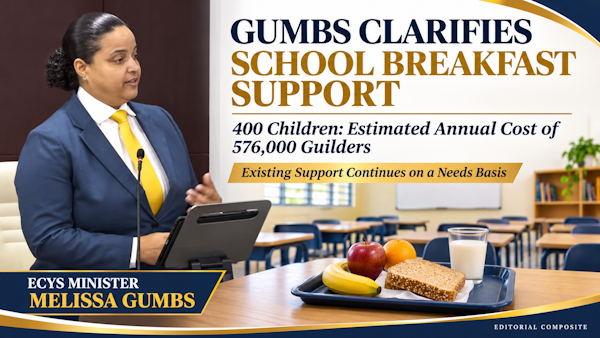 PHILIPSBURG, St. Maarten — Minister of Education, Culture, Youth and Sport Melissa Gumbs clarified that vulnerable students in public schools already receive breakfast assistance, but said expanding that support into a structured program for approximately 400 children would require reliable annual funding of about 576,000 guilders.
Returning to Parliament on November 6 to answer follow-up questions during the 2027 draft budget debate, Gumbs distinguished existing needs-based assistance from the larger, sustainably financed program MPs were requesting.
She also addressed proposals to redirect Parliament’s travel spending, arguing that money used once for repairs could produce a lasting improvement, while feeding children required funding that returned every year.
“For me both of them are priorities,” Gumbs said of school repairs and student meals.
Schools already receive breakfast allocations
Responding to MPs Sjamira Roseburg and Omar Ottley, Gumbs said breakfast support was already in place in public education.
She listed the following budget allocations:
|
School |
Allocation cited |
|
Oranje School |
9,740 |
|
Leonald Conner School |
5,100 |
|
Marie Genevieve de Weever School |
7,700 |
|
Martin Luther King Jr. School |
8,425 |
|
Ruby Labega Primary School |
3,185 |
|
Prins Willem-Alexander School |
5,400 |
|
Total |
39,550 |
Gumbs said assistance was provided according to need, with each school maintaining a roster of vulnerable children requiring breakfast support.
Her clarification established that the absence of a fully funded expanded program did not mean no breakfast assistance was being provided.
However, she did not identify how many students currently receive support through these individual allocations.
Rotary adds monthly assistance
In addition to the school budget provisions, Gumbs said the Rotary Club of St. Maarten contributed 630 per month per school, totaling 4,410 per month, including St. Maarten Vocational Training School.
She presented that community support as another component of the existing assistance.
The school allocations and Rotary contributions were separate from the annual estimate for the proposed program, which would serve approximately 400 children.
The expanded program would cost 576,000 guilders annually
Gumbs confirmed the estimate discussed earlier in the debate: approximately 576,000 guilders per year to feed 400 students across public education.
The broader proposal previously described to Parliament included breakfast and a mid-morning snack.
Her latest response did not announce that the full amount had been secured or that the expanded program had received final approval for implementation.
Instead, she emphasized the recurring financial commitment required to make it sustainable.
The distinction was between helping children through existing school resources and partners, and establishing a structured program with dependable funding from one year to the next.
Repairs and meals compete within a constrained budget
Gumbs said the questions raised by Roseburg and Ottley illustrated the difficult choices facing ECYS.
She described the ministry’s situation as one of “triage,” comparing the prioritization of limited resources to decisions made in a post-disaster setting.
MPs were pressing for rapid, comprehensive school repairs while also demanding a structured breakfast program, she said.
As an example of infrastructure costs, the minister cited an estimate of approximately 300,000 to replace the roof at Ruby Labega Primary School.
She maintained that both infrastructure and nutrition were important, but the ministry’s resources were insufficient to meet every demand immediately.
The minister’s explanation did not reject either need. It emphasized how government and Parliament would finance both.
Travel-budget transfer would need to recur for meals
The debate turned to Parliament’s travel budget after MP Raeyhon Peterson announced an intention to propose reallocating a substantial portion toward public school repairs.
Roseburg asked whether some additional resources could instead support feeding children.
Gumbs responded that the uses had different financial implications.
A transfer could help pay for repairs to some schools, although she doubted that even Parliament’s entire travel budget would cover all public school infrastructure needs.
A breakfast program, however, would require continued financing.
“I cannot feed children year over year with the travel budget of Parliament unless I get the travel budget of Parliament,” she said, then clarified that this would mean receiving the allocation annually.
Her point was that a one-time amendment could not, by itself, guarantee a permanent meal program.
Parliament must determine amendment priorities
Gumbs said MPs should debate their amendments, decide what they consider the priority, and build support from colleagues.
She did not select school repairs over meals or announce support for a particular division of the proposed funding.
Instead, she reiterated that both were priorities for her ministry.
For a lasting solution, she argued, the country needed to generate more revenue so the available budget could increase.
That position linked ECYS’s immediate funding pressures to the wider parliamentary debate over revenue-generating measures.
Her response nevertheless left Parliament to decide whether to redirect existing resources in the meantime and, if so, how to provide continuity for any expanded program.
Minister acknowledges oversight on pilot-program question
Gumbs also returned to Roseburg’s question about the CRT pilot program.
She acknowledged that the question had not, to her knowledge, been formally forwarded to VSA and apologized to both the MP and the VSA Minister for the oversight.
She said follow-up was underway through the Secretary-General so VSA could provide its answer.
ECYS Youth Affairs had only played a consultative role in that initiative, she explained.
Existing support confirmed; expansion still needs financing
Gumbs’s clarification answered an important question raised during the earlier exchange: public schools already have breakfast allocations, supplemented by Rotary support, and assistance is being provided on a needs basis.
What remained unresolved was how the government would finance the proposed larger program for approximately 400 children on a sustained annual basis.
No new funding commitment, start date, or final parliamentary allocation for that expansion was announced during this response.