MP says patients have traveled abroad alone and calls for a closed-door meeting with SZV after Minister Connor outlines companion approvals and nursing arrangements.
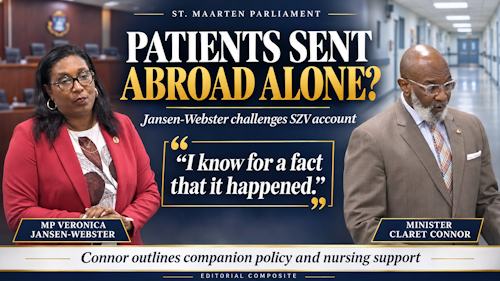 PHILIPSBURG:--- MP Veronica Jansen-Webster challenged the account presented to Parliament about support for patients referred abroad by Social and Health Insurances SZV, saying she personally knew of patients who had traveled without someone to assist them and warning that vulnerable patients could struggle with even basic needs while receiving treatment overseas.
The exchange followed Minister of Public Health, Social Development and Labor Claret Connor’s explanation of SZV’s companion policy during deliberations on the proposed 2027 budget. While the minister described arrangements intended to ensure patients receive support, Jansen-Webster questioned whether those arrangements consistently translate into adequate assistance in practice.
She renewed her request for a closed-door meeting with the minister and SZV, where they could discuss specific patient experiences.
Approval for a Companion Does Not Guarantee One Is Available
Connor told Parliament that patients aged 65 and older, as well as minors, are automatically approved for a companion when SZV refers them abroad.
However, he acknowledged practical limitations: not every patient has someone available to travel, and not every companion can remain overseas for the entire treatment period.
To accommodate those circumstances, SZV allows companions to change every 30 days, he explained, enabling relatives or other support persons to take turns.
Where a patient does not have a companion, Connor said SZV arranges nursing support through the treating healthcare institution. According to the minister, that arrangement is intended to ensure patients traveling without companions are not left without care and support.
Connor also said SZV does not keep a separate record of patients who travel without a companion.
That limits the information available to Parliament about how frequently patients make these journeys alone and how often alternative support must be arranged.
Jansen-Webster Cites Personal Knowledge
Jansen-Webster was not satisfied that the minister’s explanation addressed the experiences she had raised.
She told Parliament that she had personally encountered a patient in Colombia who was there alone. She also said she knew someone who had recently been sent abroad without a companion.
Her concern extended beyond the medical procedure itself. A patient receiving treatment overseas, she argued, may be unable to manage ordinary tasks independently, particularly when complications arise.
She warned that even getting a meal at night could become difficult.
Jansen-Webster characterized the information conveyed through the minister as suggesting that patients were not being sent alone and firmly disputed that interpretation.
“I know for a fact that it happened,” she said.
The distinction between the two accounts is important. Connor’s explanation did acknowledge that some patients travel without companions. He said nursing support is arranged in those circumstances. Jansen-Webster’s intervention questioned whether patients’ actual experiences matched the assurance of adequate support.
The exchange therefore left unresolved whether the cases she cited involved missing arrangements, insufficient assistance, communication failures or other circumstances requiring investigation.
Demand for Accountability in Individual Cases
Jansen-Webster said that if patients had been left in such circumstances through an error, SZV should acknowledge what happened and apologize.
She objected to any suggestion that the experiences she described had not occurred.
Her intervention focused on whether the institution’s response to Parliament adequately addressed specific patients, rather than simply explaining the general policy.
Approval for a companion, the availability of someone to travel and the provision of alternative nursing assistance are separate matters. The exchange did not establish what support was arranged in the individual cases Jansen-Webster referenced, whether it was delivered or whether patients knew how to access it.
No patient files, treatment records or case-specific findings were presented publicly during the discussion.
Closed-Door Meeting Requested
Speaking as chair of Parliament’s VSA Committee, Jansen-Webster said she had asked the minister to attend a closed-door meeting with SZV so the committee could examine these concerns directly.
Such a meeting would allow MPs to raise individual experiences without publicly disclosing sensitive medical information.
Her request also reflected dissatisfaction with relying on general assurances when she believed concrete examples required an institutional response.
The discussion did not produce a confirmed date for that meeting. The recorded exchange also did not include a completed response from Connor to the specific cases raised during her clarification.
Parliament subsequently adjourned briefly to allow the minister to prepare answers to the outstanding questions.
Complications and Liability Also Raised
The wider discussion included questions about what happens when treatment abroad results in complications or suspected medical wrongdoing.
Connor said SZV covers the cost of treating complications arising from authorized overseas treatment. Where medical wrongdoing is established, he said liability rests with the treating facility, which has its own liability insurance.
He also described annual evaluations of overseas healthcare services and feedback to the institutions concerned.
Those explanations addressed treatment coverage and institutional responsibility. They did not resolve Jansen-Webster’s separate concern about the practical assistance available to an individual patient navigating treatment in another country.
A patient may have an authorized referral and medical coverage while still requiring help with meals, communication, mobility, and other daily needs.
Missing Figures Leave Questions Open
Connor’s statement that SZV does not keep a separate record of patients traveling without companions left Parliament without a numerical picture of the issue.
The exchange did not establish how many patients traveled alone, how many received alternative nursing assistance or how many complaints were made about inadequate support.
Without those figures, the discussion could not determine whether Jansen-Webster’s examples reflected isolated failures or a broader problem.
For patients and their families, the central question remains whether the support described in policy is reliably available throughout an overseas referral.
Jansen-Webster’s challenge placed that question directly before the minister and SZV. The next step she requested was a detailed examination of actual cases, with an explanation of what happened and what action would follow where assistance fell short.