VROMI minister says broad residential subsidy requires an identified funding source; estimate places fuel costs above the energy-charge component.
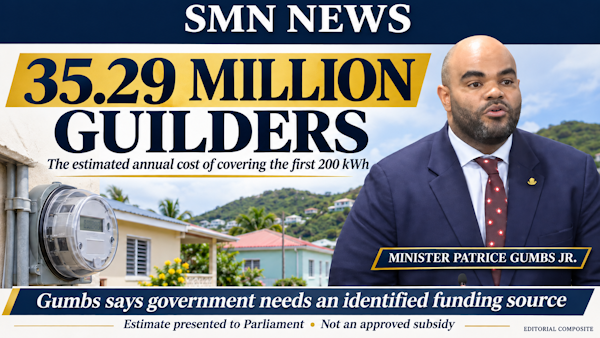 PHILIPSBURG:--- Covering the first 200 kilowatt-hours of monthly electricity consumption for GEBE’s residential customers would cost approximately 35.29 million guilders annually, Minister of VROMI Patrice Gumbs Jr. told Parliament in response to questions from MP Omar Ottley.
The estimate gave Parliament a concrete price for a proposal to reduce household electricity expenses. It also exposed the financial obstacle the government says must be addressed before such assistance could proceed.
Gumbs said the government’s current financial position could not accommodate a subsidy of that size without a budget adjustment identifying how it would be funded.
No subsidy was approved or announced during the exchange.
Approximately 148 Guilders per Customer Monthly
The calculation presented by Gumbs used a residential customer base of 19,871 and assumed that every customer would qualify and consume at least 200 kWh each month.
It included both the energy charge and fuel-cost charge.
|
Component |
Estimate presented to Parliament |
|
Monthly energy charges |
1.07 million guilders |
|
Monthly fuel-cost charges |
1.87 million guilders |
|
Combined monthly requirement |
Approximately 2.94 million guilders |
|
Annual requirement |
Approximately 35.29 million guilders |
|
Monthly value per residential customer |
Approximately 148 guilders |
The figures were presented as estimates. The actual cost would depend on consumption, prevailing tariffs and the eligibility conditions established for any eventual program.
The fuel-cost component was the larger part of the projected monthly expenditure, placing the fuel clause at the center of both the relief discussion and the broader debate over electricity affordability.
Government Says Funding Must Be Identified
Ottley asked whether government could temporarily subsidize residential consumption or fix the electricity charge for residential customers.
Gumbs responded that the estimated annual requirement exceeded 35 million guilders and that government was not positioned to provide that amount within its current financial circumstances.
He left open the possibility of an amendment from Parliament or another budget adjustment, but said it would need to specify realistically how and where the money could be provided.
The response did not identify an alternative allocation, a reduced subsidy level or a date for presenting a government-funded proposal.
It therefore established the estimated cost of the broad approach without committing government to implement it.
Universal Estimate Leaves Targeting Questions Open
The calculation assumed coverage for the full residential customer base used in the estimate.
That is a significant condition. A program restricted by income, vulnerability or another eligibility test could have a different cost, while households consuming less than 200 kWh would also affect the actual expenditure.
Gumbs acknowledged that eligibility and individual consumption would influence the final financial requirement.
However, he did not present a separate calculation for a targeted program or identify how many households would qualify under different criteria.
Parliament was therefore given a broad estimate rather than a fully developed subsidy design.
Questions remain about eligibility, administration, duration and the treatment of residential accounts serving more than one household.
GEBE Figures Require Careful Distinction
In answering Ottley’s wider questions about the utility’s customer base, Gumbs reported that GEBE had 20,071 unique active customers as of October 1, 2026.
He distinguished those customers from 26,279 active contract accounts and 46,166 active utility services.
Those categories are not interchangeable: a customer can hold more than one account or receive more than one utility service.
For the electricity subsidy estimate, the relevant figure presented was the residential electricity customer base of 19,871.
The minister also reported growth in electricity contract accounts from 21,207 in 2022 to 23,282 in 2026, alongside an increase in water contracts from 20,825 to 22,876.
The figures illustrate why any relief proposal requires a clearly defined beneficiary group and a consistent basis for calculating its cost.
Subsidy and Tariff Reform Are Separate Decisions
The debate over a government subsidy unfolded alongside Ottley’s challenge to GEBE’s fuel-clause explanation.
A subsidy would determine who pays part of the customer’s bill. A change to the tariff or fuel-clause calculation would address how that bill is constructed.
Gumbs said BTP’s review of the fuel-clause calculations was being finalized and that the TEATT minister was examining implementable recommendations. He did not announce an immediate tariff adjustment.
The 35.29 million-guilder estimate consequently puts a major funding decision before Parliament, while leaving the underlying pricing review unresolved.
For households seeking relief, neither discussion had yet produced a confirmed reduction in what they would pay.