Canadian company faces penalties of up to US$100,000 if it fails to comply
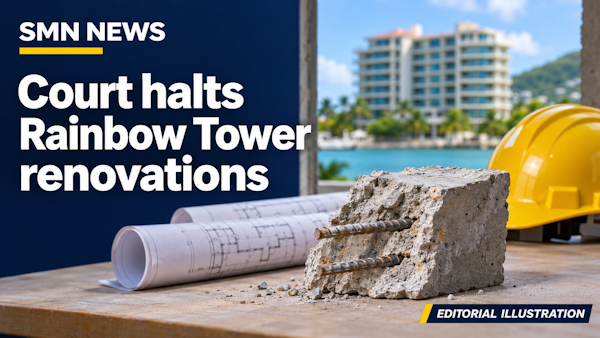 ST. MAARTEN:--- The Court of First Instance has ordered a Montreal-based company to immediately halt renovations at Rainbow Tower after photographs persuaded the judge that part of a reinforced concrete wall appeared to have been removed. Work can resume only after engineers inspect the unit and complete any safety measures and repairs deemed necessary to restart.
The Rainbow Tower Building Homeowners Association sought the emergency order against 17366884 Canada Incorporated, which acquired the unit after a September 2025 auction of assets belonging to bankrupt Sabra N.V. The unit sits on the third floor at parking garage level, below the building’s regular residential units. The condominium deed designated it as office space, but Sabra had already converted it into three residential units. The new owner was renovating the property to continue using it as three separate residences.
Homeowners’ association warned the owner twice
The association warned the company’s director in March and again in August 2026 about the renovations. The director maintained the work was permitted and told the court his contractor had verbally assured him no structural elements were affected. After the contractor removed part of a wall, the association demanded an immediate stop. It argued that uncertainty about the wall’s role in the building put residents in a tower of approximately 70 homes at potential risk.
Judge L.J. Saarloos found, on a preliminary basis, that the association’s photographs made it sufficiently plausible that part of a load-bearing wall had been demolished. The photos showed concrete reinforced with steel. The director submitted newer photographs showing that the removed sections had since been patched, but the court observed that the patching did not use the same reinforcement. Other photographs showed openings cut through walls for pipes, raising further questions about the effect on the homes above.
Engineers to determine whether repairs are needed
At the October 30 hearing, the parties agreed that engineering firm ICE would inspect the work for the homeowner’s association, with an engineer retained by the company also present. The inspection will assess whether the alterations required the association’s approval and whether they still pose a concrete risk. The court said the company would bear the cost of addressing any such risk.
The November 13 ruling also requires the company to submit a detailed renovation plan within seven days of formal service of the judgment. The plan must identify the proposed work, the affected building components and installations, the materials, and the schedule. Where the condominium deed requires the association’s approval, the company must obtain it in writing before proceeding.
The court set a penalty of US$1,000 per violation or per day or part of a day of noncompliance, capped at US$100,000. The court can enforce the order immediately, even if it is appealed.