Gumbs: No Affordable Homes Planned for Construction or Completion in 2027 as MPs Demand Results.

VROMI Minister outlines road paving, landfill rehabilitation and digital permitting plans, but faces pointed questions over housing delivery, garbage collection, government land records and a backlog of 631 building permits.
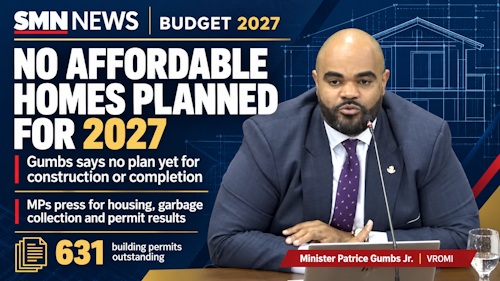
patricegumbs02102026PHILIPSBURG:--- Minister of Public Housing, Spatial Planning, Environment and Infrastructure (VROMI) Patrice Gumbs Jr. told Parliament that there is currently no plan to construct or complete affordable homes in 2027, prompting sharp questions about when government’s housing ambitions will translate into actual homes for residents.

Responding to Members of Parliament during the Central Committee’s examination of the draft 2027 National Budget, Gumbs outlined a broad agenda covering housing policy, road improvements, waste management, building permits and parking.

His presentation identified several milestones, including a target to pave 35 side roads in 2027, the expected start of landfill rehabilitation works that year and the introduction of a new building code targeted for July 2027. However, key elements of the housing and permitting programs still depend on staffing, financing, legal changes, and further planning.

For residents facing housing shortages, overflowing garbage bins and lengthy permit delays, the central question emerging from the debate was when those preparations would produce measurable improvements.

Housing target still lacks a delivery timetable

Asked by MP Lyndon Lewis how many affordable homes would reach construction or completion in 2027, where they would be located and who would qualify, Gumbs gave a direct answer.

“There is no plan yet to construct or complete affordable homes in 2027,” the Minister said.

He explained that the housing policy sets out approaches intended to support future delivery, including reusing existing housing stock, increasing density, apartment development and semi-detached homes.

The policy defines affordability in relation to residents earning a median income, with housing costs not exceeding approximately 30 percent of median net income. Gumbs also identified teachers, healthcare workers and civil servants as categories of workers who should be able to purchase homes within the affordable housing segment.

However, specific locations, construction schedules, and detailed eligibility arrangements still need to be developed during implementation.

Responding to questions from MP Egbert J. Doran about the previously announced objective of 1,200 homes over ten years, Gumbs emphasized that the housing policy is a strategic document rather than a construction plan.

The Ministry must still translate that objective into a multi-year implementation program that identifies projects, responsible parties, financing requirements, and activities that can be budgeted.

Gumbs said the Ministry is recruiting a policy advisor dedicated to implementing the housing policy. He could not provide a completion date for the multi-year housing strategy, citing capacity constraints.

At least 70 percent of the housing program is intended to come through approaches such as reuse of existing properties, densification, apartments, semi-detached homes and townhouses, he explained.

Lewis and Doran press for tangible housing progress

Lewis challenged the gap between repeated budget discussions and actual housing delivery, asking in which budget residents could expect an affordable housing program to materialize.

He pointed to successive budgets considered during his time in public office and questioned how much could realistically be accomplished within the remaining parliamentary term.

Doran similarly argued that the Minister’s responses lacked concrete starting dates and project milestones despite the housing crisis.

He sought clarification on Vineyard Heights, asking whether a new legal dispute affected the development, whether an existing plan would change, and when work could begin.

Gumbs said development would require a concrete housing action plan supported by available resources and resolution of relevant land issues. He indicated that the new land issuance policy was expected to be finalized in October 2026.

The Minister also referred to discussions on a public-private partnership involving land associated with the housing foundation in the Foga area.

He stressed that the government was pursuing opportunities with potential partners while preparing the broader implementation framework.

Landfill works expected in 2027, closure targeted for 2032

On waste management, Gumbs outlined national targets of 75 percent waste diversion and fully professional waste collection by 2030.

The proposed transition includes an independent waste authority to manage the sector, while government focuses increasingly on legislation, regulation, enforcement and oversight.

The Minister said government and the National Recovery Program Bureau are pursuing landfill works involving reshaping and stabilization, protective infrastructure, and eventual capping and vegetation.

Construction is expected to begin in 2027 and continue for approximately three years, with closure of the landfill targeted for 2032.

The closure works have already been tendered, he said. Bids are undergoing technical evaluation, to be followed by financial evaluation before a contractor is selected. A firmer implementation cost will become available after procurement is completed.

Gumbs also acknowledged that closing the landfill requires a workable alternative for the country’s waste. Options under consideration include waste-to-energy, waste export and cooperation with surrounding islands.

A proposed allocation of approximately 2.7 million is intended to relocate businesses operating on the landfill site. According to the Minister, those relocation costs are not eligible under the applicable World Bank project financing procedures.

MPs demand improvements before next year

Gumbs said residents should see clearer collection responsibilities, better bin management, maintained collection points, removal of stray garbage and improved communication about collection schedules in 2027.

He also identified a weighbridge and electronic recording system as essential for measuring incoming waste, supporting future planning, and enabling a weight-based tipping system.

Lewis argued that improvements should begin before 2027, saying he had not seen significant changes in garbage collection this year.

MP Ardwell Irion raised the practical problem of insufficient bins, citing an apartment building with 16 units served by only two small green bins.

He asked how residents could obtain bins, how many were needed nationally, whether the budget reflected purchases, and whether waste haulers were expected to buy them.

Irion also requested clarification about bins previously discussed by the TEATT Ministry and whether they had been distributed.

Chair of Parliament Sarah Wescot-Williams asked Gumbs to address the five items contained in the unanimously adopted garbage motion of January 16, 2025, in his written responses. She also recalled the garbage motion adopted during the 2026 budget deliberations.

The supplied proceedings do not include the Minister’s answers to these follow-up questions.

Cleaning contracts expired; interim spending questioned

Doran questioned arrangements after district cleaning contracts expired on March 31.

Gumbs said the tender for district cleaning and public-area maintenance services for 2026–2031 had been launched, with bids due on October 9, 2026.

He reported interim expenditure of 255,310 for a one-time pre-hurricane cleanup and temporary beach cleaning services.

According to the Minister, contractors were selected through an invitational bidding process. The Minister approached previous contractors first because of their familiarity with the assigned areas. Where they could not undertake the work, the Ministry invited another contractor with relevant experience and capacity.

Doran requested the names of the companies receiving the work and further clarification on the authorization requirements for those arrangements.

Gumbs said the Ministry intends to introduce a contract-management dashboard providing updates where necessary.

“There should not be a gap between the conclusion of one contract and the commencement of another,” he stated.

631 building permits remain outstanding

The Minister reported that 631 building permits remained outstanding as of the day before the meeting, down from 661 in his response.

He cautioned that the figures reflect both applications processed and new applications received. The reduction of approximately 30 therefore does not establish how many permits were issued during the period.

The draft budget provides for digitizing and automating the permitting process, including electronic document management, applicant access, workflow tracking, security, audit trails, and training.

The intended system would allow applicants to submit documents online, receive a reference number, respond electronically to correction requests and track their applications.

However, Gumbs could not commit to a date for full online access. Additional legal provisions may be required to support electronic documents, signatures, decisions and records.

He also said the Ministry could not establish one fixed processing-time target for every application at the beginning of 2027.

35 side roads targeted, subject to approval

Gumbs said approximately 25 roads had been identified for consideration in the second phase of the side-road paving program, with a target of 35 roads in 2027.

Selection criteria include an unpaved surface, access to at least five residential properties, a width exceeding three meters, an officially recognized name and the absence of family or ownership disputes. Priority would be given to low-income areas.

Assessments are expected to finish in November 2026, followed by publication of the proposed program in December. Final selection and execution remain subject to budget approval.

Doran and Irion asked how low-income areas or roads would be defined and whether an established policy supported that prioritization.

Paid parking considered; land inventory remains incomplete

Gumbs said paid parking is being considered for Philipsburg and Simpson Bay, potentially through a tiered system charging more near commercial centers while allowing consideration of free parking farther away.

Final pricing and measures to reduce costs for regular users would depend on the business cases for proposed public-private partnerships.

The Minister also acknowledged that government cannot yet provide a complete, sufficiently verified inventory of government land free of leasehold, rental or third-party obligations.

Doran challenged that explanation and renewed his request for a list of available government land.

Gumbs said record verification and cooperation with the Cadastre were intended to improve the Ministry’s land administration.

The debate left VROMI with a clear accountability challenge: turn policy objectives into funded projects, publish credible delivery schedules and answer the outstanding questions about services residents need now.
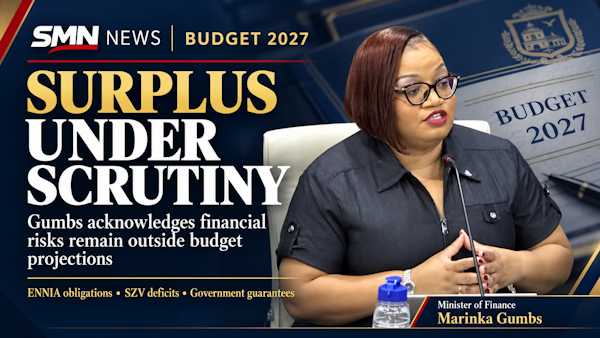

Surplus under scrutiny: Gumbs acknowledges financial risks outside 2027 Budget Projections.

Finance Minister promises clearer ENNIA disclosures, confirms no SZV debt settlement provision and outlines tax reforms as MPs question the difference between a projected surplus and money available to spend.

marinka02102026PHILIPSBURG:--- Minister of Finance Marinka Gumbs acknowledged that financial risks have not been incorporated into the draft 2027 National Budget’s projected result, while promising corrections to the presentation of Sint Maarten’s long-term ENNIA obligations following detailed questioning in Parliament.

During the Central Committee budget deliberations on October 2, Gumbs addressed projected tax revenue, government exposure to GEBE and TELEM, ENNIA contributions and guarantees, liquidity, and the deteriorating financial position of several funds administered by Social and Health Insurances SZV.

Her answers outlined planned improvements to tax administration but also exposed significant unfinished work: no complete reconciliation of the budget result against major fiscal risks, no completed stress test of the potential impact of faster SZV reserve deterioration, and no specific provision for settling outstanding balances between government and SZV.

MP Ludmilla de Weever welcomed the Minister’s detailed responses but warned that a projected annual surplus must not be presented as freely available money while substantial debt and long-term obligations remain.

Minister: Financial risks have not been incorporated

Responding to De Weever’s question about which material fiscal risks had been included in the projected ordinary-service surplus, Gumbs acknowledged that the risks had not been incorporated into the budget and said this had been discussed with the Committee for Financial Supervision, CFT.

She explained that the budget reflects the information and assumptions available when it was prepared. Should significant risks materialize during the financial year, government would address their effects through budget amendments.

However, the Ministry could not provide a complete reconciliation showing the projected result before and after the potential effects of healthcare deficits, SZV and social fund risks, government-owned companies and other contingent liabilities.

Gumbs said several exposures could not yet be quantified reliably and required further information and analysis. She also cited limited policy capacity within the Ministry, which must divide resources between preparing and executing the budget and conducting more detailed financial risk assessments.

The Minister maintained that the surplus remains the government’s current projection, but must be considered alongside the identified risks. If those risks produce high costs, government could have to reprioritize expenditure.

ENNIA provision to be corrected after parliamentary scrutiny

De Weever questioned why the budget provides 3 million guilders for ENNIA when the agreed annual contribution is 2.082 million guilders.

Gumbs said the larger allocation represents a precautionary provision rather than an amendment to the underlying agreement. She confirmed that neither the agreement nor its addendum had been amended.

According to her explanation, Sint Maarten’s annual contribution is structured as a subordinated loan to the resolution fund. She identified March 15, 2027, as the first contribution date and March 15, 2057, as the last, while describing the arrangement as a 30-year commitment.

De Weever also challenged the placement of this long-term obligation under the general heading of “projects and activities.”

Gumbs agreed that the commitment should be clearly identifiable and promised to correct its presentation through a budget amendment document. The recurring obligation should also be visible in the applicable multi-year estimates for 2028 through 2030, she said.

The Minister credited parliamentary scrutiny with identifying a presentation issue that had not been raised during earlier reviews.

Peak facility carries a separate guarantee exposure

The ENNIA discussion extended beyond the annual contribution to Sint Maarten’s exposure under the resolution arrangement’s peak facility.

Gumbs confirmed that Sint Maarten’s 6.49 percent share of the overall 500 million guilder facility results in a guarantee exposure of up to 32.45 million guilders. She promised to correct the disclosure of that contingent liability.

The Minister said current calculations anticipate that approximately 7.756 million guilders could be needed for Sint Maarten’s share over a 50-year period.

That projected use and the maximum guarantee exposure are different figures: the estimate describes anticipated requirements, while the guarantee represents a potential liability under the arrangement.

Gumbs also referred to a separate 55 million guilder capital injection financed through a bond subscribed to by the Central Bank of Curaçao and Sint Maarten, CBCS, and guaranteed according to the countries’ allocation shares.

She said Sint Maarten had not entered into a separate insurance arrangement for the peak-facility exposure. The addendum permits voluntary contributions to build a reserve, but her response did not establish that such a reserve had already been funded.

CBCS dividends expected to support payments

Gumbs said the financing framework anticipates CBCS dividend distributions and that government currently has no indication those expected payments will fail to materialize.

She described an expected minimum annual dividend payout to Sint Maarten of approximately 3.0336 million guilders under the arrangement, compared with the annual ENNIA contribution of 2.082 million guilders.

The 2026 budget includes 6 million guilders in anticipated CBCS dividend income, she added.

The Minister cited investments in United States Treasury bonds as supporting the financing framework. Nevertheless, she acknowledged that government would be responsible for covering a resulting shortfall if anticipated dividend contributions did not materialize.

No specific additional budget line has been identified for that scenario because government does not currently anticipate a shortfall.

SZV funds project a combined deficit

The Minister’s answers also revealed continued financial pressure across funds administered by SZV.

For 2027, she presented combined projected revenue of 318.3 million and expenditure of 332 million, producing a projected deficit of 13.7 million.

The sickness insurance fund, ZV, accounts for a substantial part of that pressure, with projected revenue of 108.2 million against expenditure of 140.8 million—a deficit of 32.6 million.

The FZOG fund is also projected to run a deficit of approximately 8.5 million.

Positive results in other funds, including the old-age pension fund AOV, reduce the combined deficit but do not eliminate the negative positions of the financially strained funds.

Gumbs reported that total projected reserves decline from 302.7 million in 2026 to 289 million in 2027 and 246.5 million by 2030.

She emphasized that certain individual funds already show negative reserve positions at the beginning of the projection period and are expected to deteriorate further under the current policy scenario.

The figures, she said, demonstrate the urgency of healthcare reform. They remain projections based on the assumptions available when the analysis was prepared.

No SZV settlement provision or completed stress test

Asked how much government and SZV owe each other, broken down by type and year, Gumbs said the balances were still being compiled and verified.

She promised to provide that information before the public budget meeting.

“At this time, no specific provision has been incorporated into the budget 2027 for a repayment or settlement arrangement,” the Minister stated.

Discussions are continuing to reconcile the amounts and determine how they should be settled. Any necessary provision would be addressed through the appropriate budgetary process once the financial implications are established.

Gumbs also confirmed that a formal stress test assessing the effect on the government’s budget if SZV reserves deteriorate faster than projected has not yet been completed.

The extent to which healthcare shortfalls could become a country obligation remains part of the ongoing general health insurance and healthcare reform discussions.

Year-end cash projected at approximately 2 million

Gumbs rejected suggestions that the budget’s liquidity tables contradicted each other, explaining that they present the same information at different levels of detail.

She said the projected opening cash balance for 2027 is 5 million, with a closing balance of approximately 2 million—a net decline of 3 million during the year.

She also confirmed that total loan repayments for 2027 amount to 22 million, rather than 17 million.

These cash figures are distinct from the ordinary-service surplus: a positive projected annual result does not mean government has that amount sitting in available cash.

Tax revenue increase rests on economic growth

Responding to MP Lyndon Lewis, Gumbs said the projected 19 million increase in tax revenue is based on expected economic growth.

Government has not included a separately quantified gain from improved tax compliance because it cannot yet measure that contribution reliably.

Instead, the projections apply the 2025 tax-to-GDP ratio to anticipated growth. Additional receipts resulting from better compliance would therefore be above the current estimate.

Lewis pressed for measurable collection targets and criticized delayed assessments, referring to complaints about 2021 assessments arriving in 2026.

Gumbs had explained that assessed tax cannot automatically be treated as collectible cash because provisional assessments, objections, court decisions and administrative adjustments can change the amounts.

However, her response did not provide the requested total of assessed but uncollected taxes or a specific 2027 recovery target.

Taxpayers promised improvements from January

The Minister outlined tax administration reforms expected in 2027, including online filing of 2026 income tax returns, expanded business filing services, automated processing of simple returns, improved taxpayer communications and cleaner registration records.

Other measures include payment integration, filing and payment dashboards, staff training and work on the administration’s legal and organizational structure.

The individual estimated costs she listed total approximately 1.112 million guilders.

Taxpayers should begin seeing improvements from January 2027, with shorter income tax processing times expected during the second half of the year.

Gumbs also explained that business license revenue rises from 7 million to 12 million because the estimate better reflects invoiced amounts on an accrual basis. It does not necessarily represent an equivalent increase in cash collected.

GEBE and TELEM create financial exposure

The Minister identified a 75.6 million guilder loan under VROMI for GEBE generator purchases.

For TELEM, she cited a 3.5 million guilder government guarantee connected to the company’s severance program and a further requested guarantee of 5 million that remained under assessment when the budget was prepared.

Finance and General Affairs are also assessing possible use of the TELEM building. Gumbs did not announce a purchase decision.

Responding to MP Darryl York, she said answers concerning TELEM’s operational and financial challenges had been submitted confidentially on September 29 because they included commercially sensitive information, litigation matters, strategy and contract values.

She acknowledged delays in responding to parliamentary correspondence and committed to finalizing outstanding tax department responses before the public budget meeting.

York welcomed receipt of the TELEM answers but said his question about financing the Road Fund remained unanswered.

De Weever warns against treating surplus as spending money

MP Ardwell Irion asked whether changing the accounting treatment of ENNIA would increase the reported surplus from approximately 8 million to about 11 million. He also requested updates on the borrowing processes for 2026 and 2027.

These were follow-up questions; the provided proceedings do not contain the Minister’s substantive answers.

De Weever emphasized that any increase in the displayed annual result would not erase the country’s debt or long-term commitments. She referred to outstanding debt approaching a billion and warned against interpreting a surplus as permission for unrestricted spending.

She urged ministers and MPs to prioritize expenditure, exercise restraint and assess new revenue expectations realistically.

Chair of Parliament Sarah Wescot-Williams reiterated that answers delivered orally must also form part of the written responses. The Central Committee proceedings concluded with further disclosures and clarifications still expected ahead of the public debate.

Gumbs’s presentation supplied important explanations, but Parliament’s next assessment will depend on the promised corrections, reconciled balances and written answers—particularly where financial obligations remain outside the headline surplus.

Valeska Laurant awarded Distinguished Toastmaster Distinction.

valeskalaurent02102026District 223 proudly extends its heartfelt congratulations to St. Maarten’s own Valeska Laurant on achieving the prestigious Distinguished Toastmaster (DTM) designation, the highest educational award bestowed by Toastmasters International.

This remarkable achievement reflects Valeska’s unwavering dedication to personal and professional development, servant leadership, and excellence in communication. Her Toastmasters journey stands as an inspiring example of perseverance, commitment, and the transformative power of continuous learning.
Since joining Toastmasters in 2018, Valeska has embraced every opportunity to grow as a communicator and leader while helping others do the same. Her leadership contributions
have been significant at every level of the organization. She served as Area Director during
the 2021-2022 program year and later as Division I Director for District 81 during the 2023-
2024 program year.


Today, she continues to make a meaningful impact through several leadership roles,
serving as Vice President of Education for the Caribbean Pearls Toastmasters Club, Vice President of Public Relations for the Philipsburg Toastmasters Club, and Division D Council Assistant Program Quality. Beyond her formal positions, Valeska is widely respected as a mentor, trusted advisor, and source of encouragement, inspiring fellow members and community members alike through her positivity, integrity, and willingness to serve.

As part of her Distinguished Toastmaster journey, Valeska recently organized the successful DTM Project SXM Scavenger Hunt, which brought together Toastmasters from St. Maarten/St. Martin and Anguilla for an afternoon of learning, fellowship, teamwork, and fun. The event highlighted her ability to foster meaningful connections while creating engaging experiences that strengthen the Toastmasters community.
For Valeska, this achievement represents more than a milestone. It reflects a journey of growth, discovery, and stepping outside her comfort zone. Through this experience, she embraced new challenges, expanded her skills, and gained valuable confidence both personally and professionally. She extends her heartfelt gratitude to her support team, mentors, and fellow Toastmasters members for their encouragement, guidance, and unwavering support throughout this journey. Their belief in her and the shared learning experiences along the way played an important role in helping her reach this
accomplishment.

The Distinguished Toastmaster award is a fitting recognition of Valeska’s years of dedicated service, exemplary leadership, and steadfast belief in others' potential. Through her actions, she continues to embody the core values of Toastmasters and leaves a lasting
impact on those she mentors and serves.
Congratulations, Valeska Laurant, DTM, on this outstanding achievement. Join us in wishing her continued success as she inspires others to grow, lead, and achieve their fullest potential.

For more information visit :
https://www.facebook.com/district223toastmasters
https://www.toastmasters.org/education/distinguished-toastmaster

Trust Fund's Mental Health Project Making Mental Health Support Easier to Access in Sint Maarten.

trustfund02102026PHILIPSBURG:--- The Ministry of Public Health, Social Development and Labor (VSA), together with the NRPB, is working towards reforming how people access appropriate mental health care support in Sint Maarten. Under the Improving Mental Health Services Project, several work areas are moving from assessment and planning to practical testing. These initiatives are being supported by the Trimbos Institute, an independent scientific knowledge institute specializing in mental health and addiction, including gambling, substance use, and prevention.

During the first year of a two-and-a-half-year collaboration, the Trimbos Institute provided technical support in finalizing Sint Maarten's National Strategic Mental Health Plan. The work is now moving further into implementation, with the development and testing of new screening and referral systems aimed at improving access to appropriate mental health care. The project collaborates closely with professionals and organizations in Sint Maarten's mental health and social support systems to ensure the entire sector supports the new systems.

During a recent mission to Sint Maarten, technical experts from the Trimbos Institute worked with local partners to begin a pilot of improved mental health screening and referral protocols. General Practitioners participated in practical training sessions on the protocols ahead of the pilot. The pilot will help identify how to recognize people who need mental health support and connect them with the appropriate service, as well as challenges in the referral process that may need to be addressed.

In addition, the Trimbos Institute team advises on prevention and promotion, child and adolescent mental health, social support, and ways to connect people with appropriate services within the community.

Public Health, Social Development and Labor

The project's approach recognizes that people may need support from different parts of the community and health care system. Engagement under the project therefore extends beyond healthcare providers to government agencies, social services, faith-based organizations and community groups.

The approaches being developed build on Sint Maarten's existing systems and are intended to reflect the culture, identity and realities of the communities they serve.

Prof. Dr. Laura Shields-Zeeman, Head of Mental Health and Prevention at the Trimbos Institute, explained the importance of taking a connected approach to strengthening mental health support.

“Mental health is an ecosystem. Making support easier to access requires healthcare, policy, financing, trained professionals, and communities to work together. The approaches being tested in Sint Maarten are being shaped around the country's own needs and existing systems.”

The Trimbos team that participated in the recent mission also included Sint Maartener Dr. Andrew Gilmoor, Stakeholder Engagement and Research Consultant at the Trimbos Institute. His work focuses on stakeholder engagement and research, helping the project understand how people experience the existing mental health system and ensuring community and professional perspectives inform the approaches being developed and tested.

“I’ve always wanted to be in a place where I can have a great impact in what I do. The ultimate goal is to help our community and help our country. It’s an awesome opportunity to have.”

The Improving Mental Health Services Project is supporting longer-term improvements to mental health services through investments in infrastructure, policy, prevention, professional capacity, and the organization and delivery of care. Work completed or advanced through the project includes the National Strategic Mental Health Plan, as well as assessments and technical work to identify gaps and opportunities within the existing mental health system.

The project is also supporting the development of a new purpose-built facility for the Mental Health Foundation (MHF) at St. John's. The facility will provide an improved environment for delivering mental health services, complementing the wider work underway to strengthen the systems, people, policies, and services needed to improve mental health care in Sint Maarten.

The National Recovery Program Bureau (NRPB) implements the Improving Mental Health Services Project, in collaboration with the Ministry of Public Health, Social Development and Labor (VSA), on behalf of the Government of Sint Maarten. The Sint Maarten Trust Fund funds it, financed by the Government of the Netherlands and administered by the World Bank.

 [TL1]to be obtained still? Can Muraiye actually engage in public statements as a civil servant?

Subcategories